


 Francais
 Deutsch
 Italiano
Refine Your Search
Greek-Civil-War stock footage and images
- Showing 3241 to 3246 of 27482 results more
more Hide
Hide
U.S. propaganda film during WW2, "Know Your Ally: Britain" showing war battle scenes and scenes of life in England
'Know Your Ally: Britain' - An Allied propaganda film to solidify Anglo-American solidarity within the ranks as well as to counter Nazi German propaganda aimed at weakening the alliance during World War II. Scenes in the United States of a college football game as a player makes a touchdown and a crowd erupts in loud cheering. Football team at blocking and tackling practice on a practice field. A World War 2 tank fires. British and American soldiers fire artillery and infantry forces running on a battlefield. Explosions occur and smoke rises. Views of soldiers of China, Russia, Britain and the United States. Allied troops march. Idaho, United States and Britain on a map showing population. Vehicular traffic and pedestrians on a road including cars and double-decker buses and pedestrians showing congested space in Britain. People talk to their neighbors. British policemen seen. British citizens emerge from underground transit system. Groups of British men, women and children in crowds are seen. Image of British Bobby police officer with hand up and narrator relates that British police do not carry a gun. Newspaper headlines about a strike, a catastrophe in Britain. Animated map of the Great Britain shows that it is surrounded by sea. Ships at sea. An old man and a boy sitting on a stoop with a model of a tall masted sailing ship. Brief views of cities in different parts of the world, including Sydney Australia; an unidentified South African port; an aerial view of the city of Wellington, New Zealand; parliament and government buildings in Ottawa, Canada; a large passenger ferry boat passing by with the skyscrapers of Manhattan New York City in the background.
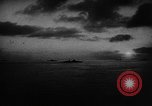
U.S. Navy ships bombarding Okinawa and fighting off attacks by Japanese Kamikaze aircraft in World War II
Conclusion of U.S. Navy film: "The Fleet That Came To Stay." Role of U.S. Navy Task Force 58 during the Battle of Okinawa in World War 2. Opening scene shows ships of U.S. Task Force 58 sitting quietly in waters off the coast of Okinawa, at dawn on May 9, 1945 (VE Day, when Germany surrendered in World War 2). Navy gunners silhouetted against the dawning sky, with twin Bofors anti-aircraft guns. Silhouettes of sailors on early watch. Sailor walks on deck of an aircraft carrier, past parked aircraft with it's vertical stabilizer and rudder riddled to pieces by battle damage. An escort aircraft carrier and other warships are moving slowly past the camera ship. A Douglas Dauntless dive bomber, with only a pilot aboard, takes off from a carrier. Brief glimpse of aircraft taking off from a carrier. It carries a bomb underneath and displays the number 559 on its engine cowling. Numerous American aircraft in formation above the ships. A U.S. cruiser in the distance. Closeups of capital ships bombarding Okinawa with heavy guns and firing anti-aircraft guns at attacking Kamikaze aircraft. Black flak clouds and tracer bullets tracking a Japanese aircraft. Superimposed slate tallies Japanese aircraft shot down: "May 12th: 164; June 3rd: 45; June 6th: 67; June 8th: 30." A kamikaze plane crashes into the sea. Gunners aboard a ship work rapidly to reload their anti-aircraft guns. View of an Essex class aircraft carrier with black flak clouds overhead. Two explosions occur next to her hull. Gunners track a Japanese airplane flying low and close to the water. It passes a carrier and crashes into the sea. More views of sailors working at speed to reload anti-aircraft guns. A sailor firing an Oerlikon 20 mm cannon from gun position atop a ship. A Kamikaze plane crashes at starboard side of an Escort aircraft carrier underway. View of long line of anti-aircraft guns firing simultaneously from beside the flight deck of an aircraft carrier. Smoke rising from the firing and driven by the wind. Remains of a Kamikaze plane spin down amid black flak clouds, after being hit by gunfire. Slate reads "4232 (Japanese planes shot down). The spinning pieces of the Kamikaze plane crash well clear of a nearby Cleveland class light cruiser. Against background of flak filled sky, a Washington Post Newspaper headline is shown reading: "Navy Okinawa Casualties near 10,000 and 2 more ships hit."
The Arcadia Conference in Washington, DC and Paratrooper Demonstration at Fort Jackson, South Carolina in World War II
The Arcadia Conference in Washington, DC, during World War 2, from December 22, 1941 to January 14, 1942. American President Franklin D. Roosevelt and British Prime Minister, Winston Churchill, are seated in chairs on a portico of the White House. ( Roosevelt wears a black arm band, in mourning for his mother, Sara Delano Roosevelt, who died on September 7, 1941.) Behind them stand representatives from various Allied nations. Scene shifts abruptly to Fort Jackson, South Carolina, June 24, 1942, where Prime Minister Churchill and U.S. Army Brigadier General William C. Lee, ride in back of an open white convertible car to inspect U.S. Army troops at attention in a massive formation. Next, the troops are seen marching. Churchill smoking a cigar is seated on a bench watching as the parade continues, to include soldiers in jeeps, and trucks. Closeup of U.S. Army chief of Staff, General George Marshall, conversing with Prime Minister Churchill. Next, Churchill, accompanied by General Lee, personally inspects Army paratroopers in their jump gear. Among others accompanying him is U.S. Secretary of War Henry L. Stimson, wearing a pith helmet. Churchill listens on a portable radio, as paratroop commanders in flight give orders for their paratroopers to jump. Formations of U.S. Army Air Forces C-47 aircraft are seen overhead, as hundreds of paratroopers jump from them and descend by parachutes. Churchill, seated on a chair, next to General Lee, watches the paratrooper demonstration. Secretary Stimson, sits behind him. British and American officers and soldiers stand behind and watch, as well. Closeup of Churchill with cigar in his mouth, shielding his eyes, with his hands as he watches the demonstration. The second person seated behind Churchill is British Field Marshal Sir John Dill, with his hand on an upright wood support. More views of parachutes floating down into an area of trees, and of more C-47s dropping paratroops from overhead.
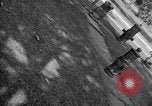
Franklin Delano Roosevelt , Mrs. Eleanor Roosevelt, and Secretary of War, Harry H. Woodring,at the Watervliet Arsenal, New York
President Franklin Delano Roosevelt inspects an arsenal in Watervliet, New York. He arrives in a 1938 Packard open car with Mrs. Eleanor Roosevelt and Secretary of War, Harry H. Woodring. A car with Secret Service agents follows. The U.S. Army Colonel in charge greets them upon arrival. Arsenal employees lined up on either side to greet the Presidential party, which drives slowly between buildings at the arsenal as Secret Service agents run alongside the car. Secret Service agents move enthusiastic Arsenal employees back as the President's car emerges from an Arsenal building. The Presidential party remains in the car as they inspect railway guns, a navy broadside gun and 155 mm guns at the Watervliet Arsenal. An Army Captain describes details of the guns to them. The Presidential party also visits the Revolutionary War historic sites, including the Block House, on the site of Fort Neilson and the headquarters of General Benedict Arnold of American Continental Army.. View of signs identifying these sites, and a view of the the blockhouse.
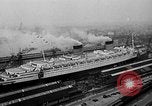
Vyacheslav Molotov, Senator Tom Connally and UN dignitaries on first post war voyage of luxury liner Queen Elizabeth.
The first post war (World War II) voyage of luxury ocean liner Queen Elizabeth on October 16, 1946. The luxury liner ship "Queen Elizabeth" docked in a harbor in Southampton England. Soviet Foreign Minister Vyacheslav Mikhailovich Molotov, United States Senator Tom Connally and other dignitaries board the ship. Smoke comes out of stacks. A sailor operates the helm. People standing on the dock sing and cheer together as the Queen Elizabeth departs on her voyage. The Queen Elizabeth underway in the Atlantic Ocean. The Queen Elizabeth arrives in New York harbor in the early morning and enters New York harbor at day break where she is greeted by fire boats shooting streams of water aloft in salute. Manhattan, New York City skyline barely visible in early morning mist. United Nations dignitaries disembark from the ship. Molotov is greeted by Soviet representative to the UN Andrei Andreyevich Gromyko. Molotov addresses the gathering.
United States 5th Army fights German troops and liberates Rome, Italy from German control during World War II.
Liberation of Rome from German control during World War II. U.S. 5th Army advances in Rome, Italy. Trucks loaded with soldiers move on streets. Battle equipment and tanks advance. German prisoners move through the streets towards an Allied Defense Camp. Civilians greet the troops advancing through the city. United States troops at war against German troops. Explosions occur. United States Army Generals drive through the streets. A large crowd of civilians gathered during a reception to greet the Generals.
CRITICALPAST.COM: About Us | Contact Us | FAQs - How to Order | License Agreement | My Account | My Lightboxes | Shopping Cart | Advanced Search | Featured Collections | Website Terms & Conditions | Privacy Policy ©2026 CriticalPast LLC.
License Agreement |
Terms & Conditions |
Privacy Policy
©2026 CriticalPast LLC.