


 Francais
 Deutsch
 Italiano
Refine Your Search
Greek-Civil-War stock footage and images
- Showing 3499 to 3504 of 27482 results more
more Hide
Hide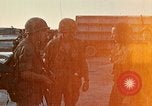
UH-1D helicopters of the United States Army take soldiers to Nui Ba Den Mountain during Vietnam War.
At start of film, a U.S. Army officer is seen talking with some soldiers preparing to depart Tay Ninh airfield for Nui-Ba-Den mountain, Vietnam. Next, the troops head across the field to helicopters of the 187th Assault Helicopter Co. (the Crusaders), waiting on marsden matting pavement at the field. A line of helicopters with troops aboard and engines running. They take off sequentially in trail formation. (Vietnam War period).
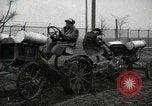
Tug of war between two Fordson tractors at a field in United States.
Two Fordson tractors in a tug of war at a field in United States. A man with a bicycle stands nearby and looks. The front wheels of a tractor rise up in the air.
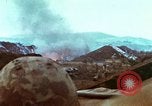
U.S. Air Force Military Airlift Operations in 1968 during the Vietnam War, and during 1976 border tensions in Korea
View from a U.S. Marine bunker as enemy shell explodes nearby, during the siege of Khe Sanh in 1968 during the Vietnam War. The United States Marines in the Battle of Khe Sanh firing mortars and a 105mm howitzer from their bunker. Enemy shells exploding on the tarmac, where American Air Force C-130 aircraft are parked. Marines rushing wounded comrades on stretchers, to C-130s for evacuation. Scene shifts to U.S. Marine Corps Lieutenant Colonel James P. Sheehan, standing at Camp Pendleton, California. (He was a company commander in the siege at Khe Sanh.) As he describes the C-130 aircraft support operations, a contingent of marines marches past, behind him. Scene shifts to a civilian narrator standing in the Military Airlift Command (MAC) Headquarters Command Center at Scott Air Force Base, Illinois. Among other things, he describes MAC support to the Tactical Air Command in Korea. Camera focuses on MAC air routes in the vicinity of the Philippines, Japan, and Korea. Next, is seen view of airfield at Mountain Home Air Force Base, Idaho, briefly at sunset, and then at night, as pilots of the 366th Tactical Fighter Wing and their F-111 aircraft prepare to depart for Korea, in response to border tensions, in August, 1976, after North Korean forces killed two American officers ("Korean Axe Murder Incident" and resulting "Operation Paul Bunyan"). Ground crewman directs a taxiing F-111 using lighted wands. The F-111s takes off. One of them is seen landing after the 7 thousand mile flight to Korea, as Major Paul Malandrino,Jr. (unseen) of the 366th Wing, speaks about MAC's airlift support. A C-141 MAC aircraft is seen landing. View of a C-141 with tail doors open and its cargo of military equipment on the ramp behind it. Glimpse of a marine with rifle and earphones, guarding equipment on the airfield ramp. Closeups of F-111 aircraft taking off.
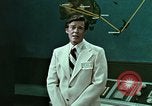
MAC aircraft transport and deliver relief material, bring back prisoners of war, and transport dignitaries
A man talks about American MAC medical missions from the MAC command headquarters. A map shows the path taken by a medically equipped C-141 from Irkutsk to Yokota Air Base hospital, Japan. Ground crewmen signal to a United States Air Force Military Airlift Command (MAC) aircraft. MAC planes deliver relief material to people during the floods in Pakistan. Men move towards the helicopter along with supplies. Supplies delivered during the famine and drought in North Central Africa. Men carry sacks of China rice. Destruction caused due to an earthquake in Guatemala. Cartons of clothes and other supplies loaded into a MAC plane. Plane taxis and takes off. Pilots talk on radio. U.S. prisoners of war brought back from Vietnam during Operation Home Coming. U.S. President Jimmy Carter exits a helicopter at Andrews Air Force Base and shakes the hand of a general. President Jimmy Carter climbs steps to Air Force One and enters the Boeing aircraft. Air Force One takes off from Andrews Air Force Base.
Damage caused during World War II and German prisoners at a prison camp in France.
Damage caused during the war between Allied forces and the German troops in France. Wrecked vehicles, artillery and other equipment. Wounded German soldiers. Soldiers carry wounded on a stretcher. German prisoners emerge single and then in small groups. German prisoners at a prison camp built by them for the French. The prisoners sit, stand and talk. A soldier talks to a man. Soldiers talk to a boy who was made a slave after his parents were killed by the Nazis in Ukraine. Prisoners eat and drink.

British and Canadian troops attack German forces on Walcheren Island in Netherlands during World War II.
British Marine Commandos and Canadian First Army attack Nazi positions during World War II. Soldiers on a ship ready to attack Walcheren Islands through the Scheldt Estuary in Netherlands. Soldiers load and fire artillery. Smoke arises due to explosion. British soldier on ship fires at the Nazis. The ship sinks due to the attack. British Typhoons dive bomb German battery. Soldiers keep a watch. Explosions in water. German guns hit a boat. Canadian First Army landing craft make landings on beaches at Flushing on Walcheren under heavy fire from the Germans. Machine gun and artillery fired. Soldiers carry equipment across the beach. Allied flags sway with the breeze. Soldiers fire at the retreating Nazis. Soldiers capture Westkapelle. Destroyed buildings and rubble. Soldiers celebrate the victory which opens the route to Antwerp.
CRITICALPAST.COM: About Us | Contact Us | FAQs - How to Order | License Agreement | My Account | My Lightboxes | Shopping Cart | Advanced Search | Featured Collections | Website Terms & Conditions | Privacy Policy ©2026 CriticalPast LLC.
License Agreement |
Terms & Conditions |
Privacy Policy
©2026 CriticalPast LLC.