


 Francais
 Deutsch
 Italiano

Refine Your Search
Greek-Civil-War stock footage and images
- Showing 3601 to 3606 of 27588 results more
 Hide
Color Sound
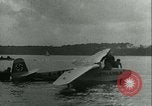
Hitler Youth have fun with a flying boat glider at a camp during World War II.
Hitler Youth in Germany during World War 2. Boys are seen with boats on a lake. They pay out a line fastened to a glider designed to look like a German Lufthansa flying boat. A boy tows the glider out to the center of the lake using a rowboat. Person in the glider cockpit closes its hatch. On shore, the tow line is seen being rolled up rapidly on a wheel driven by a motor, causing the towed flying boat glider to gather speed across the lake, until it breaks from the water and soars into the air. The glider seen in flight, and then making a graceful landing on the lake.

Nazi organizations parade in Luxembourg following German invasion in World War II
A group of uniformed Luxemberger National Partei (LNP) members lead a parade across the Adolphe Bridge across the Pétrusse River, in Luxembourg, during World War 2. The State Savings Bank building is seen in the background. They are followed by large numbers of LNP men in dark trousers, white shirts, and dark ties, wearing swastika arm bands. Scene shifts to center of city where spectators line the sidewalks to watch the parade. The parade proceeds toward the Luxembourg Railway Station (bahnhof), where a small group of Luxemburger Volksjugend (LVJ), an organization similar to the Hitler Youth, are seen marching. Spectators acknowledge them with Nazi salutes. Scene changes to a courtyard where volunteer Luxembourg soldiers present arms as German Army officers descend steps from a building, to review them and contingents of LNP and LVJ. Senior German Nazi Party official, Gauleiter Gustav Simon, leads the reviewing group. A Luxembourg military band plays. Closeup of Luxembourg soldiers. Boys and girls of the LVJ youth render the Nazi salute.

Men and machines at work inside a steel mill in Germany during World War II.
Industrial steel mill in Germany during World War II. The mill in a field amidst hills. Chimneys, smoke stacks and a network of pipes at the mill. Smoke emitted from the stacks. Large machines at work inside the factory. Raw material is transported in rail carts. The carts pass through a tunnel. Conversion of ore to liquid steel. Smelted ore poured down a large funnel. Men at work inside the factory. Smelted ore is poured into large containers. Smoke and fire from blast furnaces. The process of casting an ingot. A slab of solidified steel transported using machines. The slab on a conveyor belt. The ingot on rollers during the billet rolling process.

German officers gather, plan a campaign, observe heavy artillery, and visit a destroyed Port in France in World War II
German military officers early in World War 2. Field marshal Walther von Brauchitsch, Supreme Commander of the German Army, greets group of military officers, individually. Each steps forward, salutes, and shakes his hand. Afterwards he is seen chatting with the officers, smiling and laughing. Scene changes to German officers discussing battle plans in a field. German military officers watch demonstration of a large German artillery gun. Scene changes to France, where German military officers inspect ruined docks. They exit a large heavily damaged coastal bunker. They tour the battle damaged French facilities on foot and in cars. Wrecked British Expeditionary Force military vehicles (Lloyd Carriers) line the destroyed dockside.

German officers supervise the off loading of food supplies in occupied France during World War II.
Foodstuff unloaded at a dock in German occupied France during World War II. Ships and boats in the dock. Workers unload the food supplies. Men and women sort and organize the supplies. German officers inspect the foodstuff and supervise the entire process. Supplies in the dock warehouse. Foodstuff including sausages and cheese blocks.

French civilians apply for and collect food ration stamps in German occupied France during World War II.
French civilians apply for food ration stamps in German occupied France during World War II. French civilians in lines at a stamp collection booth. Men and women apply for and collect their food ration stamps. Staff seated at counters distribute ration stamps. Men and women with children in lines. A man holds an 'Individual Supply Card' with several ration stamps. Close-up view of the ration booklet.
CRITICALPAST.COM: About Us | Contact Us | FAQs - How to Order | License Agreement | My Account | My Lightboxes | Shopping Cart | Advanced Search | Featured Collections | Website Terms & Conditions | Privacy Policy ©2026 CriticalPast LLC.
License Agreement |
Terms & Conditions |
Privacy Policy
©2026 CriticalPast LLC.