


 Francais
 Deutsch
 Italiano
Refine Your Search
Greek-Civil-War stock footage and images
- Showing 3847 to 3852 of 27482 results more
more Hide
Hide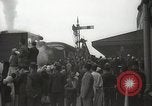
The 7th Egyptian battalion departs and War minister poses with the officers in Cairo, Egypt.
The 7th Egyptian battalion departs for Sudan from Cairo, Egypt. Soldiers greet by waving to people standing over platform. People watch soldiers depart. War Minister poses with officers ready to leave for Sudan service.
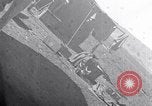
B-25 bomber of 321st bomb group hits targets near Capua, Italy, during World War II
Slate photographed at Grottaglie, Italy where the U.S. Army Air Forces 321st Bombardment Group is based, in September, 1943, during World War 2. View of a 321st Bomb Group B-25 bomber in flight over a River in Italy. A string of bombs dropping from the B-25. View of the Volturno River below and bombs striking roads, buildings, and a bridge over the river in the vicinity of Capua, Italy.
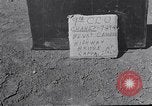
USAAF 321st bomb group B-25s attack bridge near Capua, Italy., during World War II
B-25 of the U.S. Army Air Forces 321st Bombardment Group parked at Grottaglie Airfield in Italy, during World War 2. It displays nose art showing two cartoon characters and lettering reading: "Sylvester the Snarp." Two characters are shown. The smallest shoulders a bomb. Missions flown by the plane are recorded with bombs painted on its fuselage. Momentary glimpse of another B-25 parked in the distance. Scene shifts to aerial view of bends in the Volturno River near Capua, Italy. At lower right of image, smoke can be seen rising from explosions as bombs strike a bridge over the river and nearby roadways. View from overflying aircraft is obscured momentarily by cloud cover. Then network of roads is clearly seen. Scene shifts to B-25 bombers flying in formation.
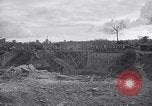
U.S. 5th Army vehicles traverse bridges at Volturno River near Mignano, Italy, in World War II
U.S. 5th Army vehicles cross two small bridges across the Volturno River, near Mignano, Italy, during World War 2. An MP (Military Policeman) monitors and directs traffic from side of the muddy road. Army engineers repair another bridge and use compressed air gun to drive fasteners. Closeup of the new bridge boards and construction work. Jeeps, trucks, personnel carriers, and other vehicles are all on the move. A destroyed civilian vehicle is seen at side of road.
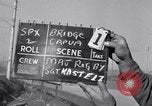
Allied military traffic using bridge across Volturno River, built by U.S. Army engineers in World War II
Traffic moving across a Bridge over Volturno River built by 1st battalion U.S. Army 343rd Engineers in Capua, Italy,during World War 2. The original bridge has been demolished and sits in the river bed. Closer view of the site. Traffic moving on the intact bridge is mostly military. View from water of an almost completely submerged section of the destroyed bridge. View from opposite shore of old buildings across the river, including the tower of the Cathedral of Capua (Cattedrale dei SS. Stefano e Agata). Camera pans from various places, including sandy bank of the river. Closer views of bridge show pedestrians walking across it. (Note 1: The bridge built by 343rd Engineers, from October 16th to November 9th, was a semi-permanent structure, 332 ft high, 370 feet long, and classified as a two-way Class 40 or one-way Class 70 bridge. A million vehicles crossed it during the entire Italian campaign. Note 2: reportedly, opening slate refers to Major Linden Rigby, 196th Signal Photo Company, involved in the making of this film.)
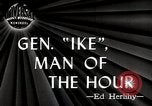
General Eisenhower returning home to Washington, DC after World War II, by way of Paris and London.
With the war ended, General Dwight D. Eisenhower is feted in London, on his way home to America. He is seen stepping into a ceremonial horse-drawn carriage, as throngs of spectators line the sidewalks to watch. Accompanied by British Air Marshal Arthur Tedder, Eisenhower rides in the carriage, escorted by police on white horses. Crowds cheer Ike from the sidewalks as the carriage passes. The carriage stops at the London Guildhall. (A sign reads: "Site of the Guildhall Chapel, 1299-1822.") Inside, Sir Frank Alexander, Lord Mayor of London, is seen making Ike an honorary citizen of London and presenting him a token sword that once belonged to the Duke of Wellington. Outside, the streets are jammed with London well-wishers who applaud and cheer the Supreme Allied Commander as his carriage passes them on the way to Mansion House. At some points, Eisenhower stands and acknowledges the crowds cheers and he sometimes salutes, while seated. Glimpse of spectators jammed side-by-side in the streets. Eisenhower is seen standing on the balcony of Mansion House, flanked by Prime Minister Winston Churchill, in a top hat. The balcony is decorated with British and American flags. Sounds of the cheering crowd can be heard as Ike says: "Whether or not you know it, I am now a Londoner, myself." The crowd cheers. He continues: "I have just as much right to be down in that crowd, yelling, as you have." He goes on to make other remarks about the peaceful state of things. He bids all farewell and he and Churchill turn to enter the building. Scene shifts completely to the Arch of Triumph in Paris, where General Eisenhower is seen ceremoniously laying a wreath at the tomb of the unknown soldier. He steps back to stand beside French General Charles de Gaulle. They and accompanying military officers salute. The memorial flame at the tomb fills the foreground. Next, in a closeup, General de Gaulle is seen decorating Eisenhower with the Medal of Liberation. Glimpse of enthusiastic French citizens cheering as Eisenhower tours the city with de Gaulle, in an open car escorted by police on motorcycles. They proceed along the Champs Elysees, with the Arc de Triomphe in the background. Ike and de Gaulle both stand as they drive along. Closeup from moving vehicle passing close to crowd. Views from rear as the car and escorts move through the spectator-lined streets. Similar views from ahead. Scene shifts to Eisenhower finally arriving in the United States. A pointed arch supports a large American flag above a "Welcome Ike" banner. General Eisenhower steps from an airplane in Washington,DC, where Mrs. Mamie Eisenhower greets him. The two pose for the camera. Next, a motorcade of jeeps travels along Pennsylvania Avenue. The Post Office building is seen on the right and the capitol in the far background. District Commissioners present Ike keys to the City. Views of jeep motorcade proceeding along Pennsylvania Avenue. Eisenhower standing in a jeep acknowledging the crowds. As they reach the capitol, a disabled veteran gives something to Ike. Inside, Eisenhower makes his way to the podium to address a joint session of the Congress. View of Ike addressing the session, with Speaker of the House, Sam Rayburn and president pro tempore of the United States Senate, Kenneth Douglas McKellar, behind him. (The latter was serving as President of the Senate, in the temporary absence of a Vice President, after Harry Truman became President upon the death of Franklin D. Roosevelt.)
CRITICALPAST.COM: About Us | Contact Us | FAQs - How to Order | License Agreement | My Account | My Lightboxes | Shopping Cart | Advanced Search | Featured Collections | Website Terms & Conditions | Privacy Policy ©2026 CriticalPast LLC.
License Agreement |
Terms & Conditions |
Privacy Policy
©2026 CriticalPast LLC.