


 Francais
 Deutsch
 Italiano

Refine Your Search
Greek-Civil-War stock footage and images
- Showing 3853 to 3858 of 27588 results more
 Hide
Color Sound
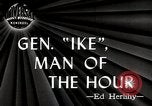
General Eisenhower returning home to Washington, DC after World War II, by way of Paris and London.
With the war ended, General Dwight D. Eisenhower is feted in London, on his way home to America. He is seen stepping into a ceremonial horse-drawn carriage, as throngs of spectators line the sidewalks to watch. Accompanied by British Air Marshal Arthur Tedder, Eisenhower rides in the carriage, escorted by police on white horses. Crowds cheer Ike from the sidewalks as the carriage passes. The carriage stops at the London Guildhall. (A sign reads: "Site of the Guildhall Chapel, 1299-1822.") Inside, Sir Frank Alexander, Lord Mayor of London, is seen making Ike an honorary citizen of London and presenting him a token sword that once belonged to the Duke of Wellington. Outside, the streets are jammed with London well-wishers who applaud and cheer the Supreme Allied Commander as his carriage passes them on the way to Mansion House. At some points, Eisenhower stands and acknowledges the crowds cheers and he sometimes salutes, while seated. Glimpse of spectators jammed side-by-side in the streets. Eisenhower is seen standing on the balcony of Mansion House, flanked by Prime Minister Winston Churchill, in a top hat. The balcony is decorated with British and American flags. Sounds of the cheering crowd can be heard as Ike says: "Whether or not you know it, I am now a Londoner, myself." The crowd cheers. He continues: "I have just as much right to be down in that crowd, yelling, as you have." He goes on to make other remarks about the peaceful state of things. He bids all farewell and he and Churchill turn to enter the building. Scene shifts completely to the Arch of Triumph in Paris, where General Eisenhower is seen ceremoniously laying a wreath at the tomb of the unknown soldier. He steps back to stand beside French General Charles de Gaulle. They and accompanying military officers salute. The memorial flame at the tomb fills the foreground. Next, in a closeup, General de Gaulle is seen decorating Eisenhower with the Medal of Liberation. Glimpse of enthusiastic French citizens cheering as Eisenhower tours the city with de Gaulle, in an open car escorted by police on motorcycles. They proceed along the Champs Elysees, with the Arc de Triomphe in the background. Ike and de Gaulle both stand as they drive along. Closeup from moving vehicle passing close to crowd. Views from rear as the car and escorts move through the spectator-lined streets. Similar views from ahead. Scene shifts to Eisenhower finally arriving in the United States. A pointed arch supports a large American flag above a "Welcome Ike" banner. General Eisenhower steps from an airplane in Washington,DC, where Mrs. Mamie Eisenhower greets him. The two pose for the camera. Next, a motorcade of jeeps travels along Pennsylvania Avenue. The Post Office building is seen on the right and the capitol in the far background. District Commissioners present Ike keys to the City. Views of jeep motorcade proceeding along Pennsylvania Avenue. Eisenhower standing in a jeep acknowledging the crowds. As they reach the capitol, a disabled veteran gives something to Ike. Inside, Eisenhower makes his way to the podium to address a joint session of the Congress. View of Ike addressing the session, with Speaker of the House, Sam Rayburn and president pro tempore of the United States Senate, Kenneth Douglas McKellar, behind him. (The latter was serving as President of the Senate, in the temporary absence of a Vice President, after Harry Truman became President upon the death of Franklin D. Roosevelt.)

Gasoline ban lifted in United States after end of World War 2.
Motorists at a gas station as OPA (Office of Price Administration) lifts gas restrictions in United States just after the end of World War II. Sign reads "Gas rationing off, no stamps required." Man scrapes gas ration sticker letter "A" off of car window. A gas station employee fills the tank of motor car. Calco meter is shown registering gas sale. Motor cars enter a Mobil Oil gas station. Motorcars at Mobil Oil gas station. Employee fills the gas tank of a car. Station attendants raise car hood and check fluids.
Spanish language film depicting scenes of Tokyo, Japan shortly before World War II
Japanese Propaganda film shortly before World War II: Opening slate "La Federacion Japonesa de los gremios de exportadores e importadores con la America Latina Producida por Domei Tsusin Sha". Scenes from exterior and interior of a Radio Studio in Tokyo where a Japanese radio announcer addresses persons of Latin America and South America in Spanish. He introduces a Japanese orchestra in the radio studio which begins to play. Scenes of a map with animation of the radio signals from Japan being carried to Latin America and South America. View of the Tokyo Imperial Palace. View of the Niju-bashi Bridge. Flock of birds flying in Tokyo. Japanese crowd in streets and residential area. Many views of modern buildings for government, offices, businesses, and residential areas of Chiyoda, Tokyo. National Diet Building (1 Chome-7-1 Nagatachō, Chiyoda City, Tokyo 100-0014, Japan) in Chiyoda City. Embassy buildings of foreign governments. Point of view street views of busy Tokyo streets as seen from a moving vehicle or streetcar (beneath streetcar or trolley wires). View of buildings at Ginza district. View of the iconic Wako Clock Tower (4 Chome-5-11 Ginza, Chuo City, Tokyo 104-0061, Japan) and neon lights at night in Ginza.

Japanese paratroop attack on Celebes, Dutch East Indies in World War II.
Japanese military operation in World War 2. Japanese writing on map. Formation of Japanese Kawasaki Ki-56 (Thalia) transport planes fly over Celebes, Dutch East Indies. Explosion over the mountains. Aerial views show the smoking ruins below. Japanese paratroops parachute downward. They assemble and go into action. They fire a field gun. The Japanese Navy flag. An officer gives orders.
Scenes of Rangoon, Burma, under Japanese occupation during World War II.
Rangoon, Burma, under Japanese occupation during World War 2. Japanese propaganda film states, in Japanese, that Volunteer Corps is building a 'New 'Burma,' and that Volunteer corps training illustrates how people can enjoy and manage their freedom from the British. Burmese gather at open market in front of a hotel in Rangoon. Words "On Look Hotel" appear along with Japanese lettering on the hotel front. Several Japanese soldiers mingle amongst the crowd at an open market. All manner of foods and goods being sold. Women display fabrics. Crowd gathered in grandstand of stadium to watch Volunteer Corps training and parade. Shwedagon Paya (Pagoda), Buddhist temple seen in background. Japanese officer stands on steps and salutes as Volunteer Corps pass in review. Their most notable weapon is a machine gun mounted in a wagon.
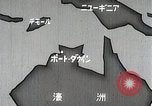
Japanese bombers take off to attack Port Darwin, Australia, during World War II
"Bombing Raid on Port Darwin". An animated map with Japanese writing shows course of Japanese Air Force bombing mission (probably from Poeloeti-Penfui Airfield, West Timor) against Port Darwin, Australia, during World War 2. Japanese Mitsubishi G4M "Betty" bombers taking off on the mission. Airmen on the field wave their hats at the departing planes. View from nose greenhouse of a bomber breaking ground on takeoff. Formation of G4Ms in flight. View inside, of pilots in cockpit. Pilot holding control yoke. Japanese writing on cloth fastened near right cockpit window.Crew members eating lunch en route in flight.
CRITICALPAST.COM: About Us | Contact Us | FAQs - How to Order | License Agreement | My Account | My Lightboxes | Shopping Cart | Advanced Search | Featured Collections | Website Terms & Conditions | Privacy Policy ©2026 CriticalPast LLC.
License Agreement |
Terms & Conditions |
Privacy Policy
©2026 CriticalPast LLC.