


 Francais
 Deutsch
 Italiano
Refine Your Search
Greek-Civil-War stock footage and images
- Showing 3991 to 3996 of 27482 results more
more Hide
Hide
Boats and ship in port of Varna (Bulgaria's Black sea port) during World War I.
Slate states that Bulgaria's Black sea port of Varna is being shelled by Russian Battleships. However this is not noticeable in these scenes. Boats are tied up at the docks and men go about their activities, with no clear evidence of Russian battleships or shelling. There is a brief aerial view of a ship, next to a breakwater where a lighthouse stands. Smoke is rising from her stack. (World War 1; WWI; WW1)
British soldiers dig trenches in France during World War I
British soldiers at work digging trenches in France, during World War 1. The work with picks and shovels and dig several deep parallel curved trenches in a field. At the end of their work, they are seen being led by an officer as they march in column of fours along a dirt road, carrying soap and towels, to wash up. (WWI; WW1)
Ambulatory French wounded soldiers receive first aid followed by, rest and food at base in France during World War I
Ambulatory French wounded soldiers walk to base camp after receiving first aid from medical station attended by Royal Army Medical Corps (RAMC) during World War 1. Bandages are visible on several of the soldiers. French soldiers seated on ground eating a meal at their base. Field kitchen trailers visible behind them.
British Soldiers demonstrate use of Allenbury gas mask in World War I.
Allenbury patent protects British soldiers from Asphyxiating Gases. Soldiers hide behind wood logs lying on a field. Soldiers wear the Allenbury gas masks. Gas cloud covers the area. After it passes, they rise up and perform a (mock) attack. View of a soldier modeling the mask in England during World War 1
Film about 1919 Railroad strike and its effects on Londoner's following World War I
Opening slate states: "The Railroad Strike, Scenes at the London Terminal and at the overcrowded bus and tram routes." People are seen walking about in a London train station after World War 1. Baggage is piled up on one section of a platform. Army officers climb onto an open car filled with luggage, and wave as they drive away. A large queue of people is seen at a bus station, where double decked buses are loading and discharging passengers. Women board a horse-drawn wagon as an alternate way of traveling. Back at the train station, Army officers help a woman from a car and then climb aboard it themselves with their luggage. A family sits atop a flat railway cart with luggage underneath. More views of too many people trying to get on too few buses. Scene shifts to Piccadilly Circus where pedestrians walk near the Shaftesbury Memorial Fountain and the Criterion Theater.
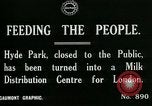
Hyde Park, London, turned into a milk distribution center during World War I
Farmers drive wagons filled with milk cans, into Hyde Park, during World War 1. Volunteers help unload the milk cans and line them up along a walkway. Afterwards, they clean their hands in the park lake. A new slate speaks of need to conserve petrol. Men stand looking over stacks of petrol (gasoline) cans in another area of the park. Two trucks (lorries) drive between the stacks of cans. Scene reverts again to volunteers washing their hands in the lake, and to men moving cans of milk. Next, British soldiers in uniform, are seen helping to move milk cans. Scene changes to a long queue of men and women waiting for public transport. Double-decker buses move through the area. A glimpse of a railroad train station, is followed by another look at the men washing hands in the lake. A line of empty trucks leaves the park. A final view of stacked milk cans.
CRITICALPAST.COM: About Us | Contact Us | FAQs - How to Order | License Agreement | My Account | My Lightboxes | Shopping Cart | Advanced Search | Featured Collections | Website Terms & Conditions | Privacy Policy ©2026 CriticalPast LLC.
License Agreement |
Terms & Conditions |
Privacy Policy
©2026 CriticalPast LLC.