


 Francais
 Deutsch
 Italiano
Refine Your Search
Greek-Civil-War stock footage and images
- Showing 4051 to 4056 of 27482 results more
more Hide
Hide
United States prisoners released at 92nd Evacuation Hospital area on Luzon, Philippine Islands, in World War II.
United States prisoners released on Luzon, in the Philippines during World War 2. Signal Corps photographer takes picture of Major Emil P Reed of Brownsville, Texas, Regimental Surgeon of 26th Cavalry on Bataan. Soldiers and released prisoners around 92nd Evacuation Hospital area. Major Reed talks to soldiers. One armed released prisoner soldier Afred Jolly of San Francisco walks.
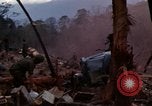
Scenes from Operation Delaware by 1st Air Cavalry Division in the A Shau Valley during Vietnam War
Scenes from massive offensive by 1st Air Cavalry Division against the People's Army of Vietnam (PAVN) in A Shau Valley, during the Vietnam War. Film opens showing scattered wreckage of a U.S. Army UH-1H helicoptor damaged by enemy fire or by collision with obstacles during landing. As troops work to clear wreckage, another UH-1 lands precariously in the midst of debris. United States Army soldiers dismount. Other soldiers work around the crash site. Nearby, a contingent of troops is busy carving out a proper landing zone, using small tools and a number of chain saws. Two of them pass close by the camera, carrying a huge tree trunk. Troops employ chain saws close to one another as they work on the tangled underbrush and trees. In the background, one soldier chops smaller brush with a machete. (Note: It has been reported that these scenes depict elements of B Company, 227th Assault Helicopter battalion, at LZ Pepper, and the UH-1H seen landing might be from the 1st/9th "Head Hunters.")
Wilbur H. Durborough, America's famous Press photographer, goes to Germany during World war I
Closeup scenes show Wilbur H. Durborough-America's famous press photographer, seated behind the steering wheel of a 1911 Alto touring car parked on a street in Chicago, Illinois, getting ready to depart for Germany, during World War 1. Sitting behind him is his assistant cameraman, Irving G. Ries. Both have goggles pushed back on their foreheads. and both smoke cigars. Some spare tires are seen behind Mr. Ries. As camera moves back, they are seen surrounded by numerous friends and well-wishers as they prepare to depart from Chicago. Next, Durborough is seen standing on the bridge of the Holland-America steamship, S.S. Nieuw Amsterdam, with ship's Captain Jan Baron, who is on lookout for mines and submarines. Captain Baron passes his binoculars to Mr. Durborough. Captain Baron and Mr. Durborough stand on the deck looking at some documents. Lifeboats on davits behind them are ready for emergency. Durborough drives his car from the ship terminal onto a street in Rotterdam, with Captain Baron standing on a running board. The car is loaded down with luggage and equipment. He drives away as the Captain and others wave goodbye. Displaying an American flag on the hood, Durborough arrives at the German border. Dutch officials examine the car's contents, including a look into the engine compartment. Next, Durborough is stopped by German border guards, who examine his passport and greet him in a friendly manner. Durborough is seen in the offices of U.S.Ambassador James W.Gerard, as he describes his plans for visiting. He is honored by a visit from Prince of Reuss of German General Staff, Prince Max of Baden and Count Von Bernstorff- son of German Ambassador to the United States, who are seen chatting with him, before entering their car to depart.
German youth in Wandervogel organization march in a weekly drill during World War I
Members of the German youth group, Wandervogel, march to music provided by a brass band, during World War 1. They parade across a grass field accompanied by their adult advisors, who march beside them. A contingent of Wandervogel follow, walking their bicycles. The band falls in and marches behind the bicycle cadre.
Frau von Ihne, wife of the Emperor's architect, arranges an outing for blind and wounded German soldiers in World War I
Frau von Ihne, wife of Ernst von Ihne, architect to the German Emperor, escorts a blinded German soldier (likely from mustard gas attack) onto a bus for an outing during World War 1. More disabled, blinded soldiers are helped to board, by other soldiers. As they board the bus, and it drives away, German troops, with shouldered weapons, continuously march past on the street. Scene shifts to Frau von Ihne, tending to refreshments for the soldiers, in a large hall containing tables set with decorative table cloths. Assisted by another woman and a German soldier, she is cutting a cake. Next she is seen serving soldiers seated at a table. A young man assists her. Many soldiers are then seen sitting at tables as Frau von Ihne and several other women attend to them. (Note: Frau von Ihne founded a home for blinded soldiers on Bellevuestrasse, in Berlin. This may be where the bus was parked at the start of the film.)
Jane Addams, Alice Hamilton, and Aletta Jacobs in Berlin, during World War I
Three influential women in the early 20th century women's movements and suffrage are seen walking in front of the Brandenburg Gate, in Berlin, during World War 1. On the left is American, Jane Addams, co-founder of Hull House, in Chicago, and President of the newly formed Women's International League for Peace and Freedom (WILPF). In the middle is Alice Hamilton. She was a close associate of Addams in the Hull House project, and, in 1919, became the first woman professor at Harvard University. The third woman is Dutch pacifist, feminist and suffragist (sometimes called a suffragette) Aletta Jacobs, who was also involved with founding of the WILPF. Jacobs was also the first female University graduate in the Netherlands. (Medicine in 1877 and 1878). (Note: Film shot by photographer William H. Durborough.)
CRITICALPAST.COM: About Us | Contact Us | FAQs - How to Order | License Agreement | My Account | My Lightboxes | Shopping Cart | Advanced Search | Featured Collections | Website Terms & Conditions | Privacy Policy ©2026 CriticalPast LLC.
License Agreement |
Terms & Conditions |
Privacy Policy
©2026 CriticalPast LLC.