


 Francais
 Deutsch
 Italiano
Refine Your Search
Greek-Civil-War stock footage and images
- Showing 4699 to 4704 of 27482 results more
more Hide
Hide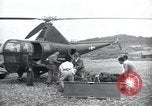
U.S. Army Medical Service in Korea. Evacuation of wounded to Japan for treatment during the Korean War
Medical aid being provided to U.S. soldiers during the Korean War. Helicopters with special containers on their sides to be used for evacuation. An injured soldier being carried in a container on the side of the helicopter. The helicopter takes off. An injured soldier being brought to a medical station aboard a light liaison airplane. Men carry soldier on stretcher into an evacuation airplane. Cover over ramp into aircraft reads'374th troop carrier wing, Hospital Evacuation'. The aircraft will evacuate the wounded to Japan. In Japan, Japanese civilians are seen carrying wounded U.S. soldiers from a C-47 aircraft ,on a stretcher into an ambulance. View of ambulance interior,shows tiers of litters. Ambulance arrives at Tokyo Army Hospital. View of the hospital building. The wounded soldiers being carried into the hospital for treatment.
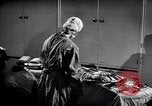
U.S Army Medical Service in Korea. Injured U.S. soldiers evacuated to the United States during the Korean War.
Scenes inside U.S. Army hospital in Japan. Surgeons scrub hand and arms at sinks before surgery. Surgeons prepare for operation on patient. Patients are moved about and treated. Nurse tending bedridden patient. Several soldiers seen leaving to return to duty in Korea. Others are transported to Haneda Air Base, near Tokyo, where the Military Air Transport Command operates long range aircraft in the so-called "Pacific Air Shuttle." A wounded soldier is taken from an ambulance and placed aboard a transport aircraft. Interior of aircraft is shown, with stretchers, medical workers and nurses. Aerial view of Honolulu, Hawaii from aircraft. The aircraft lands at Hawaii where wounded are cared for at Tripler Army Hospital until ready to continue journey to Travis Air Force Base in California. View from cockpit of aircraft landing at Travis Air Force Base. Wounded patients being moved through rear cargo doors of C-97 aircraft. Exterior view of fountains and main entrance at Walter Reed U.S. Army General Hospital in Washington, DC. Captain Zimmerman introduces Lt. Col. S.J. Newsome, who was a surgeon in Korea with the 7th Division. Dr. Newsome emphasizes "speed" as the most important factor in recovery of wounded soldiers. He also mentions the problem of disease affecting soldiers in foreign places like Korea, saying that, "Korea is a disease ridden country" with cases of pnemonia, smallpox, and "orgental diseases we had never seen before." Scenes of Army doctors performing medical examinations on soldier patients. Wounded being placed aboard jeep in Korean War. Soldier firing rifle. Soldiers slogging through mud and water. Soldiers firing artillery in the snow, and evacuating wounded on inflated litter in snow. Combat in jungle. View of civilian people wasing at side of river in India. Civilian dead in streets.
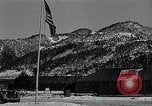
U.S. Army nurses treat injured soldiers. Doctors perform surgery. Nurses enjoy free time during Korean War.
The role of nurses in the United States Army during the Korean War. View of tent hospitals. The American flag on top of a flagpole near tent hospital. A group of United States Army nurses walking back to the tent hospital. An army nurse inserts thermometers on patients. Female nurse checks patient's pulse. A nurse spoon-feeds a soldier with soup. A team of surgeons performs surgery on a wounded soldier. A nurse assists surgeons during a surgery. Army nurses making snowmen during their free time. Two nurses play table tennis. A nurse clapping. Nurse applies nail polish. Nurses on street buy souvenirs. A nurse buys souvenirs from a Korean shop attendant.
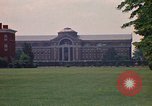
National War College and Industrial College of Armed Forces at Fort Lesley J McNair, in Washington DC.
Fort Lesley J. McNair, Washington, DC. Views of Roosevelt Hall, of the National War College (NWC) designed by the famous firm of McKim Mead & White,and built 1903-1907. Historic red brick Federal Penitentiary Building (Built 1826), is also seen. Views of the more modern Eisenhower Hall, of the Industrial College of the Armed Forces, dating from 1924.
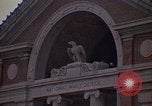
Views of Roosevelt Hall, of the National War College,at Fort Lesley J. McNair, in Washington DC.
Views of Roosevelt Hall of the National War College at Fort Lesley J. McNair in Washington DC. The building was designed by architects McKim, Mead, and White, and built during 1903 through 1907. An eagle adorns the front entrance. A cannon; an anchor; and a propeller are displayed on the front steps, representing the three main branches of U.S. Military (Army, Navy and Air Force).
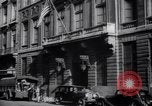
Views of United States Consulate building in Bordeaux France, and American citizens at consulate departing France in World War 2
Front of American Consulate building in Bordeaux France. Plaque above the door marked with - CONSULATE of the UNITED STATES of AMERICA. Interior of the Consulate where American consul, Mr Waterman is at his desk. American refugees waiting in the consulate for passports as they prepare to depart France shortly before the fall of Paris to Nazi Germany in World War II. Red Cross workers assisting consul. June 1940.
CRITICALPAST.COM: About Us | Contact Us | FAQs - How to Order | License Agreement | My Account | My Lightboxes | Shopping Cart | Advanced Search | Featured Collections | Website Terms & Conditions | Privacy Policy ©2026 CriticalPast LLC.
License Agreement |
Terms & Conditions |
Privacy Policy
©2026 CriticalPast LLC.