


 Francais
 Deutsch
 Italiano
Refine Your Search
Greek-Civil-War stock footage and images
- Showing 493 to 498 of 27579 results more
more Hide
Hide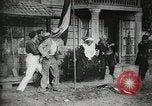
Dramatization depicts: soldiers cover dead soldier with the American flag and carry it on a stretcher in the United States.
Paper print. Early motion picture from turn of 20th century, depicts American civil war. Union soldiers in battlefield in the United States. Dramatization depicts: civilians stand outside a building. Soldiers fire guns on field. They cover the dead body of soldier with the American flag. Soldiers carry dead soldier on a stretcher. Woman weeps as she looks at the dead body of soldier.Confederate soldiers appear. Woman appeals to them.
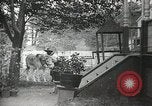
Dramatization: Slave arrives at house to warn that Union troops are coming. Family hides basket in tree.
Paper print. Early motion picture made in United States. Civil War era dramatization. Slave mounted on horseback arrives at a house. He calls warning that Union troops are coming. The household gathers basket and he climbs up a tree to hide it. Union troops arrive but soon leave. The resident family arrives and celebrate that they suffered no loss.
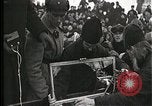
Bolshevik man displays bones of a Saint taken from a wooden box. Spectators show mixed emotions.
Perhaps as part of campaign to denigrate holy relics, and to question incorruptibility, a secular Bolshevik Russian man is seen on an outdoor stage holding an electric device with wires connected to it. He displays bones of a Saint to crowd of persons. Men on stage hold up various bones of the saint. Snow on ground. Crowd of soldiers and civilians shows mixed emotions during this anti-religious campaign of the Russian Civil War, following the Russian Revolution.
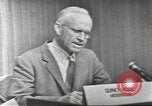
Vice President Nixon talks about Communist influence in the Western Hemisphere prior to presidential elections in the U.S.
The fourth presidential election debate held between Democratic nominee Senator John F. Kennedy and Republican nominee U.S. Vice President Richard Nixon in New York, United States on 21st October 1960. ABC news correspondent Quincy Howe speaks during the fourth Kennedy-Nixon presidential debate. He speaks that the candidates would answer and comment upon questions put by these four correspondents: Frank Singiser of Mutual News, John Edwards of ABC News, Walter Cronkite of CBS News and John Chancellor of NBC News. Frank Singiser puts the first question to Vice President Nixon. He asks Nixon the way he would handle Fidel Castro's regime and prevent establishment of Communist governments in the Western Hemisphere and why his policy is better for peace and security of the United States in the Western Hemisphere. Nixon answers that Senator Kennedy's policies and recommendations for the handling of Castro regime are dangerously irresponsible recommendations that he's made during the course of this campaign. Nixon speaks that what Senator Kennedy recommends is that the U.S. government should give help to exiles and to those within Cuba who oppose Castro regime, provided they are anti-Batista. Nixon says the United States have five treaties with Latin America, including the one setting up the Organization of American States in Bogota in 1948, in which the U.S. has agreed not to intervene in the internal affairs of any other American country. He further says that if the U.S. follows recommendations of Senator Kennedy then the country would probably be condemned in the United Nations and it would result in an open invitation to Soviet Premier Nikita Khrushchev to come into Latin America and to engage the U.S. in a civil war. He speaks about quarantining Cuban Prime Minister Fidel Castro by cutting off trade and diplomatic relations with Cuba.
A political advertisement critical of Democratic nominee Hubert Humphrey during the 1968 presidential campaign
A political advertisement from the Nixon campaign or Republican party during the 1968 Presidential election campaign portrays Democratic party challenger Hubert Humphrey in a negative light. Still images show Democratic presidential nominee Hubert Humphrey at the party's convention in Chicago, Illinois. Riots in the United States following assassinations of prominent leader in the African American civil rights movement, Martin Luther King, Jr., and Senator from New York Robert F. Kennedy, in 1968. U.S. soldiers battling the enemy in Vietnam during the Vietnam War. A picture depicting poverty shows a poor family. Images of Humphrey are interspersed throughout, portraying him as disconnected from the issues of the day.
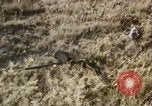
Ruins of United States Army western forts from the late 1800s, and United States Army cemetery near "Battle of Little Big Horn"
Ruins of United States Army (Union) forts established in the Great Plains of the United States from the time of the American Civil War until the late 1800s. View of various paintings by Remington that depict the Union Army regular soldiers in encampments and in battle with Native American Indians in western regions of the United States. Tombstones in a graveyard or cemetery near the Battle of the Little Big Horn. The grave of Corporal of the 2nd U.S. Cavalry James Kelley dated December 21, 1866. The grave of 2nd U.S. Cavalry Blacksmith Dennis Hurley dated July 29, 1878. The grave of Trumpeter 1st U.S. Cavalry Albert Anderson dated 22nd February, 1929. The grave of the an Unknown Soldier.
CRITICALPAST.COM: About Us | Contact Us | FAQs - How to Order | License Agreement | My Account | My Lightboxes | Shopping Cart | Advanced Search | Featured Collections | Website Terms & Conditions | Privacy Policy ©2026 CriticalPast LLC.
License Agreement |
Terms & Conditions |
Privacy Policy
©2026 CriticalPast LLC.