


 Francais
 Deutsch
 Italiano
Refine Your Search
Greek-Civil-War stock footage and images
- Showing 505 to 510 of 27579 results more
more Hide
Hide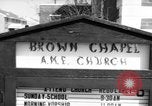
Martin Luther King, Junior and other civil rights leaders during the civil rights march from Selma to Montgomery, Alabama
The AME (African Methodist Episcopal) Church (410 Martin Luther King St, Selma, AL 36703, United States) in Selma, Alabama. Sign reads 'Brown Chapel, AME Church'. African American civil rights leaders outside the church. Prominent leader Martin Luther King, Jr. and other leaders getting started on the second Selma-to-Montgomery march for civil rights. Photographers take pictures. Various views from the march, including scenes near Edmund Pettus Bridge.

Civil Rights leaders, including members of the Civil Rights "Big Six" pose for photographs at the White House in Washington DC
Civil rights leaders at the White House in Washington DC. The "Big 6" leaders pose at the White House. Martin Luther King, Jr., a leader in the American Civil Rights Movement moves ahead and is greeted by leaders present. Cameramen take photos. Martin Luther King Jr. and other leaders stand in a group and talk. Martin Luther King Jr. and Dorothy Height speaking to Robert Kennedy. James Farmer, A. Philip Randolph, Roy Wilkins, and Whitney Young also seen, as well as Vice-President Lyndon B. Johnson. View of the White House.
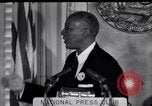
United States Civil Rights leader Philip Randolph speaks about Civil Rights to National Press Club in Washington DC.
Speaking two days before the famed "March on Washington for Jobs and Freedom", the United States Civil Rights leader A. Philip Randolph addresses a gathering of the National Press Club in Washington DC. Speaking at the podium, he talks about the rights of African Americans and asserts that African American people seek the exact same rights that White citizens possess, including all same social, economic and political rights. Flags in the background.

Johnson addresses Congress on voting rights; Martin Luther King Jr and activists march for civil rights in Selma, Alabama.
United States President Lyndon Baines Johnson seeks end to civil strife in the United States. Exterior view of the dome of the U.S. Capitol Building illuminated at night. Inside view as the President addresses Joint Session of Congress to push a voting rights bill (Voting Rights Act) to end discrimination in voting. Dignitaries and members of the Congress are seated. Next scenes are all from civil rights marches in the U.S. during March, following the March 11 beating death of minister James Reeb. Protestors march on streets all over the country in solidarity with the Selma, Alabama marchers. They carry banners. A banner reads 'We March With Selma'. Another banner says "We Shall Overcome". The people march on streets and carry banners in a Harlem, New York demonstration. The demonstrators gather in large number to pay tribute to Unitarian minister James J. Reeb. Brown Chapel African Methodist Episcopal (A.M.E.) Church (410 Martin Luther King St, Selma, AL 36703, United States) in Selma, Alabama which was a headquarters for the drive for the right to vote. A sign reads 'Brown Chapel'. The people gathered during the campaign. Leader of African American civil rights movement, Dr. Martin Luther King Jr., with other officials. View of protestors in the second Civil Rights march from Selma to Montgomery on March 9, 1965. Martin Luther King Jr marches with the people for Civil Rights. Men take pictures. Martin Luther King with white ministers, African American and white citizens, and civil right workers marching on the street. The police stand blocking the road at the end of the Edmund Pettus Bridge. The marchers stand. Martin Luther King Jr. speaks to a policeman. The marchers kneel on the street and pray. Men take pictures. Martin Luther King Jr with other officials speaks to the marchers. After praying the marchers turn around and go back to Selma. They cross the Edmund Pettus Bridge in Selma, Alabama.
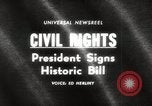
President Lyndon B. Johnson signs the Civil Rights Act at the White House in Washington DC.
United States Congress passes the Civil Rights Bill. After the House votes on the measure, President Lyndon B. Johnson signs the Civil Rights Act of 1964 into law before an audience of Legislators and Civil Rights Leaders at the White House in Washington DC. He calls it 'a turning point in history' and uses one hundred pens to affix his signature. Many civil rights and government leaders seen behind the President, including Everett Dirksen and Hubert Humphrey, Marting Luther King Jr., and J. Edgar Hoover, all of who receive signing pens. President Johnson hands several signing pens to Attorney General Robert Kennedy, for members of the Kennedy family.
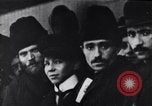
Accomplishments of the Amalgamated Clothing Workers of America, and later challenges of the Civil Rights movement in America
Turn of the Century immigrants to the United States pose aboard ship. Some wear fez hats. View of clothing industry workers at sewing machines in early 1960s. Picture of Sidney Hillman and his wife, circa 1910. Older garment worker cutting cloth. Clothing or garment factory workers punching a time clock in the early 1960s. Men operating sewing machines. A cutter marking cloth from a pattern. A man sewing button holes on clothing. Old pictures of earlier garment workers. More modern view of unionized clothing workers at sewing machines. A cutter using a machine to cut multiple layers of fabric. Supervisors discussing a sample of sewn product. numerous views of men and women sewing garments. Flashback to earlier times of workers marching to demand a union contract. Union member distributing literature at a factory gate. Small group of union picketers on sidewalk. Union leader speaking to group of women workers in Southern town. Union organizer with bloodied head, smoking cigarette. Striking Workers (mostly women) standing in group outside employment office of Tuf-Nut Garment Manufacturing Company in Little Rock,Arkansas. The striking women being arrested by policemen. Change of scene to closeup of Alabama State policeman smoking cigar. Civil rights marchers during demonstration in Birmingham Alabama on May 7, 1963 during the "Birmingham Campaign" or "Birmingham Movement". Fire fighters in fire engine pumper truck stops near police on street in town and sets up fire hoses to spray high powered water directly at African American civil rights marchers. Civil Rights marchers soaked by high powered water hoses. One protestor or demonstrator tries to run away from the fire hose and is grabbed by two white police men. A protestor takes cover behind a telephone poll as a firehose is directed toward him. A black man converses with two women on a snowy street. Civil Rights marchers of the African American Southern Christian Leadership Conference carrying signs during a demonstration. People fill the area around the reflecting pool by the Lincoln Memorial during the March on Washington for Jobs and Freedom on August 28, 1963. A man and his daughter share time together on a snowy day. Children sledding in the snow. People ice skating on lake in Central Park, New York City. Closing views of early immigrants to the U.S.A.
CRITICALPAST.COM: About Us | Contact Us | FAQs - How to Order | License Agreement | My Account | My Lightboxes | Shopping Cart | Advanced Search | Featured Collections | Website Terms & Conditions | Privacy Policy ©2026 CriticalPast LLC.
License Agreement |
Terms & Conditions |
Privacy Policy
©2026 CriticalPast LLC.