


 Francais
 Deutsch
 Italiano
Refine Your Search
Greek-Civil-War stock footage and images
- Showing 511 to 516 of 27579 results more
more Hide
Hide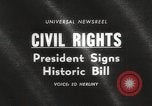
U.S. President Lyndon Baines Johnson signs the Civil Rights Act at the White House in Washington DC, United States.
United States President Lyndon Baines Johnson signs the Civil Rights Act of 1964 in Washington DC, United States. The meeting of the Congress for the signing of the bill. View of car and other vehicle traffic on Pennsylvania Avenue in Washington DC, looking toward the Old Post Office building (1100 Pennsylvania Avenue NW, Washington, DC 20004) and the U.S. Capitol building beyond. The exterior of the Capitol building with American flag waving on flagpole. People walking on the street in front of the building. People gather in front of the Lincoln Memorial. The exterior of the White House. Officials gather inside the building. U.S. President Lyndon Baines Johnson seated at a desk. The President addresses the legislators and people and talks about civil rights, justice, and peace for the people. President Johnson signs the Civil Rights Bill. Lawmakers and guests gather around him. He gives signing pens to Everett Dirksen and Hubert Humphrey, and then to civil rights leader Martin Luther King Jr., and to FBI chief J. Edgar Hoover. Several pens are given to Attorney General Robert Kennedy, to be given to various members of the Kennedy family.
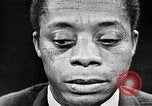
Views of Martin Luther King Jr. and Kenneth Clarke on the position of African Americans in the US; Civil Rights protest scenes
James Baldwin speaks in United States. Scenes of strife and struggle during civil rights movement. Policemen beat a African American man. Doctor Kenneth Clark, Professor of Psychology at the City College of New York; Director of Fallen Youth Opportunities Unlimited and Research Director, North Pride Center for Interpretation, sits in a chair during an interview. He speaks on the position of African Americans and America's Promise. Other scenes: Martin Luther King Jr. addresses a small gathering of African Americans. They are standing at the scene of a bombed out or destroyed church. He speaks about what happened there alluding that they know the truth of the racist hate crime. He speaks about remaining strong in striving for freedom for African American citizens. People around him sing and clap. Martin Luther King Jr. looks into a bible. Ebenezer Baptist Church and its interiors are seen, where Martin Luther King Jr. preaches. Exterior view of a Woolworths store where African Americans in protest sit at a segregated lunch counter at Woolworth store and wait to be served, in a non-violent demonstration. People pass through doors. Men moving on a road are stopped by a policeman. He stands with other policemen. The civil rights demonstrators stop and pray together. They are then directed to a waiting police paddy wagon van for arrest. Policeman hits a African American man. African Americans are put in police paddy wagons. Policemen detain African American demonstrators during a march and use dogs in rounding up demonstrators. Fire truck arrives during a protest and firemen spray fire hoses at African American demonstrators on May 7, 1963 in Birmingham Alabama during the Birmingham Campaign or movement. High powered fire hoses spraying water at demonstrators. Police chasing and detaining demonstrators in a crowd during a black civil rights demonstration. Martin Luther King Jr. leaving a courthouse, his wife by his side. He walks down the steps where a reporter asks him, "Dr. King how long do you expect to stay in jail". King replies "I'm under orders to keep walking."
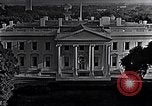
President Lyndon B Johnson remarks upon signing the Civil Rights Bill at White House, Washington DC.
View of the White House (1600 Pennsylvania Avenue NW Washington, D.C. 20500 U.S.) in Washington DC, USA. President Lyndon B. Johnson speaks upon signing the Civil Rights Act of 1964 at the White House, Washington DC. View of the bill signing ceremony for the Civil Rights Act. Scene changes to moderated discussion. The anchor welcomes Roy Wilkins, NAACP executive secretary, Leroy Collins, Former Governor of Florida, and Sterling Tucker, Washington Director of National Urban League, at a studio during Civil Rights Anniversary. The anchor starts conversation and Wilkins answers.
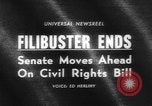
Senators speaking in favor of and against the Civil Rights Act; Senate works to clear the way for the bill's passage.
View of the Capitol Hill in Washington. United States Senate clears the way for Civil Rights Bill by voting to limit debate on the measure. Group of lawmakers, including Everett Dirksen and Hubert Humphrey, shown together with a paper recording Cloture votes. On the steps of the Capitol, Democratic Hubert Humphrey gives a statement in favor of the bill. Senator Richard Russell of Georgia, a "Dixiecrat" leader of opposition to the civil rights movement in the Democratic party, speaks to a reporter and gives his view in opposition. Russell states that he does not think the Civil Rights Act should pass without many additional amendments and says "we are not yet ready to surrender in our opposition to this bill, which we feel is a perversion of the American way of life, and a great blow at the right of dominion over private property, that has been the genesis of our greatness."
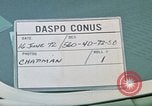
Civil Defense field headquarters truck parked outside Pennington County Courthouse in Rapid City. Officials coordinate response
Vehicles parked outside a Pennington County Courthouse building in Rapid City, South Dakota. View of the Civil Defense (CD) emblem. Sign on side of truck reads 'React 13-9'. Civil defense official talks on radio inside truck and takes notes. Interior of the Civil Defense response truck, shows map on wall, radio equipment, and several response personnel, seated.
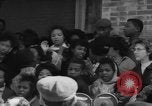
A large crowd of demonstrators in Selma, Alabama during the Civil Rights Movement.
Activists work to register African American voters in Selma, Alabama during the Civil Rights Movement. African Americans and White Americans demonstrate and march for civil rights. A man holds a microphone in his hand. A man at the demonstration takes photos with a camera. A large crowd of demonstrators. Two cars in the foreground. African American civil rights movement leader John Lewis is interviewed by media persons.
CRITICALPAST.COM: About Us | Contact Us | FAQs - How to Order | License Agreement | My Account | My Lightboxes | Shopping Cart | Advanced Search | Featured Collections | Website Terms & Conditions | Privacy Policy ©2026 CriticalPast LLC.
License Agreement |
Terms & Conditions |
Privacy Policy
©2026 CriticalPast LLC.