


 Francais
 Deutsch
 Italiano
Refine Your Search
Guadalajara Mexico 1920 stock footage and images
- Showing 601 to 606 of 1233 results more
more Hide
Hide
Scenes of World War 1 and the period between the wars, illuminating career of U.S. Air Force General Henry (Hap) Arnold.
Newspaper headline in Washington post reads 'United States and Germany at War'. Civilians recruited into the army. American pilots of the 103rd Aero Pursuit Squadron, in France, with their Spad aircraft. American airplane production factories in operation, with manny women war production workers seen assembling aircraft. People celebrate in the streets at end of World War I at time of armistice. Airplanes, under command of General Billy Mitchell bomb obsolete warships in demonstration of aircraft power in warfare. 1920s: Postwar flyers and stunt wing walkers perform in the roaring twenties. Developments and improvements in parachutes, and view as stunt men parachute from high buildings and airplanes. Aircraft flying forest fire patrols. Aerial view of burning forest fire below. Lieutenant Colonel Arnold commands emergency airlift and drop of food to snowbound Native American Indians in American Southwest, in 1932. World War I scene of American 103rd Aero Pursuit Squadron Spad airplanes taking off, in France. Lieutenant Colonel Hap Arnold with his family, including two young boys and a young girl (his sons and daughter) and his wife.
Montage of images pertaining to Nguyen Ai Quoc, an early 20th Century Vietnamese nationalist.
1920 photograph of Nguyen Ai Quoc, Vietnamese Nationalist, with two comrades. A letter from him to comrades in 1924, written in China. Images of French and English newspaper articles about Nguyen Ai Quoc, referring to him as an Annamite. A 1931 handwritten dossier compiled on Nguyen Ai Quoc. Picture of him with associates.
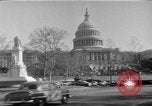
Decline in industry and jobs, and Stock Market crash and start of Great Depression in the United States.
The film 'The Unfinished Revolution' opens by showing people recovering after the Great Depression in the United States. Most scenes circa 1929 - 1931 (but film produced in 1960s). Landmarks in Washington DC: the United States Capitol building with 1940s and 1950s cars and taxi cabs on roads in foreground. View of exterior of Supreme Court building. Closer view of U.S. Capitol and then of the White House in Washington DC. Also the Washington Monument. Scene changes to the American West and a herd of sheep and of cattle grazes on pastures or ranch. Cowboys on horseback herd cattle on a giant field with snow covered mountains in the background. Farmers work in a field picking cotton. Scene changes to New York City with view of Manhattan skyline including Empire State Building, with new skyscrapers in construction in the foreground. View of market area and tenements; push cart vendors lined up on a street in a lower east side New York City neighborhood, and a Ford sedan on the street. Busy New York City streets filled with cars and pedestrians at end of 1920s. Children standing on fire escape in poor downtown area look down over suspended laundry lines between tenement buildings. An officer looks out from small window of a raised booth traffic light as the lights on the booth change color. A Ford automobile assembly line. Engineers work in a factory with minimum wages. A farmer plows a field of potatoes using four horses. A wheat thresher working a field. Trains at a crossing, on a bridge, and coal cars lined up at a coal yard. Busy New York Stock Exchange (NYSE) floor filled with people around time of 1929 stock market crash and start of Great Depression. Frenzied stock market scenes. Board outside a factory reads 'No Men Wanted'. Scenes of silent railroad yards and dormant factories. A man plays an accordian and collects coin donations. Jobless people wait in relief lines, soup kitchen lines, unemployment lines or queues and bread lines. Unemployed and homeless men asleep in public areas.
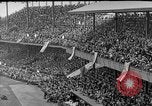
U.S. President Herbert Hoover throws out first pitch on opening day of 1929 baseball season
Shot of packed stands at Griffith Stadium in Washington, D.C. on opening day of 1929 baseball season. American flags hang from second deck. U.S. President Herbert Hoover arrives at his seat. Mostly male crowd, along with a few women, dressed in 1920s style overcoats and hats. Players of home team Washington Senators and the visiting Philadelphia Athletics line up on the field before the game. Senators manager and Hall of Fame pitcher Walter Johnson gives baseball to the president for the ceremonial first pitch. President Hoover releases strong throw; he and the crowd sit down.
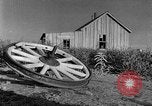
Conditions leading to the dust bowl on the American Great Plains
A homestead on a farm in the U.S. Great Plains. Horse carts break the plains. A woman sweeps stairs. A man and a child stand on the plains near the plow. An explosion on the land. World War 1 news headlines: 'England declares war on Germany, Belgium invaded, French win at sea' and 'War news tumbles securities, Stock Exchange Closed, Wheat Prices Soar'. A man drives a tractor with a plow on a plain land and dust cloud rises. The plow breaks the plains. News headlines: 'Wilson proclaims war, Spy ring arrested, German ships seized' and 'War sends wheat soaring, Grain up 13 points, Pit in Pandemonium'. The postwar decline of the wheat market results in overproduction: Farm machinery is used to sow the land. Wheat grains are poured into a thresher. A steamer at a sea. Tractors are driven and plows break the plains. A dust storm in the foreground during dust bowl era. Overproduction of wheat. Notice of 'Farms for Sale' in lower prices. Farm machinery is used. The sun rises in the background. A notice of 'Own a farm away from home'. Overproduction of wheat is shown. Over-exuberance in roaring 20s market is shown by a stock market or commodities market ticker running large amounts of ticker tape and a scene of a 1920s African American jazz musician drummer playing the drums enthusiastically and smiles while another band musician in the background plays bass.
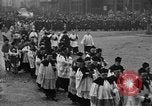
Religious procession to steps of a cathedral in Germany celebrating founding of Weimar Republic
Celebration of the Weimar Republic in Germany, following World War I. A Roman Catholic procession led by clergy, and involving Karl Josef Schulte, Archbishop of Paderborn, moves through the streets of Cologne, Germany, to the steps at the front entrance of Cologne Cathedral. The procession also includes many persons including students in various uniforms, carrying banners. One banner refers to the years 1853 to 1903. Large numbers of persons fill the streets. Policemen on horseback are seen. (Note: It is not clear whether Felix von Hartman or Karl Joseph Schulte is the Bishop in this film. The weather appears to be pleasant, which suggests it might be Hartmann, who fell ill in September and died in November. He was succeeded by Karl Joseph Schulte, Bishop of Paderborn, who formally became Archbishop of Cologne in March, 1920. Historical records describing this film mention "Archbishop Shulpe" with no further information or details. We believe that to be a misspelling of "Schulte".)