


 Francais
 Deutsch
 Italiano
Refine Your Search
Guadalajara Mexico 1920 stock footage and images
- Showing 637 to 642 of 1233 results more
more Hide
Hide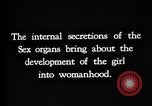
Female organs, fertilization and growth of fetus and menstrual flow are shown in an educational film produced in the U.S.
From a early 1920s educational film on health and hygiene for girls. Clip focuses on sexual education, targeted to a female audience. Female organs and their functions are identified on an inanimate model in the United States. Sex glands shown on the inanimate model. Reproductive system overview with summary that healthy condition of these organs makes for happy wife hood and successful motherhood. The reproductive system shows ovaries, egg cells and fallopian tubes through which the egg cells reach uterus. `A fertilized ovum grows into a baby in the uterus. Vagina is the tube opening outward from the uterus. Reproductive system diagram depicts a male sperm cell fertilizing an ovum within the body of mother. An animated diagram shows that for nine months the child is kept warm, protected and fed within the womb. A fetus grows in the womb and the child is pushed out through the vagina into the outer world. A nurse cleans and bathes an infant child in a wash tub basin. Reproductive system depicts menstrual flow.
British troops advance in an open field and fire artillery in Europe during World War I.
Scenes from a British World War I movie, released after the war, in the 1920's. British soldiers on a battlefield in Europe during World War I. Soldiers climb a wall and jump to the other side. The troops advance in an open field and then charge a German enemy bunker. The soldiers fire artillery. Smoke in the background. The soldiers in position in a trench. The soldiers run in the field and cross barbed wire entanglement. Explosions happen and smoke rises from the explosions. A wounded soldier lying on the ground. Bodies of dead soldiers lying on the ground.
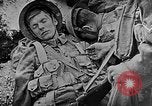
British soldiers in trench and during battle wearing gas masks
War casualties in Europe during World War I. A British soldier looks at a dead comrade. British soldiers in trench. Location shifts to a smaller dug-in trench. A handful of British soldiers during battle. They are wearing gas masks. Scene shows one soldier shaking violently after he is overcome by gas. (Note: This is an excerpt from a British World War I movie, released after the war, in the 1920's.)
Damaged buildings and ruins in French town of Chaumont-Porcien, during World War II.
Ruins in the French town of Chaumont-Porcien, in the Ardennes region, during World War II. Damaged buildings in the town. View of "Le Poilu victorieux de Chaumont-Porcien": A World War 1 statue of a French soldier in the Place de la Mairie. (The statue is a rendition of the Monument to the dead by Eugène Bénet, designed in 1920 in memory of French soldiers who died in World War I. It depicts a French soldier or "Poilu" with rifle in left hand, holding aloft a laurel wreath or olive branch with his right hand.) A small circular fenced cemetery beside the monument is shown, containing crosses and German helmets of recent German soldiers deaths. German Army vehicles advance into town, passing horse drawn carriages lined up on a street.
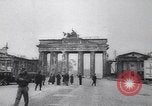
Ruins and damaged buildings in Berlin and Munich Germany at the end of World War II in Europe.
Opening scenes are of ruins in Berlin, Germany at the end of World War II in Europe. Damaged Brandenburg Gate and ruined buildings of Berlin. Damaged building of Adlon Hotel. Allied troops move forward in Germany to complete the Allied occupation of Germany. A truck loaded with Allied troops heads towards Berchtesgaden. Smoke rises from the Berghof, German Chancellor Adolf Hitler's mountain residence (Narrator refers to it as the Eagle's Nest, which is not correct. The Eagle's Nest or Kehlsteinhaus was not bombed and is not shown in this clip). Ruins and damaged buildings in Munich including exterior building facade, and arched stair entrance to festhall, marked with painted lettering by American soldiers, "157th infantry, 45th Division." Interior views of the Hofbräuhaus München beer hall (Hofbräuhaus am Platzl), including interior views of ruins inside its drinking room (trinkstube) with shattered windows and broken furniture. (Narrator refers to this as "the famous beer hall." At least two noteworthy NASDAP formative events occurred there: On February 25, 1920, Hitler presented the Nazi Party Twenty Five Point Program there. On November 4, 1921 the National Socialist party held a large public meeting at the Hofbräuhaus and fighting and protesting broke out after Hitler spoke. The Sturmabteilungen, or "SA", then in its infancy, attacked and ejected protestors.)
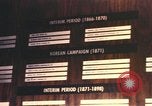
Hall of Heroes at the Pentagon showing hero names from Korean Campaign to the Vietnam War
View of the Hall of Heroes at the Pentagon, in the United States, during the Vietnam War. Names of the war heroes in the hall. Nameplates of the war heroes of each historical conflict on the wall. Names of the soldiers and officers who served the best in the wars. Names under the nameplates reading: 'Interim Period (1866-1870)', 'Korean Campaign (1871)', 'Interim Period (1871-1898)'. Other nameplates read: 'War with Spain (1898)', 'Philippine insurrection (1899-1913)', 'China Relief Expedition-Boxer Rebellion (1900)'. Several other conflicts mentioned in the hall. Other nameplates read: 'World War I (1917-1918)', 'Haitian Campaign (1919-1920), 'Second Nicaraguan Campaign (1925)', 'Word War II (1941-1945) and 'Vietnam (1964-Present).