


 Francais
 Deutsch
 Italiano

Refine Your Search
Guadalajara Mexico 1920 stock footage and images
- Showing 631 to 636 of 1239 results more
 Hide
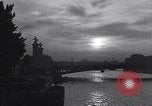
Morning in Paris, with the River Seine, Eiffel Tower, Place de la Concorde, and a busy street
Dawn and morning time in Paris. Sunrise in Paris. A bridge over the River Seine. Clouds over the city. A Statue of Liberty replica on the Ile aux Cygnes Island (Pont de Grenelle, 75015 Paris, France). Men sleep on the riverbank. The Eiffel Tower (Champ de Mars, 5 Avenue Anatole France, 75007 Paris, France) on the riverbanks. Two pillars flank a road. Smoke from a stack. The Rue Royale, the Obelisk and a fountain at the Place de la Concorde (75008 Paris, France). Trucks spray water around the fountains. A man sweeps the street. Women push a cart full of baked goods. A busy market street. Men carry heavy load, push, and pull carts. A mail man at a window. Children walk to school with book bags. 1920s and 1930s cars moving on the roads, as seen from unusual point of view of a moving camera at low level, just a few feet above the road surface.

The Nazi Party and national flag of Germany flies in the breeze.
Flag of the Nazi Party (1920–45) and National flag of Germany (1933–45). It is seen from both sides as it blows almost straight out under a very stiff breeze.
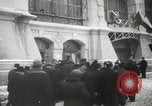
Life under Soviet domination in Eastern Europe following World War II
Legislators entering a hall in Czechoslovakia, in 1948. Inside,an image of the Small Coat of Arms of the Republic of Czechoslovakia (1920) dominates the scene. New scene shows Gustav Husak, acting Prime Minister, delivering an address urging support for the Communist Party. The next sequence shows violent Communist-led demonstrations, as armed trade unionists riot in the Prague streets, attacking the offices of the political opposition. Police attempt to restore order. On February 25, 1948, the communists achieve a Czechoslovak coup d'état. On February 27th, Czech President, Edvard Benes, receives a delegation including communist Premier Klement Gottwald and the 12 new members of the cabinet, at the Presidential Palace. He is seen signing documents accepting the communist cabinet. Change of scene shows Czech Foreign Minister, Jan Masaryk, giving a speech rejecting the change. (He remained in office, but died under suspicious circumstances on On March 10, 1948.) View of Masaryk in his casket. Mourners at his funeral.The Czech Parliament Building with flag at half staff. President Benes seen strolling, using a cane, accompanied by his wife, Hana Benes, in the garden of their summer home, Benesova vila, in Sezimovo Usti. Narrator notes that he refused to sign a new constitution drawn up by the communists. He died of natural causes at his villa on September 3, 1948. Scenes of his funeral and of him in his casket. Views of Benes' state funeral, with mourners lining the streets. View of British Prime Minister Winston Churchill. Narrator describes circumstances using Churchill's term "Iron Curtain." A communist parade in an Eastern European city. A person who was roughed up on the street. View of East German uprising in 1953, being suppressed with Soviet tanks. Uprising in Poland in 1955 being put down by local police and Russian soldiers. Polish musicians playing and examples of Polish political cartoons permitted under relaxed communist rule.

Two women flappers flaunt tradition and get their hair cut in a barber shop, during the "roaring twenties,"in the U.S.
Two women walk on a city sidewalk in the U.S. in the 1920s. They enter a barber shop (which usually has only men for patrons). Both women have "bob" short hair styles that are a considerable departure from styles of a decade earlier. They sit in the shop and read a newspaper, as they wait for the barber to finish giving a man a haircut. A woman goes to the empty barber chair as she explains, to the barber, how she wants her hair trimmed. The barber begins to cut her hair.

Popular American music and dance, during the "Roaring Twenties" and early 1930s
Music and dance in America in the 1920s and early 1930s. American composer, George Gershwin, performs solo passage on the piano. Gershwin at the piano accompanied by Paul Whiteman's orchestra, with Whiteman conducting. Paul Whiteman playing violin with several other violinists. A Harlem jazz band of African American musicians performing in a jazz club (early Harlem Renaissance period). Couples dancing the Charleston. Band members singing with megaphones as flappers and couples dance, including the Charleston dance.

Movie portrayal of Speakeasy activities during prohibition in the U.S.A.
Actors portray purveyors and consumers of illegal liquor during prohibition in the United States. Sales and consumption in city establishments in the 1920s. Man knocks on a door. He is eyed from inside, slips money through slot and receives bottle of liquor. An innocent-looking package contains bottles of Gordon's gin. A man slips something through a window slot in a speakeasy door and is admitted. Sculpture of the Statue of Liberty at a restaurant where illegal alcohol is served. Men and women in the restaurant. People dance. Men pour liquor in glasses.