


 Francais
 Deutsch
 Italiano
Refine Your Search
Hoboken New Jersey 1918 stock footage and images
- Showing 595 to 600 of 9472 results more
more Hide
Hide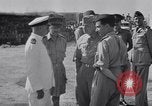
Allies force German forces almost completely out of Tunisia, North Africa, during World War II
Opens with General Dwight D. Eisenhower, Supreme Commander of Allied forces conferring with his deputy for land forces, British Field Marshal Harold Alexander, his deputy for sea forces, British Admiral Andrew Browne Cunningham, and his deputy for air operations, British air marshal Arthur William Tedder, during North African campaign in World War 2 . Map illustrates Allies military plans as analogous to internal combustion engine. General Eisenhower on an airfield consulting with his British Deputy commanders. B-17 bomber in background. Eisenhower salutes the British officers as he walks away. Lieutenant General Carl Spatz, Commander of the North West African Air Force, confers with British air marshal Tedder. Major General Jimmy Doolittle briefs airmen and smiles for camera. Strategic bombers with nose art names Pluto, Yankee Doodle, Jersey Jackass, Alice the Goon, and Fancy Pants. Picture of British Air Vice Marshal, Sir H.P. Lloyd, chief of Coastal air Force. A British Avro Anson aircraft flying air cover over a convoy of Allied ships. Diagram shows how all British and American fighter aircraft and attack bombers were placed under the command of British Air Marshal Cunningham, who is seen stepping from an airplane. British Field Marshal Harold Alexander in command of all ground forces is also seen stepping from an aircraft. Both are seen at a small camp trailer that they shared in the Tunisian mountains, where they work together, at a planning table. Marshal Cunningham is seen briefing air crews in mid March, 1943. B-24 Liberator bombers fly in formation and drop bombs on German Mareth fortifications in Tunis. German anti-aircraft guns create many black flak clouds among bomber formation. View from B-24 aircraft of the bombs exploding on the ground. British Field Marshal Harold Alexander is seen walking with a member of his staff across the sands. Diagram shows planned advance of the British 8th Army. Numerous British heavy guns fire nighttime barrages against the German positions, as British infantry advance during battle. They use scaling ladders and sappers detonate charges. Soldiers carry sticks to line trenches and set up defensive fortifications. Tanks advance. Heavy rain creates problems and some armor bogs down in mud. The next morning British troops are seen in their trenches as smoke drifts across the area. British soldiers moving cautiously under fire. German Field Marshal Rommel looks through binoculars. Additional German armored units entering the area. British gunners firing field artillery and mortars. Map illustrates how 2nd New Zealand Division under Lieutenant-General Bernard C. Freyberg, swings around behind the German line. Formation of British B-26 Marauder aircraft flying over desert. British Vickers Wellington bomber in flight. Bombardier in aircraft pressing a release button and bombs fall away creating huge explosions on ground. British mosquito bomber flying low. Bomb explodes on ground and Mosquito aircraft pulls up and away. Another Mosquito aircraft flying low on a strafing run. Tanks of 2nd New Zealand Division welcomed into El-Hamma, Tunisia, in the Battle of the Mareth line. View of South African army engineers using caterpillar tractor to build roads for Allied forces. Glimpse from rear of three British warships underway in the Mediterranean sea. Front view of a British Queen Elizabeth Class battleship underway. The battleship firing her 15-inch guns. U.S. P-38 fighter planes in formation. Glimpse of pilot in cockpit wearing leather helmet and earphones. Formation of German Junkers Ju-52 aircraft flying low over sea, carrying German troops to reinforce those in Tunisia. View of German soldiers inside the cabin of a Ju-52. Closeup of three Ju-52 transports flying very low over water. Several U.S. P-38 fighter planes attacking the transports. Pilot in one, pressing button to fire his guns. Scenes of aerial dogfight combat between U.S. Army Air Force aircraft and German Luftwaffe aircraft. Gun camera images of P-38s shooting down German transport planes. Map shows American, British, and French forces pressing Eastward against Germans. Views of battle and U.S. Lieutenant General George Patton at the front as his forces move forward during Battle of Guettar. American patrols of light tanks meet up with British patrols from their 8th Army on April 7. Views of the U.S. and British soldiers happy to meet one another and sharing cigarettes. Map shows Allied forces pushing the Germans further. Allied infantry walking into town of Enfilaville. Local families returning to their homes with all their belongings, in carts pulled by donkeys and other animals. In the town, encouraged by British troops, a group of Jewish boys remove Jewish star of David emblems from their jackets that had been used by occupying Germans to identify them as Jewish. British army doctors tending to local women and children.
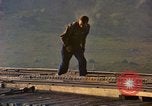
Scenes from famous sites and cities in America in mid 1960's; focus on various wheeled vehicles.
Children lean out windows of railroad train climbing hill at Mount Washington, New Hampshire, as men make adjustments on track bed while the train approaches at slow speed. People outside Binion's Horseshoe casino and hotel in Las Vegas with neon lights flashing and illuminating a woman crossing the street. View of people walking on city streets, town streets, and inside buildings in America in mid 1960's, including views of various late 1950's through mid 1960's cars on roads. View of Belmar Hotel in New Jersey. Families on vacations hiking on ridge tops and beside large canyons; possibly Grand Canyon. Three young boys, shirtless, walking along a wooden fence on a large western ranch. Three women in bathing suits walking on sand of a beach. Heap of waste old 1940's and 1950's cars stacked up. A family with women and children walking along a city street. A line of boys with backpacks, possibly boy scouts, walking along a trail in the woods. Air Force Academy cadets marching on grounds of the U.S. Air Force Academy in Colorado. Pedestrians crossing busy city streets and cars on city streets in American cities. Boy pulls a girl seated in a red wagon along a suburban sidewalk. Man crosses city street with garment wagon as a vendor pushes his food truck along the street. Man pushes a cart stacked high with cardboard boxes. Men on golf course wheel golf bags near the green. Man wheels gas tank along a seashore area. Post office mail carrier wheels mail bag on sidewalk of neighborhood. Women pushing babies in strollers and scenes along a street market
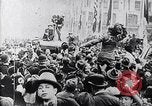
Post World War I political issues in the U.S.A. including Red Scare, anarchists, labor strife, and KKK
A huge crowd on streets of New York City cheering and celebrating victory over Germany in World War I after signing of the Armistice. A cemetery of U.S. soldiers died in World War I. Cross burning and views of hooded Klan members at a Ku Klux Klan (KKK) ceremony, with several uniformed U.S. Army soldiers in foreground, dimly lit (possibly at Stone Mountain Georgia but location not confirmed). Palmer Raid victims: Suspected leftists, left wing, and anarchists seen being led away in a group by police after their homes were raided and searched without search warrants, and some were deported, under program led by U.S. Attorney General A. Mitchell Palmer, during 1919 and 1920. (Second group shown is likely in Paterson, New Jersey; note sign for J.T. Doremus Hardware on building in background.) Palmer Raid arrestees seen behind barbed wire fences where they were held without charges for three months and denied legal representation. Some arrestees being escorted by U.S. soldiers in uniform. Vigilante businessmen and town leaders enforcing 12 hour work days at Steel factories in Pittsburgh Pennsylvania and Gary Indiana. Vigilantes (deputized and armed by local authorities) seen with rifles and shotguns marching down streets enforcing labor demands and countering steel workers on strike. They approach a striking worker on the road side and seize a stick he is holding. They beat a protestor with sticks. Together with police they begin to hit and beat back the protesting crowd of men. Someone fires a gun in the crowd and shooting starts on both sides during fight. An injured or dead steel worker on the ground is lifted up by a man and carried away.
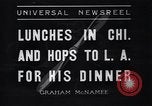
Howard Hughes flies a Northrup Gamma airplane from Chicago to Los Angeles in less than half a day
A newsreel titled 'Lunches in Chi. Hops to L.A. For his dinner.' Howard Hughes, famed industrialist and aviator, is seen dressed in a suit and tie, seated in a Chicago restaurant having lunch. He finishes and leaves. The next scene shows nose of a Northrop Gamma 2G airplane with engine running. A brief glimpse of Hughes,still in suit and tie, wearing leather flying helmet with goggles pushed up on his forehead. With Hughes piloting, the airplane taxis and takes off from Chicago. It is seen in a gentle left bank as it departs. Later, Hughes is seen landing at Union Air Terminal in Burbank, California. Hughes is seen in opened cockpit as he taxis in to the parking ramp. He taxis past a Stinson hangar, parks, and climbs down from the aircraft. He is accompanied by a number of men as he walks across the parking ramp. (Note: Howard Hughes is flying a modified Gamma 2G airplane, number NC13761,that he leased from famous woman aviator, Jacqueline Cochran, who ordered it powered by a liquid-cooled 700-hp Curtiss Conqueror engine,driving a two-blade propeller. Hughes modified it with a 1000-hp Wright SR-1820-G2 radial engine, driving a three-blade constant speed propeller, and used it to set a new transcontinental nonstop record, flying from Burbank, California to Newark, New Jersey in 9 hours 26 minutes 10 seconds with an average speed of 259 mph, on 13-14 January 1936. The flight shown here set a speed record of 8 hours and 10 minutes from Chicago, Illinois to Los Angeles, California.)
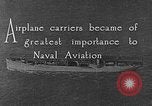
USS Langley (CV-1) in Panama Canal and USS Saratoga (CV-3) being launched
The U.S. Aircraft Carrier, USS Langley (CV-1) going through the Gaillard Cut of the Panama Canal with many aircraft parked on her deck. In different sequence, aircraft are seen taking off and landing on the deck of the Langley. Complete change of scene shows launching of the USS Saratoga (CV-3) at the New York Shipbuilding Corporation shipyard in Camden, New Jersey. The USS Saratoga is christened with a bottle of champagne and slides down the ways into the river. Views from the deck of the Saratoga as she proceeds down the ways.
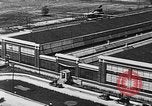
Aircraft manufacturing factories at various places in United States
Manufacturing of aircraft in United States World War I. Aircraft factories at Elizabeth, New Jersey; Buffalo, New York; Detroit, Michigan; and Dayton, Ohio. Aerial views of aircraft factory, railway siding, warehouses and lumber yard. Crowd of men war production workers go to work at one of the plants and factory workers at work. Men sit around small round tables as they eat in a plant cafeteria. Many of them appear to be production plant executives and at least one U.S. Navy sailor in uniform. African American waiters seen in the dining area.
CRITICALPAST.COM: About Us | Contact Us | FAQs - How to Order | License Agreement | My Account | My Lightboxes | Shopping Cart | Advanced Search | Featured Collections | Website Terms & Conditions | Privacy Policy ©2026 CriticalPast LLC.
License Agreement |
Terms & Conditions |
Privacy Policy
©2026 CriticalPast LLC.