


 Francais
 Deutsch
 Italiano
Refine Your Search
Hoboken New Jersey 1918 stock footage and images
- Showing 6631 to 6636 of 9472 results more
more Hide
Hide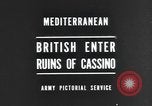
Re-enactment of British forces occupying the town of Monte Cassino, Italy, in World War II
Montage of scenes recorded after the Battle of Monte Cassino in World War 2. Opening scene shows New Zealand 19th RHQ tank in Mignano Montelungo, as the 24th New Zealand Battalion re-enacts its entry into the ruins of Monte Cassino, on March 26, 1944. In this restaging, 24th Battalion infantrymen are shown moving through rubble of destroyed town, firing small arms and one throwing a hand grenade. Narrator identifies "Hangman's Hill," (which was held by the 1st battalion 9th Gurkha Rifles) at Monte Cassino. In this restaging , New Zealanders, scramble over rubble, and dig out a "wounded" comrade, while explosions occur in background. Medics "attend" to him. Other NZ troops fire small arms from behind rubble barriers. A huge explosion occurs in background. A British artillery piece (obscured by debris) fires rounds. Infantrymen fire small arms. A camouflaged British tank fires its gun. In change of scene, other British troops advance cautiously near a damaged building and take several German soldiers prisoner. View of the destroyed Monte Cassino monastery and castle on Castle Heights. Ruins of building adjacent to the "Hotel Excelsior,"below the castle. Several medics with Red Cross flag in distant rubble. Views from destroyed Monastery atop the mountain. (World War II; WW II; World War 2; World War Two)
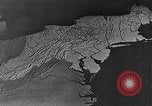
Port cities connected by railroads with industrial regions of Northeastern States of the United States.
Northeastern States of the United States serve as an industrial regions. Animated map shows port cities of New York, Boston, Baltimore, Philadelphia, and Portland used for transoceanic and coastal trade. Map depicts port cities connected by railroads with industrial regions of Northeastern States of the United States. A moving railroad train running parallel to the Hudson River in New York. View of New York Municipal Airport terminal (also known as LaGuardia Field, or LaGuardia Airport), as passenger aircraft taxi in foreground. Map depicts the daily flights from Northeastern States.
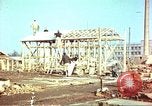
Japanese laborers work on houses under construction in Tokuyama-City, Yamaguchi Prefecture, Japan.
Construction of new houses in Tokuyama-City, Yamaguchi Prefecture. A new house under construction. A Japanese laborer drills holes through roof slats. The laborer picks up pieces he has drilled holes in and climbs up a step ladder and onto a roof. A middle class house recently constructed shows delicate and extension glass. Paneling for out doors and paper paneling for the inner corridor. Construction of a new Japanese house shows a carpenter using a tool to square lumber. Two workers roofing with bamboo. Construction of another house shows a bamboo thatched roof and in the background another house under construction. A man weaves a bamboo lathe for a house wall which is later to be plastered with mud.
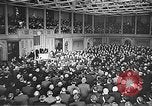
President Franklin D. Roosevelt signs the declaration of war against Japan after the attack on Pearl Harbor, United States.
America declares war on Japan during World War 2. U.S. President Franklin Delano Roosevelt addresses Congress at the U.S. Capitol. He gives a speech recounting the attack on Pearl Harbor and speaks of American success to come in the war against Japan. The President signs the declaration of war against Japan after the attack of Pearl Harbor. A large group of civilians enlist into the armed forces. Civilian young men taking an oath of service. View of new military recruits marching on a dock beside New York Harbor with view of New York City Manhattan skyline behind them. Newly commissioned U.S. officers at commissioning ceremony. Group of citizens gathered at a memorial service in Hawaii laying wreaths and mourning the loss of American lives from the Pearl Harbor attack by Japan. U.S. Navy Admiral Chester W. Nimitz presents medals to men of the armed forces who had defended Pearl Harbor. A large fleet en route to Honolulu with supplies. General Douglas MacArthur at his desk working on orders and talking on telephone. Filipino Forces march in Manila. Massive heavy artillery long gun being fired on Corregidor at Japanese forces.
Spanish Civil War. Soldiers recruited to fight fascist rebels. President appeals to nation. Irrigation project undertaken
Fascist Rebel bombardment of Madrid, during Spanish Civil War, angers population and promotes recruitment into the Republican Army. A group of men march down a street with a small boy, who appears to be in boy scout uniform, in the front rank, carrying a flag. Recruits are seen being organized into marching groups. Sidewalk in front of a railroad station is filled with new recruits. They march under direction of Republican soldiers. Motorcade of automobiles carrying Manuel Azana Diaz, President of Spain, stops surrounded by an enthusiastic crowd, in Valencia. The President steps from his car, enters a building, and delivers a speech emphasizing the democratic election of the government and decrying the need to defend it and the soil of Spain from fascist rebels. Scene shifts to several men in rural area, discussing the need to complete new irrigation projects in time for new defense of Madrid. They already have their pump and must build the pump house. One man types on a typewriter while another sketches the plan to pump water from the Rio Tajo (Tagus River), to irrigate crops. View of horse-drawn wagon loaded with cement for construction. Two men discussion construction plans. Masons using rudimentary methods to erect a pump house. Later view of pump house as men work on the roof. Men digging irrigationl canal from the river and upward toward the agricultural fields. A soldier who hitched a ride on a truck, jumps off. View of a letter he wrote a few days ago, on May 4th. He arrives at his house and is greeted by his mother. Farmers trimming plants in field to be irrigated. A boy calls one of them, his father, to come home.
Peacetime activities and contributions by the U.S. Army in the United States.
Scenes from Army Day on April 6, 1934. Secretary of War George Henry Dern, in broadcast to the nation about importance of the Army, in peacetime. Brief glimpses of the Yellowstone River lower falls and Old Faithful and Beehive geysers erupting in Yellowstone Park, Wyoming. View amongst log buildings in Reproduction of Army Fort Dearborn, at the 1933 Century of Progress Exposition in Chicago, Illinois. A pioneer wagon; Native American Indians in ceremonial regalia; antique locomotives and trains at the Exposition. Army General Leonard Wood being sworn in as the Governor General of the Philippines. Closeup of General of the Armies, John J. Pershing, America's highest ranking Military officer. Headquarters of Walter Reed Army hospital, in Washington, DC, named for U.S. Army Major Walter Reed, who confirmed that yellow fever is transmitted by mosquito. Acting on this, the U.S. was able to complete the Panama Canal. View of French dredging equipment sitting idle in the water after Yellow Fever prevented them from completing the Panama Canal. Closeup of U.S. Army General William C. Gorgas, who, in 1904, headed the Sanitary Department that controlled mosquitoes and eradicated Yellow Fever, so the Panama Canal could be finished. View of alligator in swamp near the Panama Canal. Photograph of George Washington Goethals, Chief Engineer credited with making the canal happen. Explosives employed in Panama Canal construction. Earth and rocks being loaded into open rail cars. A steamship transiting the Panama Canal. The Washington Monument; U.S. Library of Congress; and the Lincoln Memorial, cited as examples of accomplishments by U.S. Army engineers. The Wilson Dam, under construction by Army engineers, in Muscle Shoals, Alabama and system of levees being built to control the Mississippi River. The raging Mississippi River during 1927 flood. Flood victims being assisted by U.S. Army soldiers, at a tent camp, receiving food and clothing. An Army airplane flying over a forest fire. Army personnel supervising men in the Civilian Conservation Corps or CCC. Mail being loaded aboard an Army airplane, as airmail service is being opened between Washington DC and New York City. President Woodrow Wilson talking with Army pilot Major Reuben H. Fleet. Mail being loaded into the nose of an airplane. U.S. Army Douglas World Cruiser airplanes in flight, returning from their trip around the world in 1924. A pilot sitting in front seat of a Douglas O-38 airplane, pulls a fabric hood over his cockpit to practice "blind flying". View of the aircraft in flight, with instructor pilot in the open rear cockpit. Army aviators taking a camera and a rifle aboard their airplane as they prepare to leave on an aerial mapping flight. Aerial view of skyscrapers of Manhattan Island, New York City. Army Signal Corps personnel working on communications devices. A cable laying ship operating at sea, in support of the U.S. Army's Alaskan cable and telegraph system. Men loading chemicals into hoppers on Army crop dusting airplane. Several views of Army airplanes crop dusting. Glimpse of boll weevil, the target of their efforts. Closeup of Karl Connell, who as a major in the AEF, in World War I, invented a superior gas mask known as the “Connell” or “Victory” mask. A group of miners wearing gas masks enter a smoky mine entrance. The Army invented tear gas, which is shown being used to thwart a bank robbery, in a staged demonstration. Brigadier General Hugh Johnson, appointed by President Franklin Roosevelt, as head of the Great Depression era National Recovery Administration, or NRA, is seen about to give a speech. Narrator cites him as an example of U.S. Army officers who also serve the country in civilian life. Scene shifts to cadets on parade at the United States Military Academy, West Point, New York.
CRITICALPAST.COM: About Us | Contact Us | FAQs - How to Order | License Agreement | My Account | My Lightboxes | Shopping Cart | Advanced Search | Featured Collections | Website Terms & Conditions | Privacy Policy ©2026 CriticalPast LLC.
License Agreement |
Terms & Conditions |
Privacy Policy
©2026 CriticalPast LLC.