


 Francais
 Deutsch
 Italiano
Refine Your Search
Hoboken New Jersey 1918 stock footage and images
- Showing 6637 to 6642 of 9472 results more
more Hide
Hide
American soldiers and WACs prepare for the arrival of Vietnamese refugees in the United States at end of Vietnam War.
Operation New Life and Operation New Arrival in the United States at the end of the Vietnam War. A building in a receiving area of Fort Indiantown Gap (FIG) near Jonestown, Pennsylvania. A sign board near the building reads: 'US Army Task Force New Arrivals Receiving Station'. Members of the 401st Personnel Service Company lining up in formation. Troops and Women's Army Corps (WACs) enter the building to prepare for the arrival of Vietnamese refugees. Members being briefed by an officer. Officer explains the use of paper forms. Soldiers and WACs listen. Officer addresses them. Members look at the forms. I believe the date this was shot was in late April we were there to stock all of the building before the refugees arrived. These solders and WACs were flown in from Ft. Carson. That day the fort was nearly a banded maybe 25 regular stationed there until our plane landed. We stocked every barracks with everything from tooth brushes, toilet paper to sheet and blankets. In a couple weeks we changed a ghost town into a town of about 30,000 people. I was in the second platoon front line next to the shortest WACs in the army.
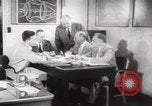
General Electric producing the first American jet airplane engine. Bell Aircraft building first U.S. jet powered airplane.
General Electric Company engineers work on designs for America's first jet aircraft engine during World War 2. In the company's plant, at Lynn, Massachusetts, machinists make parts for the engine and others assemble it. Company executives conversing about the enterprise. On April 18, 1942, the first engine produced is rolled into a test cell for operational testing. Engineers pull down the door to the test cell displaying the words: "Fort Knox." Engineers at control panel of the test cell. View into the test cell. GE Project manager, Donald F. Warner, actuates toggle switch to "on" position, and the engine ignites. Flame seen in rear of the engine. Complete change of location. View of Bell Aircraft company buildings. Bell engineers working on design of an airplane designated, XP-59A (Airacomet) to be powered by the new General Electric jet engine (later designated J-31 by the military). Views of the Bell engineering and production activities at secret facilities in Buffalo, New York. Two Bell workers expressing reservations about airplanes without propellers. A main intersection street scene in Schenectady, New York. Pedestrians walking and shopping. An F.W. Woolworth store on the corner. Copy of the Schenectady Gazette Newspaper, with headline about 500 planes raiding Berlin. A man buying a copy of the paper.
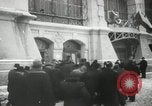
Life under Soviet domination in Eastern Europe following World War II
Legislators entering a hall in Czechoslovakia, in 1948. Inside,an image of the Small Coat of Arms of the Republic of Czechoslovakia (1920) dominates the scene. New scene shows Gustav Husak, acting Prime Minister, delivering an address urging support for the Communist Party. The next sequence shows violent Communist-led demonstrations, as armed trade unionists riot in the Prague streets, attacking the offices of the political opposition. Police attempt to restore order. On February 25, 1948, the communists achieve a Czechoslovak coup d'état. On February 27th, Czech President, Edvard Benes, receives a delegation including communist Premier Klement Gottwald and the 12 new members of the cabinet, at the Presidential Palace. He is seen signing documents accepting the communist cabinet. Change of scene shows Czech Foreign Minister, Jan Masaryk, giving a speech rejecting the change. (He remained in office, but died under suspicious circumstances on On March 10, 1948.) View of Masaryk in his casket. Mourners at his funeral.The Czech Parliament Building with flag at half staff. President Benes seen strolling, using a cane, accompanied by his wife, Hana Benes, in the garden of their summer home, Benesova vila, in Sezimovo Usti. Narrator notes that he refused to sign a new constitution drawn up by the communists. He died of natural causes at his villa on September 3, 1948. Scenes of his funeral and of him in his casket. Views of Benes' state funeral, with mourners lining the streets. View of British Prime Minister Winston Churchill. Narrator describes circumstances using Churchill's term "Iron Curtain." A communist parade in an Eastern European city. A person who was roughed up on the street. View of East German uprising in 1953, being suppressed with Soviet tanks. Uprising in Poland in 1955 being put down by local police and Russian soldiers. Polish musicians playing and examples of Polish political cartoons permitted under relaxed communist rule.
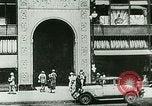
The U.S. National stock market craze during the "Roaring 20's" before the stock market crash.
An office entrance in Tacoma, Washington. Sign at door reads: "A.R. Blair & Co. Importers." A man smokes and reads the Tacoma Daily Ledger newspaper in his office. He reads the page with New York Stock Exchange (NYSE) prices for Thursday, August 30, 1928. A sign '"George R. McCall & Company, Stocks and Bonds, with offices at New York, Buffalo, Chicago & St. Louis." A number of the company's clients sit in chairs and watch as the latest stock prices are posted on display boards. Men are shown on the telephone communicating stock orders to their brokers. Hectic activity is seen on the New York Stock Exchange with floods of orders to buy and sell shares. Stock exchange number boards lit up with numbers. Men are seen in various places hovering over stock exchange ticker tapes running fast out of ticker tape machines. Scene of fireworks in the sky at the end (alluding to collapse of the stock market and the "Crash" on Wall Street that precipitated the Great Depression).

Polish Refugees travel three years and 3 thousand miles to Iran during World War II.
Many Polish refugees are seen in the final phase of their monumental trek of three years and three thousand miles from Poland, during World War 2. Scene shifts to Poland in 1939, where polish refugees crowd roads carrying their belongings in wooden carts and other conveyances. They are seen at a rest stop where they obtain food. Animated map shows path of refugees fleeing East into the Soviet Union, following the German invasion in August, 1939. The path continues Southeast in 1941, as they flee from the German campaign, Operation Barbarossa, into the Soviet Union. Their journey continues along the west coast of the Caspian Sea, through the Caucasus, to Persia (Iran). Views of refugees arriving at the Persian border, where they are seen near many tents, and being provided with articles of clothing from British and American Red Cross Stations. Refugees donning new shoes and other items. Young girls having their hair styled. Refugees sit at long tables where they receive hot meals. A teacher conducts an outdoor class for Polish refugee children. Closeup of children at their desks. Refugee women are seen tilling soil to plant crops, while fathers and grown sons and daughters leave to join the new armies of the Polish Government in Exile. Views of Polish women, in uniforms marching and of uniformed armed Polish soldiers, as well becoming part of the Allied war against the Axis powers. Polish refugees at an outdoor shrine, offering prayers for the safety of their members in the military. New polish refugee arrivals at the Persian border being greeted by others, many of whom are family members.
Industrialization of the U.S. and U.S. President Andrew Jackson and statesman Daniel Webster in the America
The history of the United States. Illustration : industrial workers at work in mills in New York. View of other industries with power machinery. New York is made the economic capital. Vehicles on streets. A map showing the east of Mississippi and new states added to the union. Andrew Jackson becomes the U.S. President in 1828. Men of the Congress during a meeting. American statesman Daniel Webster addressing the House of Representatives. Men listening to Daniel Webster.
CRITICALPAST.COM: About Us | Contact Us | FAQs - How to Order | License Agreement | My Account | My Lightboxes | Shopping Cart | Advanced Search | Featured Collections | Website Terms & Conditions | Privacy Policy ©2026 CriticalPast LLC.
License Agreement |
Terms & Conditions |
Privacy Policy
©2026 CriticalPast LLC.