


 Francais
 Deutsch
 Italiano
Refine Your Search
Hoboken New Jersey 1918 stock footage and images
- Showing 6907 to 6912 of 9472 results more
more Hide
Hide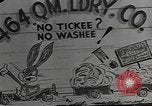
The U.S. Army Quartermaster Corps provides numerous support services to troops in the South Pacific in World War II
The U.S. Army Quartermaster Corps delivers laundry and myriad other services in the South Pacific during World War 2. Opening scene show a cartoon sign by the 464th Quartermaster Laundry Company featuring Bugs Bunny in a jeep pulling mobile laundry equipment in wagons. Next, U.S. troops are seen in jungles subject to rain and mud of the South Pacific. A soldier crouches in a riverbed and washes his clothes. A mobile laundry installed near a river. Soldiers using washers and dryers in the facility. Views of larger fixed installation Quartermaster laundry, such as in New Caledonia; Fiji; and the New Hebrides. Quartermaster salvage and repair workers operating sewing machines as they repair military clothing. A sign identifies "Island Quartermaster C&E Repair Shops" (Clothing and Equipage Repair Shops). Here workers sort, repair, and remark sizes on salvaged clothing. Two workers sit in a mound of garments that they cut into rags and toss into a heap behind them. Two workers repair broken shoes. Soldiers' feet seen walking through mud. A stack of army shoes needing repair. A team of army workers using modern machines to repair them. View of finished shoes, as good as if repaired in the U.S.A. Sign identifies Orthopedic Department where a man works on specially designed and fitted shoes prescribed for an injured soldier by a medical officer. A nurse and a doctor place the special shoe on a patient. A nurse assists the patient to walk. Typewriters needing repairs line shelves. Technicians are seen at work stations, repairing typewriters. The final sequence begins with a sign reading: "Tent Repair, Drive in here. All tents must be clean, dry, and folded properly." Quartermaster workers raise a tent inside a shelter and then identify and repair a hole in it by applying fabric glue and a patch.
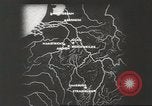
German Army Group Oberrhein undertakes Operation Nordwind, in Alsace, during World War II
German troops are seen in white winter uniforms, during World War 2, with some holding panzerfaust. Narrator mentions combat against Anglo-Canadian forces, and then speaks of preparation for the New Year's offensive. Heinrich Himmler, as commander of Army Group "Oberrhein" had ordered the launch of Operation Nordwind to recapture Strasbourg. Accordingly, On New Year's Eve, 1945,The Germans launch an offensive (Nordwind) into Alsace, attacking the Allied 6th Army Group at multiple points. On January 5, 1945, Army Group Oberrhein begins a support attack by General Otto von dem Bach's XIV SS Corps, the 553d Volksgrenadier Division, reinforced with armor and commando units. They are seen crossing the Rhine river in small boats at Gambsheim, just ten miles north of Strasbourg. Allied aircraft bomb German positions on the West bank of the Rhein (Rhine) River. The German troopers seize high ground West of the Rhein. German troops are seen firing recoilless anti-tank weapons in a field, Views of knocked out British and American tanks. Abandoned German Jagdpanzer IV faces a U.S. Tank Destroyer. German troops are seen advancing into town North of Strasbourg (Herrlisheim, Drusenheim, Offendorf ?). Scenes of destruction in town. Words: "Haus Bewohnt Civil" scrawled on homes to identify them as civilian occupied.
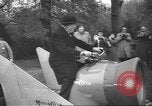
A motor boat with propellers and rudders being demonstrated in England.
A motor boat in England. Propellers of the motor boat rotate. Men look at the new boat with rudders and propellers. A man rides the boat as he takes it to the water. A cameraman takes picture of the new motor boat.
A U.S. Soldier demonstrates the use of a carbine equipped with a night vision sniper scope in Burma during World War II.
U.S. Army soldiers train with new "Sniperscope" equipment during the Burma Campaign in World War II. The 475th Infantry regiment of the U.S. Mars Task Force are seen gathered for a demonstration of the new Sniper Scope. A U.S. Army soldier demonstrates the parts and use of the sniper scope. He shows a carbine equipped with the sniper scope for accurate firing in the dark. He explains the functioning of the scope and how its attached infrared spotlight operates in conjunction with a telescopic sight mounted on the rifle to enable night vision. He looks through the telescope sight. He demonstrates the use of a unit, attached by a cord, that contains batteries and an electrical focusing attachment. He turns a focusing dial on the unit. The American soldiers examine the carbine and look through the telescopic sight. Narrator explains that the night scope will be used primarily in preventing night infiltration of U.S. held positions.
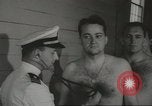
Young American men enlist as Naval Reserves and military forces advance in preparation for World War II.
The United States in preparation for World War II. Men stand in line for physical examination. Navy doctor checks lungs of each man with stethoscope. Young American men enlisting and new recruits being sworn in as Naval Reserves at the Naval Reserve Station in New York. Men working in war production factories to manufacture aircraft, ships, guns, and armament as part of the war production effort building war materiel. Large gun and artillery barrels are shown in production factories. Coastal guns fired. U.S. military tanks, jeeps and trucks advance. Aircraft in flight. Tanks advance in training drills over land obstacles, including ramps that cause a tank to become briefly airborn. Lines of tanks in practice drill maneuvers at night. Machine gun emplacements firing tracers at night and hitting practice targets.
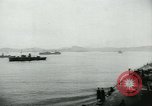
Part of a newsreel restrospective about U.S. President Franklin D. Roosevelt, made after his death in 1945
Film opens showing forward port section of the British Battleship HMS Prince of Wales in Placentia Bay, Argentia, Newfoundland. Next, Winston Churchill is seen greeting President Franklin D. Roosevelt as he arrives to meet with him during their Atlantic Conference in 1941. The President is assisted by his son, Army Captain James Roosevelt. The entire ship's company is seen assembled on deck for a church service. Closeup of President Roosevelt, Prime Minister Churchill and their principal advisors. all singing "Onward Christian Soldiers" during the service. Scene shifts to December 7, 1941, showing the American battleship USS Arizona and other battleships being bombed by Japanese aircraft. View shifts to the White House in Washington, DC. on July 19, 1940, President Roosevelt is broadcasting his speech to the Democratic National Convention, accepting nomination for an unprescedented 4th term as President. Views of ordinary Americans in various settings. Legislators congratulating the new Vice President, Harry S. Truman, after inauguration in January 1941. Truman seated and surrounded by staff and well-wishers. View of Truman, his wife, Bess and daughter Margaret, walking across the lawn at their home in Independence, Missouri. View of the three of them, inside their home, opening and sharing congratulatory messages received by the new Vice President. Immediately following FDR's death, now, President Truman is seen assuring the public that he will continue the course set by his predecessor. Glimpses of President Roosevelt seated in front of the White House and at his desk. In Yalta for the Big Three Conference, Roosevelt rides in a jeep as Prime Minister Churchill walks beside. Closeup of Roosevelt and Churchill. Participants gathering for the Yalta conference. Closeup of Roosevelt and Stalin. Churchill arriving and taking his seat. Closeup of the Big Three, Winston Churchill, Franklin D. Roosevelt, and Joseph Stalin. (World War II period).
CRITICALPAST.COM: About Us | Contact Us | FAQs - How to Order | License Agreement | My Account | My Lightboxes | Shopping Cart | Advanced Search | Featured Collections | Website Terms & Conditions | Privacy Policy ©2026 CriticalPast LLC.
License Agreement |
Terms & Conditions |
Privacy Policy
©2026 CriticalPast LLC.