


 Francais
 Deutsch
 Italiano
Refine Your Search
Hoboken New Jersey 1918 stock footage and images
- Showing 6913 to 6918 of 9472 results more
more Hide
Hide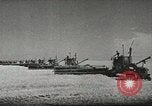
Unemployed men get jobs in industries and a cooperative farm plan to meet market demand in the United States.
Postwar (after World War II) agriculture activities in the United States. Farming equipment in operation on farms. Canned food in a store. Flashback scenes to the Great Depression during the 1930s: A man carries a banner which reads 'Unemployed Will Take Any Job'. Unemployed men lying on a bench. A sign on a gate : 'No Men Wanted'. Shabby housing tenements and shacks of poverty victims falling apart in a rural farm area. Forward again to the post war 1940s: Smoke comes out off chimneys of a factory. American workers busy at a auto assembly line finishing new cars (appears to be 1946 or 1947 Chevrolet cars). Factory workers line up at a pay window to receive pay checks. An industrialist works in his office. Crowds of American citizens on busy city streets with pedestrians and automobiles, and shoppers looking in store windows, including store windows showing elaborate Christmas displays. A cooperative farm plan to produce what the industrial and consumer markets demand. A man milks a cow with an automatic milking machine. A woman using electricity on a farm to power a new open top clothes washing machine. Farm machines are used.
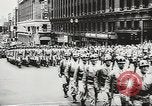
Work and achievements of Harry S. Truman during his first Presidential term in the United States
President Harry S. Truman marches with veteran soldiers of U.S. Army Company D (129th Field Artillery) with whom he served as an officer in World War 1. Wide view of men lined up on White House lawn. Disabled veteran soldiers of World War 2 greet the President. Narrator discusses problem of lack of housing for veterans and their families after World War 2. Aerial view of trailer homes or recreational vehicle (RV) camper units lined up in open space, serving as temporary housing for veterans. Truman sitting at desk while he signs the Veterans Emergency Housing Act of 1946. Views of long lines of new homes being built, and construction workers hammering to build frames of new houses in the United States. During a time of price inflation, scene shows grocer changing price signs on eggs, meats, cheeses to show increasing prices. Truman ata work in his office reviewing paperwork at his desk. Narrator mentions Taft Hartley Labor Act that Truman vetoed. View of car on road with sign on side that reads, "Veto Hartley Taft Slave Labor Bill." President Truman reading at his desk. Close up view of cover page of report entitled "To Secure These Rights. The Report of The President's Committee on Civil Rights. View of Episcopal church Bishop Henry Knox Sherrill seated at a desk. Bishop Sherrill is talking to another man. Narrator states that Truman acted on a civil rights program recommended by Bishop Sherrill, head of the Civil Rights Commission. Car pulling up to portico of White House and view of President Truman shaking hands with visiting President of Mexico, Miguel Alemán. President Truman being presented a sacred Torah by Israeli President Weizmann. Discusses foreign policy matters with Secretary of State George Marshall and comes up with Truman doctrine, Marshall plan and European recovery program. View of Truman signing Economic Cooperation Act of 1948 on April 3, 1948 (of which the Marshall Plan was a part).
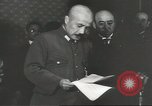
Japanese people in all walks of life supporting their war efforts in World War II
Japanese leader, Hideki Tojo addresses members of the legislature (Diet) saying their task is to set the Emperor's mind at ease. View of vast field full of Japanese soldiers performing supervised calisthenics. A kitchen preparing meals in boxes for Japanese soldiers. Soldiers hanging, one arm at a time, from a horizontal bar in a gymnasium. Radio antennas and smoke stacks are seen in Japanese industrial sites. Factory workers, all dressed alike, enter a war plant in Japan. Scientists seeking to invent new weapons of war. Japanese men and women workers in war production factories producing ammunition. Workers assembling artillery in a factory. Others building a new ship in a shipyard. Japanese boys and girls in school uniforms working on a farm. Women carrying harvested crop suspended from poles. Others threshing harvested grain and working in fields. Men and women operating Japanese fishing boats and hauling nets filled with their catches.
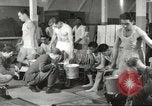
American Army recruits try on their uniforms in the United States
US Army recruits in World War 2 hold buckets of sand and stand barefoot on one leg at a time as doctor checks for flat feet and shoe sizing. A Lieutenant checks the fit of a new uniform jacket on a soldier. A group of newly recruited soldiers try on uniforms. A group of soldiers buttons their new Army overcoats
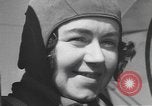
Laura Ingalls non-stop coast-to-coast U.S. record flight; also Margaret Waley found guilty in Weyerhaeuser kidnapping
Aviatrix Laura Ingalls in flight gear. Her aircraft, Lockheed Orion 9D Special, NR14222, takes off from Floyd Bennett field in New York. It sets a new nonstop flight record of eighteen hours and twenty minute flight from east coast to west coast in the United States. Ingalls was the first woman pilot to cross the U.S. non-stop from east to west. Next scenes are unrelated to Ingalls' flight: A group of men and women jurors walking on sidewalk in Tacoma Washington, during trial of Margaret Waley, wife of Harmon Waley, for her involvement in the kidnapping of young George Weyerhaeuser (nine year old heir to thriving Weyerhaeuser Company timber business in Washington state). Kaufman Leonard Company furniture delivery truck seen behind the group as they walk. The group of men and women seen entering a building. Next scene shows 9 year old boy George Weyerhaeuser holding closely to a man and avoiding cameras as he is led on the sidewalk, likely before or after giving testimony. Next scene shows 19 year old Margaret Waley, flanked by a man and a woman as she walks on the sidewalk, likely to or from court. Final scene is a group of men and women, possibly including the jurors in the case, posing on the steps of a building in Tacoma, Washington.
Governor Dewey being elected as the Presidential candidate at Republican party convention in Chicago, Illinois.
Republican national convention of 1944 in Chicago, Illinois. A banner in support of Governor Bricker of Ohio as a Republican Vice Presidential candidate. Pictures of Governor Thomas Dewey for the Presidential nomination. Representative Joseph Martin, Chairman of the Convention. Statesmen eat and discuss around a table before the convention. Wendell Willkie at desk. Cars outside the convention hall as people arrive. Delegates from various states across United States arrive at the convention. Newsmen at typewriters as they send out news about the convention. Cameramen record the proceedings at the convention. National Chairman Harrison E. Spangler opens the convention and invites Governor Earl Warren of California for delivering a keynote. Governor Thomas E. Dewey of New York at desk as he is elected as the Republican Presidential candidate.
CRITICALPAST.COM: About Us | Contact Us | FAQs - How to Order | License Agreement | My Account | My Lightboxes | Shopping Cart | Advanced Search | Featured Collections | Website Terms & Conditions | Privacy Policy ©2026 CriticalPast LLC.
License Agreement |
Terms & Conditions |
Privacy Policy
©2026 CriticalPast LLC.