


 Francais
 Deutsch
 Italiano
Refine Your Search
Hoboken New Jersey 1918 stock footage and images
- Showing 9199 to 9204 of 9472 results more
more Hide
Hide
The funeral for British Commanding Officer Admiral Sir Bertram Ramsey (WW2)
A tribute to the passing of British Commanding Officer Admiral Sir Bertram Ramsey. Funeral of Sir Bertram Ramsey in Saint-Germain-en-Laye New Communal Cemetery during World War II. Sir Ramsey deliberating plans to invade Sicily with Field Marshal Bernard Montgomery in North Africa. Sir Ramsey exits a building with United States General Dwight D. Eisenhower before the invasion of Normandy. Sir Ramsey and General Eisenhower talking. Military officials and troops attend the funeral and internment of Sir Bertram Ramsey in Saint-Germain-en-Laye. The coffin of Sir Ramsey is draped with the Union Jack flag and is carried on a gun carriage on a snow covered road. General Eisenhower and other Allied generals attend the funeral march. British Auxiliary Territorial Service (ATS) women stand at attention in the snow. A chaplain leads the funeral service. Troops fire the three-volley salute during the military funeral. Dwight Eisenhower and other generals salute and pay their respects.
81st "Wildcat" Infantry Division troops participate in a "dry run" at Guadalcanal, Solomon Islands (WW2)
United States soldiers perform a dry run of the Angaur landing in Guadalcanal, Solomon Islands during World War II. Animated map shows the Solomon Islands, Guadalcanal, New Guinea and Palau Islands. An anchor being dropped from ship. Landing craft sailing to the coast during a dry run of Angaur landing in Guadalcanal. United States 81st ("Wildcat") Infantry Division troops on LVT-4 and LVT(A)-2 Water Buffalo (Landing Vehicles, Tracked) drive onto beach. Soldiers rush to the beach after the Higgins boat door opens. Troops landing on Guadalcanal beach. Soldiers advance through jungle. Soldiers firing with M 1917 machine guns and bazookas. Soldier wearing flame thrower tanks on his back. A soldier digging in. Soldier aiming his rifle. Ships sailing after dry run exercise in Guadalcanal. Soldiers leaning over side of ship watch the ship wake.
Animations depict the relative efficiency of different sources of energy; turbines at a power plant in the United States
Slate reads “He who leaves the beaten track in search of knowledge oft comes unexpected to his goal.”. A photo of a sunrise with word “Light”. Diagram enumerates the types of light- torch, candle, kerosene, gas and electric- and their level of relative efficiency. A drawing featuring different types of lights. Animation depicts a man hand pedaling to pull a block and tackle. Animations show a moving horse and engines that operate on steam, gasoline, and electricity, operate similar machines, pulling block and tackle faster than man. Lights illuminate Times Square in New York City at night. Giant turbines operate at a power plant in the United States.
Dr. Sandcha Stepanow ; Kalmyk refugees work as artist, barber, and teachers in Ingolstadt, Germany
A photographer takes pictures of Dr. Sandcha Stepanow, a Russian-born lawyer and leader of the 600 displaced Kalmyks in Ingolstadt Displaced Persons Camp, West Germany after World War II. Dr. Stepanow meets with journalists in the camp. A Kalmyk family inside their flat in the refugee camp. A woman uses a sewing machine. The man plays with a young toddler. A woman tries on a new dress as a dressmaker adjusts the dress sleeves. An elderly Kalmyk man holds an infant playing with keys. An artist draws a charcoal illustration of an elderly man in traditional Kalmyk attire. A Kalmyk woman applies shaving cream on a man’s face at a barber shop inside the Ingolstadt Displaced Persons Camp. A Kalmyk man walks through The Kreuztor gate in Ingolstadt on his way to work. A German man greets the Kalmyk man. Displaced refugees, including a young woman, study at vocational training school in Ingolstadt. Kalmyk professor teaches in class. The Kalmyk instructor assists a man during a lesson.
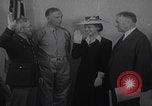
Oveta Culp Hobby is sworn in as Director of the United States Women’s Army Auxiliary Corps (WW2)
Oveta Culp Hobby is sworn into the Army with the rank of Director of the United States Women’s Army Auxiliary Corps during World War II. The organization would later be called the Women's Army Corps (WAC). Major General Myron C. Kramer administers oath of office to Oveta Culp Hobby. General George C. Marshall stands between Kramer and Hobby as he witnesses the ceremony. United States Secretary of War Henry Stimson also witnesses the event. Hobby stands with her arm raised under oath. Hobby shakes hands with Stimson, Marshall, and Kramer after the oath taking. Oveta Culp Hobby makes short statement, noting that, "This new corps is the 1942 expression of the patriotism and courage that the women of America have always demonstrated in every national crisis." Hobby continues, “In a total war, there is a total responsibility of all citizens regardless of sex, race, or creed. Every woman must do her part. The Women’s Army Auxiliary Corps offers an opportunity for every woman eligible under the law to do her part.”
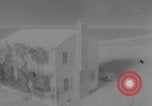
Operation Doorstep personnel bring model cars and mannequins into the Nevada Test Site
Explosion from nuclear blast. Destroyed houses and debris after a nuclear weapon explosion during nuclear testing by the United States. A mannequin partially covered by wood debris. Two men inspect groups of sitting mannequins. View of male, female, and infant mannequins. A man carries a female mannequin into a truck. Old and new passenger cars parked on the side of a road. Cars are marked with numbers. Cars start to drive in a convoy. Cars driving on the highway to the Atomic Energy Commission (AEC)’s Nevada Test Site, formerly known as the Nevada Proving Grounds, in Nye County Nevada. Cars are left at Yucca Flat. Joshua trees and weeds on Yucca Flat. Instruments to measure temperature are attached to the cars. A radiation film badge behind a car seat. Parked cars are stationed in various ranges from intended ground zero of shot Upshot-Knothole Annie, a nuclear test during Operation Doorstep. A man places a female mannequin on the passenger seat of a car. A boy mannequin is seen inside the car.
CRITICALPAST.COM: About Us | Contact Us | FAQs - How to Order | License Agreement | My Account | My Lightboxes | Shopping Cart | Advanced Search | Featured Collections | Website Terms & Conditions | Privacy Policy ©2026 CriticalPast LLC.
License Agreement |
Terms & Conditions |
Privacy Policy
©2026 CriticalPast LLC.