


 Francais
 Deutsch
 Italiano
Refine Your Search
Hoboken New Jersey 1918 stock footage and images
- Showing 9211 to 9216 of 9472 results more
more Hide
Hide
Japanese troops at Marco Polo Bridge in Peking and city of Nanking (Nanjing) during Second Sino-Japanese War
Explosion from bombing during the Marco Polo Bridge Incident at the start of the Second Sino-Japanese War. Sign at Marco Polo Bridge reads “Lu Know Kiao”. A train station near Marco Polo Bridge in Fengtai District, Peking, China. Imperial Japanese Army soldier uses binoculars while hiding in trench. A Japanese Sumida M.2593 (Type 91) armored car. Japanese troops fighting around Marco Polo bridge. The Japanese flag on mast of a battleship. Japanese battleship sailing to China. Japanese troops enter Nanking (Nanjing) after the Battle of Nanking. Soldiers in back of truck. Japanese biplane aircraft in flight. Japanese planes drop propaganda leaflets over Shanghai. Japanese planes dropping bombs. A Japanese newspaper with news on the Second Sino-Japanese War. Naval artillery crew firing guns. Japanese warships firing their guns in China. Japanese soldiers advance in battle. More bombers in flight.
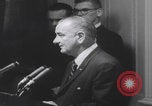
Lyndon B. Johnson speech on Vietnam War; scenes from World War II and Korean War
United States President Lyndon B. Johnson delivers a speech at a news conference in July 28, 1965 during the Vietnam War. President Johnson quotes a letter from a woman in the Midwest, "Dear Mr. President: In my humble way I am writing to you about the crisis in Vietnam. I have a son who is now in Vietnam. My husband served in World War II. Our country was at war, but now, this time, it's just something that I don’t understand. Why?”. United States Army soldiers in a Vietnamese jungle. A crying Vietnamese child. A man sits in front of a fire in the middle of a ruined house. Fascist leaders Adolf Hitler and Benito Mussolini during a parade in Munich, Germany. Flags of Nazi Germany and the United Kingdom. British Prime Minister Neville Chamberlain disembarks from in Munich for the Munich agreement. Nazi German guards turn their heads in unison. Adolf Hitler and Neville Chamberlain walk together. Crowd civilians perform the Nazi salute. Hitler and Mussolini in balcony. Neville Chamberlain reads the “Peace For Our Time” speech. “We regard the agreement signed last night and the Anglo-German Naval Agreement as symbolic of the desire of our two peoples never to go to war with one another again” Chamberlain said before smiling. Ruins of a bombarded city in Europe during World War II. Mussolini gesturing strongly during a speech. Cavalry soldiers on horseback in Ethiopia. Royal Italian Army fighting in Ethiopia during the Second Italo-Ethiopian War. Italian soldiers firing with a Fiat-Revelli M14 machine gun and advancing in field. Emperor Haile Selassie I of Ethiopia protests Italian aggression in the League of Nations. A stylized Nazi eagle statue in Austria. Austrian soldiers during the German Anschluss of 1938. Hitler and Austrian politicians perform the Nazi salute in Vienna. Explosions from night bombardment during the Korean War. Communist Chinese People's Liberation Army troops firing with Chinese Type 24 Maxim Water-Cooled Machine Gun and rifles in Korea. Soldiers’ feet climb and jump up uneven terrain in the battlefield. United States Army M46 Patton tanks pointing upwards and firing at enemy positions. An M46 Patton tank and trucks of the United Nations Forces crossing the 38th parallel line in Korea. Sign denotes the 38th parallel line. President Johnson continues his speech at the White House. “Why must young Americans, born into a land exultant with hope and with golden promise, toil and suffer and sometimes die in such a remote and distant place? The answer, like the war itself, is not an easy one, but it echoes clearly from the painful lessons of half a century. Three times in my lifetime, in two World Wars and in Korea, Americans have gone to far lands to fight for freedom. We have learned at a terrible and a brutal cost that retreat does not bring safety and weakness does not bring peace. It is this lesson that has brought us to Vietnam.” President Johnson said.
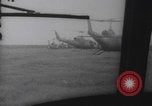
Various scenes depict Vietnamese children, soldiers in the Vietnam War, and President Johnson delivering a speech
Rear view of United States Army Bell UH-1 Iroquois “Huey” helicopters during the Vietnam War. U.S. Army helicopter pilot and soldier crew member in cockpit. South Vietnamese soldiers using a field phone. Republic F-105 Thunderchief fighter bombers in flight. Aerial bombing of Vietcong positions. An officer points to a map. Hand traces marked positions on the map. Vietnamese civilians evacuate from their homes. An injured civilian is taken on a helicopter. A Vietnamese child cries. Vietnamese children wash their hands and dries them with washcloths. A girl combs her hair. A boy lays a tablecloth and glass on the table. A girl holding a bowl of biscuits. A boy is given a biscuit and eats it. “I do not find it easy to send the flower of our youth, our finest young men, into battle,” says United States President Lyndon B. Johnson during a news conference at the White House on July 28, 1965. Photographs of various young American men of different backgrounds, some with their girlfriends or working. A photograph of American teenagers or young adults. Communist Chinese leader Mao Zedong smiling. A portrait of North Vietnamese leader Ho Chi Minh over a flag of North Vietnam. View of a ship’s bow. The United States Navy aircraft carrier USS Wasp (CV-18) or USS Lexington (CV-16). A Douglas A-4 Skyhawk fighter jet takes off from aircraft carrier. A pair of bombers dropping bombs over Vietnam. Bombs falling from bomber. Aerial view of bombs exploding in North Vietnam. A USMC LVTP-5 amphibious armored personnel carrier. United States Marines land on beach head and moving in jungle. “This, then, my fellow Americans, is why we are in Vietnam.” President Johnson ends his speech.
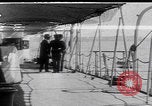
Commodore Dewey meets naval officers in Gibraltar
Commodore George Dewey onboard his flagship United States cruiser USS Olympia (C-6) during a trip back to the United States. Dewey is with other U.S. Navy officers on deck. Commodore Dewey also puts on his hat. Dewey walks back and forth deck before a group of men board the ship. The group of men take off their hats and greet Dewey. Commodore Dewey and some crew sail on a boat and land in Gibraltar. Officials in Gibraltar welcome Commodore Dewey. Dewey shakes hands with the officials. More Gibraltar officials board the ship to meet Dewey on deck. Commodore Dewey receives the Washington and New York committees of the Committee of Arrangements onboard the Olympia. Commodore Dewey takes his leave of the Washington Committee onboard.
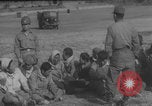
Soldiers guard refugees in Korea; President Kennedy inauguration speech
Soldiers guard a group of Korean refugees during the Korean War. The refugees sit on the ground. Hungarian rebels shoot behind a building between Károlyi and Cukor Street (Budapest, Károlyi utca 9, 1053 Hungary) in Inner City, Budapest during the Hungarian Revolution in 1956. In a devastated street, a tank rolls in, with Soviet soldiers sitting on top. Burned and abandoned tanks along Andrassy Avenue. Newspaper article titled “Khrushchev Hails New African States”. United States President John F. Kennedy delivers his inaugural speech from the East Portico of the U.S. Capitol in Washington, D.C. “We shall not always expect to find them supporting our view. But we shall always hope to find them strongly supporting their own freedom--and to remember that, in the past, those who foolishly sought power by riding the back of the tiger ended up inside.” President Kennedy said.
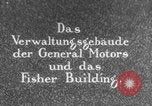
Bird's-eye view of the General Motors Building in Detroit, Michigan
Aerial view of Detroit, Michigan, late 1920s. Aerial view of the General Motors Building (Cadillac Place, 3044 W Grand Blvd, Detroit, MI 48202) by Albert Kahn located in the New Center area of Detroit.
CRITICALPAST.COM: About Us | Contact Us | FAQs - How to Order | License Agreement | My Account | My Lightboxes | Shopping Cart | Advanced Search | Featured Collections | Website Terms & Conditions | Privacy Policy ©2026 CriticalPast LLC.
License Agreement |
Terms & Conditions |
Privacy Policy
©2026 CriticalPast LLC.