


 Francais
 Deutsch
 Italiano
Refine Your Search
Hoboken New Jersey 1918 stock footage and images
- Showing 9217 to 9222 of 9472 results more
more Hide
Hide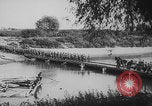
German troops cross temporary bridges in Poland during World War 2 occupation
During the German invasion of Poland during World War II, German army forces cross new temporarily built bridges. The troops are composed primarily of soldiers on foot, with horse-drawn supply wagons and some mounted cavalry. German troops crossing on a low and simply-made bridge with no guardrails. Debris in the water near the bridge. Horse-drawn wagons entering a different bridge. View of crooked rails on hastily-made bridges. A soldier on a bicycle rides up a muddy road beside a horse-drawn supply wagon. Another wagon ahead contains another bicycle. A third bridge is crossed. On the opposite bank, a wagon pulled by two horses speeds off the bridge, kicking up dust. A soldier runs behind. Horses run to pull wagons up a hill, and then slow at the top. The troops walk along a road.
Dr. Hugo Eckener, commander of German Zeppelin Hindenburg, (LZ-129) talks to journalists about his voyage to the United States.
Dr. Hugo Eckener (1868-1954) who commanded the German Zeppelin Hindenburg (LZ-129), describes the maiden voyage of the airship over the North Atlantic, and states his opinion that even in bad weather the Zeppelin would be able to successfully make regular transatlantic flights.
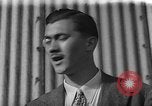
Author Leslie Charteris, a passenger on zeppelin Hindenburg's maiden voyage, tells of his experience.
Author Leslie Charteris (1907-1993), a passenger on zeppelin Hindenburg's maiden voyage, talks about his trip from Frankfurt, Germany aboard the airship. He says it is the most natural way to travel across the North Atlantic Ocean.

Father Paul Schulte describes the maiden North Atlantic voyage of the zeppelin Hindenburg at Lakehurst Naval Air Station.
Father Paul Schulte, a Roman Catholic priest from Germany, arriving at Lakehurst Naval Air Station aboard the German Zeppelin Hindenburg on the airship's maiden North Atlantic voyage, states that this is only his second trip to the United States. He would like to be able to have an airplane to explore "every nook and corner" of this country. He says "I don't like this country. I love it."
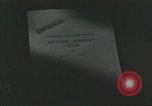
Battle off Empress Augusta Bay, during World War 2.
Night engagement off Empress Augusta Bay, during World War 2. Documents describing U.S. forces engaged in the battle. View of the Augusta Bay at dawn. Animation on screen shows the Guadalcanal naval battles and the attacks on Solomon Islands and Bougainville Island. A diagram depicts the movement of U.S. Navy Task Force 39 from Empress Augusta Bay to Shortland Island and diverting towards Treasury Island. Fleet of ships en route. United States B-24 Bomber in flight. Diagram shows the route of Japanese Forces and the United States Task Force 39. Fleet of Japanese ships on the way.

Distance, position and direction of ships at Empress Augusta Bay.
Fleet of United States Task Force 39 ships approach Empress Augusta Bay. Diagram depicts the distances of ships and the aircraft. View of a radar on screen. Diagram shows the direction and formation of ships follow. Fleet of on going ships. Cruisers open fire and explosions occur. Radar shows the range of Northern, Southern and Central groups. (World War II period).
CRITICALPAST.COM: About Us | Contact Us | FAQs - How to Order | License Agreement | My Account | My Lightboxes | Shopping Cart | Advanced Search | Featured Collections | Website Terms & Conditions | Privacy Policy ©2026 CriticalPast LLC.
License Agreement |
Terms & Conditions |
Privacy Policy
©2026 CriticalPast LLC.