


 Francais
 Deutsch
 Italiano
Refine Your Search
Hoboken New Jersey 1918 stock footage and images
- Showing 4771 to 4776 of 9472 results more
more Hide
Hide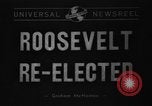
Americans vote in the 1940 Presidential election.
Newsreel opening slate reads: "Roosevelt Re-elected." President Franklin D. Roosevelt is seen in the back seat of an open car, accompanied by his wife, Eleanor Roosevelt and The President's mother, Sara Ann Delano Roosevelt, as they arrive at the town Hall in Hyde Park, New York, to cast their ballots in the 1940 Presidential election. Inside the hall, the President signs a voter registration log and is then seen entering a voting booth. Closeup of him with his mother and wife smiling after casting their ballots. View shifts to the President's car with license plate number 101, as they drive away, with Secret Service agents riding the running boards. Scene changes to New York City, where uniformed policemen control a large crowd gathered around a car carrying Republican Presidential candidate, Wendell Wilkie. He acknowledges the crowd of fans and then enters a voting booth to cast his ballot. As he leaves the polling place he again acknowledges the cheers of his supporters. Another change of scene shows an unidentified politician exiting a polling place and waving to a crowd. This is followed by a view of former New York Governor, Al Smith, who supported Wendell Wilkie. He is seen on a street, waving his hat. His wife, Catherine Ann Dunn smith, stands behind him. Next, several people are seen lined up outside a polling place. Inside, New York Mayor Fiorello LaGuardia is seen signing a registry of voters. Camera focuses again on Al Smith and his wife. He has a stogie (cigar) in his mouth and she wears a corsage and picture of Wendell Wilkie. Several views of unidentified political figures casting ballots. A room filled with reporters and photographers where election returns are being tabulated on a large board. Signs identify the news organizations, such as United Press and Associated Press. A group of persons occupying desks in an area with sign reading :"Tabulators." Closer view of the large board where returns from various voting precincts are being recorded in real time (1940 election). This the Republican Party headquarters. One side of the board has a picture of Wendell Wilkie and the other of his running mate, Charles L. McNary. People napping in some corners of the room as the night progresses. Final scenes show crowds in New York City's Times Square, celebrating the re-election of Franklin D. Roosevelt. News in lights on the New York Times building first spell out: "Roosevelt Carries New York," followed by "Re election of President Roosevelt." Cheering crowd gathered outside the Roosevelt Springwood estate in Hyde Park, New York. The Roosevelt family gathered together in front of the family home. Closeup of the President waving to the crowd.
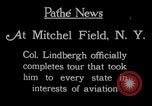
Colonel Lindbergh officially completes three month tour in his airplane 'Spirit of Saint Louis', at Mitchel Field, New York.
Officials and crowd assembled at Long Island's Mitchel Field to welcome Colonel Charles Augustus Lindbergh. Colonel Lindbergh's airplane 'Spirit of St Louis' pushed by men at airfield. Charles Lindbergh poses with an officer. Cameramen take pictures while Colonel Lindbergh gets into car.
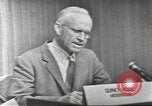
Vice President Nixon talks about Communist influence in the Western Hemisphere prior to presidential elections in the U.S.
The fourth presidential election debate held between Democratic nominee Senator John F. Kennedy and Republican nominee U.S. Vice President Richard Nixon in New York, United States on 21st October 1960. ABC news correspondent Quincy Howe speaks during the fourth Kennedy-Nixon presidential debate. He speaks that the candidates would answer and comment upon questions put by these four correspondents: Frank Singiser of Mutual News, John Edwards of ABC News, Walter Cronkite of CBS News and John Chancellor of NBC News. Frank Singiser puts the first question to Vice President Nixon. He asks Nixon the way he would handle Fidel Castro's regime and prevent establishment of Communist governments in the Western Hemisphere and why his policy is better for peace and security of the United States in the Western Hemisphere. Nixon answers that Senator Kennedy's policies and recommendations for the handling of Castro regime are dangerously irresponsible recommendations that he's made during the course of this campaign. Nixon speaks that what Senator Kennedy recommends is that the U.S. government should give help to exiles and to those within Cuba who oppose Castro regime, provided they are anti-Batista. Nixon says the United States have five treaties with Latin America, including the one setting up the Organization of American States in Bogota in 1948, in which the U.S. has agreed not to intervene in the internal affairs of any other American country. He further says that if the U.S. follows recommendations of Senator Kennedy then the country would probably be condemned in the United Nations and it would result in an open invitation to Soviet Premier Nikita Khrushchev to come into Latin America and to engage the U.S. in a civil war. He speaks about quarantining Cuban Prime Minister Fidel Castro by cutting off trade and diplomatic relations with Cuba.
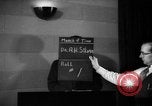
Doctor Abba Hillel Silver speaks for the United Palestine Appeal in United States.
National Chairman of the United Palestine Appeal, Doctor Abba Hillel Silver stands at a podium and gives a speech in New York City, United States. He holds several documents in his hands. A lamp on a wall in the background. He talks about the progress made for the resettling of Jews in Palestine. He states that they have acquired new land and 19 new settlements. New buildings and a new port at Tel Aviv have been constructed.
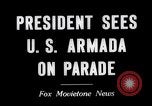
President Franklin D Roosevelt with his wife and Cabinet office-holders see U.S. Armada Parade.
United States President Franklin D. Roosevelt with his wife Mrs Eleanor Roosevelt and newly appointed Cabinet aboard the USS Indianapolis (CA-35) to view U.S. Navy maneuvers. U.S. Navy battleships, the aircraft carrier USS Lexington (CV-2) and other ships in New York Harbor. Officials including U.S. War Secretary George Dern, Secretary of Navy Josephus Daniels, Admiral Standley, and others can be seen. Biplane airplanes of the United States Navy fleet in a flight formation pass New York City. Troops on Governor's Island offer a salute. Views of skyline of New York City in the background. Views of large warships passing by with Statue of Liberty in the background. Numerous views of skyline of New York City with tall skyscrapers on Manhattan Island, as seen from ships moving in harbor.
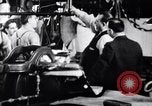
U.S. Labor strife - strikes and lockouts in the clothing industry in the 1920s
Post-World War 1 United States marked by labor-management strife and strikes, especially in the garment industry. Clothing workers are seen busy at their jobs in a factory in New York City. A man is seen symbolically closing and locking a steel door (narrative refers to a company "lockout.") Footage of police officers and crowd of laborers on New York City street. Police try to maintain order as crowds fill garment district streets in protest. Montage of persons awaiting a June 1921 decision by the Supreme Court of the State of New York, Kings County. Narrator announces that Justice James C. Van Siclen, has granted an injunction (against all picketing by the Amalgamated Clothing Workers of America). Narrator quotes Van Siclen's opening statement in the decision: "The court must stand at all times as the representative of capital, of the captains of industry..." View of Sidney Hillman, leader of the Amalgamated union (ACWA) sitting with other union members. View of a bustling New York City street lined with tenements and pushcarts in the lower east side of Manhattan. A man washing his face at a sink. A woman preparing a meal over a stove. Four children sharing a large bed. A gathering of idled clothing workers in a school room setting. Some in art classes. Dancers entertaining locked out workers. Young people presenting a puppet show. Narrator states that the lockout lasted 6 months, but the union prevailed. View of pleased union members.
CRITICALPAST.COM: About Us | Contact Us | FAQs - How to Order | License Agreement | My Account | My Lightboxes | Shopping Cart | Advanced Search | Featured Collections | Website Terms & Conditions | Privacy Policy ©2026 CriticalPast LLC.
License Agreement |
Terms & Conditions |
Privacy Policy
©2026 CriticalPast LLC.