


 Francais
 Deutsch
 Italiano
Refine Your Search
Hoboken New Jersey 1918 stock footage and images
- Showing 511 to 516 of 9472 results more
more Hide
Hide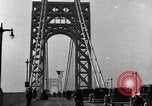
Formal opening ceremonies for the $60,000,000 George Washington Bridge over the Hudson River, New York City.
The George Washington Bridge oover Hudson River is open to traffic. Aircraft in formation overhead. Governor Franklin Roosevelt of New York and Governor Morgan Larson of New Jersey greet each other. The bridge is opened for motorists.

Ralph Heinzen gives an intelligent analysis of internal conditions in Germany as SS Gripsholm arrives in New York (WW2)
SS Gripsholm (Ship) arrives in New York, United States in World War II. Cameramen take photos as SS Gripsholm as it arrives at New York harbor. The rails are crowded with Americans. She docks at Pier F in Jersey City and ambulances roll away with wounded soldiers. Six hundred and sixty-two repatriates from German internment camps come ashore. S. Pinckney Tuck, excharge d'affairs in Vichy seen. Douglas MacArthur (General Douglas MacArthur's nephew), approaches with his dog. Passengers are happy to come in home. Ralph Heinzen of the United Press gives an intelligent analysis of internal conditions in Germany today. Stalingrad was the turning point, he states. Germany began losing the war with that defeat and Hitler started losing prestige.
Early Bell Laboratory technology in computer art and computer animation for communication, advertising, motion pictures.
Computer screen showing animation of a silhouette of a man running. Narrator states that the first such image was generated at Bell Telephone Laboratories in New Jersey in the early 1960s. More views of the so called "Olympic Runner" graphic design generated by the Bell Laboratories newest digital computer. Colors like pink, blue and red are used in the early, historic computer art and animation technology. Men seated in a control room, interacting with the digital computer and other animation and recording hardware. Views of computer monitor screens and discussion by narrator about various visual forms created by computers. Various computer generated images are shown on the screen. Engineer stands in front of video tape machine where the images are being recorded. More computer and animation hardware is shown including an Animation Aid. Narrator describes process of photographing analog computer art work onto motion picture film and then enhancing it with color choices. Engineer is seen operating camera, and then a close up view of motion picture film running on machines and on reels. Animation and color consultant in discussion as they stand over some frames of the film that they have isolated. Sample work of early computer artists is shown, with moving animated art seen on screen, combining color and motion in new ways that were not possible before the digital computer. Another view of the video tape machine operating. Narrator discusses use of the computer also in development of computer generated music that accompanies the visual images. Animated clock is seen. Different kinds of animations are seen.
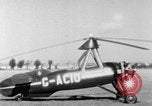
Cierva C30 Autogiro parked at airfield. Autogiro lands on roof of new Post Office Building in Philadelphia, Pennsylvania, USA.
Cierva C30 Autogiro (G-ACIO) built by British A.V. Roe & Co. is seen parked at Air Park, London, England. Several views of the autogiro. Scene shifts to aerial view of the new Federal Post Office building in Philadelphia, Pennsylvania, U.S.A. A Kellett autogiro lands on the building roof, on May 25, 1935,as part of dedication ceremonies,for the new Post Office building. Officials stand on the rooftop watching the landing. The pilot delivers a mail pouch to James A. Farley, the U.S. Postmaster General, thus initiating airmail service between Camden New Jersey and Philadelphia. Aerial views of the Post Office building and surrounding downtown Philadelphia. The autogiro climbing steeply away.
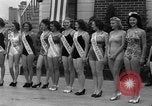
Miss Ohio Marilyn Meseke wins Miss America contest and poses wearing a sash in the United States.
Marilyn Meseke wins 1938 Miss America. The contestants wearing costumes lined up during the pageant at the Steel Pier (1000 Boardwalk, Atlantic City, New Jersey, U.S.) in Atlantic City, New Jersey. Miss Ohio Marilyn Meseke wins. Marilyn with Miss America crown. The winner poses with a sash.
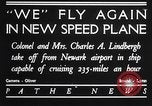
Colonel Charles A. Lindbergh and Mrs. Anne (Morrow) Lindbergh take a flight in a Lockheed 8A Sirius (Altair) airplane
Spectators watch as Charles A. Lindbergh and his wife, Anne Morrow Lindbergh, arrive by car at the Newark, New Jersey airport, where they are to try out a new Lockheed Model 8A Sirius ( Altair ) airplane, the first model equipped with retractable landing gear. Mrs.Lindbergh climbs into the rear cockpit and closes her canopy. Colonel Lindbergh converses with a Lockheed official as he climbs into the front cockpit. The aircraft taxis out and takes off. (Note: This is not the Lindberghs' airplane. This aircraft displays "NR-119-W" on its tail. It was actually purchased by the U.S. Army Air Corps as USAAC Y1C-25, number 32-393, and was damaged beyond repair in a belly up landing accident at Wright Field, Ohio, in June, 1932.)
CRITICALPAST.COM: About Us | Contact Us | FAQs - How to Order | License Agreement | My Account | My Lightboxes | Shopping Cart | Advanced Search | Featured Collections | Website Terms & Conditions | Privacy Policy ©2026 CriticalPast LLC.
License Agreement |
Terms & Conditions |
Privacy Policy
©2026 CriticalPast LLC.