


 Francais
 Deutsch
 Italiano
Refine Your Search
Hoboken New Jersey 1918 stock footage and images
- Showing 517 to 522 of 9472 results more
more Hide
Hide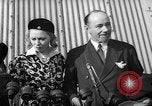
Sir Hubert and Lady Wilkins are interviewed upon arrival in the U.S. aboard the German Zeppelin Hindenburg
Australian explorer, Sir Hubert Wilkins, and his wife, Suzanne (Bennet) Wilkins, arriving at Lakehurst, New Jersey, aboard the Zeppelin Hindenburg (LZ-129). They are interviewed about their impressions. Sir Hubert talks about enjoying this trip just as much as they enjoyed travel on the "old Graf Zeppelin." But he notes the accommodations and comfort aboard the "New Hindenburg" were even better. Lady Wilkins also praised the Hindenburg airship. She tells about a storm that had no effect on the ship or passengers, noting that nobody suffered motion sickness. (Their remarks are repeated in successive takes.)
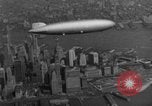
Final flight of the airship Hindenburg, then it bursts into flames when landing
The German rigid airship Hindenburg on its final flight. Views of the airship flying over Manhattan Island, New York City. Swastika symbol visible on the airship's tail section. The airship descending for landing at Lakehurst Naval Air Station in New Jersey. Views of the passengers in the windows waving to the onlookers on the ground. Explosion and massive fire and smoke consumes the airship. It crashes to the ground in flames and collapses. Rescuers in the foreground run toward the burning wreckage.
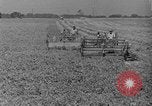
Mechanical pea harvesting, aerial spraying, freezing and dehydrating of the vegetables at a cannery in the U.S.
New methods of farming in the United States. Mechanical pea harvesters used at Seabrook Farms in New Jersey. A fleet of crop dusting biplane airplanes on the ground. An airplane taxis on the farm. Aerial spraying of insecticides by the airplanes. A cannery. The cannery in operation: Men and women workers prepare to can the food. A worker at a machine in the cannery. Vegetables are dehydrated and frozen.
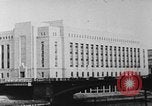
U.S. Postal Service initiates autogyro mail service between Camden,NJ and Philadelphia, PA. during dedication of new PO building
Ground view of the new Federal Post Office Building in Philadelphia on the day of its dedication,May 25, 1935. Aerial view of the top of the building as a Kellett autogyro lands on the roof. Post office officials and others stand in a line back from landing area. More aerial views of the building and environs. On the roof, the pilot initiates autogyro mail service from Camden New Jersey, by delivering a mail pouch to Postmaster General, James A. Farley, who is surrounded by other officials. Again, more views of the building and environment. The autogyro making a steep ascent from the rooftop.
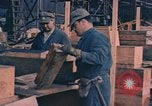
Keel laying and construction of the nuclear-powered commercial ship, NS Savannah.
Keel laying of the nuclear-powered cargo and passenger ship, NS Savannah, at shipyard of the New York Shipbuilding Corporation, Camden New Jersey. Mrs. Pat Nixon, wife of Vice-President Richard M.Nixon, is seen at the keel laying of the ship, a center piece in President Eisenhower's "Atoms for Peace" initiative. Scene at the Babcock and Wilcox company, where steel parts are being fabricated for the Savannah's nuclear reactor. The reactor head being molded. Uranium oxide fuel pellets being manufactured. Core filled with fuel pellets being lowered into the reactor. Animated diagram illustrates how the ship's reactor and propulsion system will work.View of shock-absorbing collision protection and radiation shielding being placed around the reactor shell. views of the ship under construction in the ways at the shipyard.Views of the ship's turbines manufactured by the De Laval Steam Turbine Company. A technician uses a brush to dust the precision gears of the DeLaval manufactured turbines. Meshed gears turning.
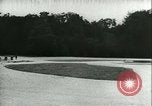
World War 2 German soldiers demolish memorial dedicated to Marshal Ferdinand Foch and the German surrender of 1918.
Germans demolish memorial dedicated to Marshal Ferdinand Foch and the German surrender in 1918. The memorial with Ferdinand Foch's statue at the center. A soldiers stands near an engraved stone on the ground. German soldiers dig with shovels and pickaxes. The memorial and a building there are blown up. Smoke from the explosions.
CRITICALPAST.COM: About Us | Contact Us | FAQs - How to Order | License Agreement | My Account | My Lightboxes | Shopping Cart | Advanced Search | Featured Collections | Website Terms & Conditions | Privacy Policy ©2026 CriticalPast LLC.
License Agreement |
Terms & Conditions |
Privacy Policy
©2026 CriticalPast LLC.