


 Francais
 Deutsch
 Italiano

Refine Your Search
Hoboken New Jersey 1918 stock footage and images
- Showing 583 to 588 of 9492 results more
 Hide
Color Sound
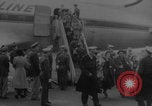
Hungarian refugees escaping from 1956 Hungarian Revolution arrive in Camp Kilmer; President Eisenhower during his second inaugural speech.
Hungarian refugees from the October 1956 Hungarian Revolution (also called Hungarian Uprising) disembark from an American Airlines plane after landing safely in the United States. Entrance to Camp Kilmer, New Jersey, where the Hungarian refugees were resettled. Hungarian refugees get off a bus. A Hungarian man holds his infant daughter with a pacifier. The camera moves to another Hungarian man, wearing a black hat. A Hungarian girl smiles, some of her front teeth missing. United States Army Sergeant Stuart Queen speaks to the camera. United States President Dwight D. Eisenhower speaks during his Second Inaugural Address at the East Portico of the United States Capitol in Washington DC. View of a radio tower. Radio tower view from the inside. View of the top of the Chrysler Building in New York City. Cars pass by modern apartment blocks with antennas on top of building. Television antenna on house roof. Man adjusts television as his wife watches from their couch in living room. A man and his wife, holding their baby, watches the inauguration speech of United States President Dwight D. Eisenhower on television from their family living room. Two women and a child watch United States President Dwight D. Eisenhower’s speech on television. Family of a woman and her children listen to Eisenhower’s speech from a radio in their living room. Bombing on a street in Budapest during the 1956 Hungarian Revolution. Men firing in Budapest. A tank fires in a park. Apartments getting devastated from firing. Hungarian man aims his gun and fires at a car. Men fire on a Budapest street. Doctor and paramedics carry an injured on a stretcher behind a tank. “Budapest is no longer merely the name of a city, henceforth it is a new and shining symbol of man’s yearning to be free”, said United States President Dwight D. Eisenhower from his second inaugural speech.

A thief snatches purse from woman, spot maps, city construction and razing.
Street signs showing New Jersey Avenue and N.W. L Street in Washington DC at night. A thief snatches a purse from a woman waiting at a bus stop at night. Woman attempts to run after thief. Hands searching a a street location file cabinet at police headquarters. A police officer pushes pins into an Oakland, CA spot map. Highway engineers consults a spot map in urban traffic planning. Engineer's hands using ruler for a new traffic plan Vacant lot with a frozen puddle and discarded tire in the Washington, D.C. area. A small house sitting beside a new modern building under construction at N Taylor Street and 4201 Lee Highway Arlington, VA 22207 Sign hanging outside 4201 Lee Highway apartment building reads, “NOW RENTING RENTAL OFFICE OPEN WEEK-ENDS”. In a Washington D.C. street with row houses, a dilapidated house bears a sign saying, “Rooms and Apts. Apply ACME RENTAL COMPANY 1011 7th ST., N.W.”. A closed factory with boarded windows. Some glass windows shattered in factory building. Wrecking ball smashes a wall in a derelict building being demolished in an urban renewal project. A police officer inspects a building at night. View of a Police Beat Location map color-coded according to level of police activity with montage of police on patrol in the city.
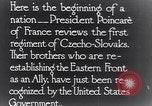
President Raymond Poincaré of France reviews Army Regiment from Czechoslovakia upon France's recognition of that nation on June 30, 1918.
Raymond Poincaré, President of France, strides in a field with Czechoslovak and Allied Armed forces officers, reviewing the 21st Regiment of Czechoslovak legionnaires, who are in formation, at attention, presenting arms. Official guests at the ceremony include Edvard Beneš and other officials of the Czechoslovak National Council. Views of a Czechoslovak soldier holding aloft a banner presented by President Poincaré that was designed by Czech painter František Kupka, as a gift from the city of Paris. The banner being held aloft as reviewing officers stand at attention. View from rear of the Regiment in formation. Several views of the Regiment parading on the field behind a color guard holding the new Regimental colors.

Armistice brings WWI fighting to an end, on November 11, 1918. German troops surrender. American troops leave combat zones.
Armistice ends hostilities of World War I. German troops surrender and large groups of Germans marching. American flag hoisted to symbolize Allied victory. American troops leave the war zone. People all over the world celebrate the end of war. People gather in New York to celebrate the end of World War I, smiling and waving happily.
Specialists at the Kessler Institute for Rehabilitation help the disabled and handicapped to recover.
Handicapped and disabled people at Kessler Institute for Rehabilitation, West Orange, New Jersey. A musician who met with a swimming pool accident plays an instrument with sticks. A physically handicapped boy reads a book. A man at the center is tested on Kohs block intelligence test. A woman puts on makeup after recovering from an accident. The founder, Dr. Henry Kessler talks about special training to be given to the patients to recover from disabilities. Specialists including physical therapists at Kessler Institute help the disabled recover. Disabled clients receiving therapy. A new leg is given to a woman who met with an accident and she takes her first step. Kessler specialist helps the woman to walk again properly.
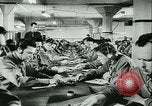
U.S. Army Signal Corps officers train at Fort Monmouth and production of signal communication items in the United States.
The role and contribution of the U.S. Army Signal Corps in combat and war. U.S. Army Signal Corps officers train at the Signal Corps Officer Candidate School (OCS) Fort Monmouth, New Jersey. Officers train at telegraph machines under the supervision of an instructor. Officers seated at desks in a classroom. Instructors take classes with the help of charts, diagrams and black boards. Officers seated atop electric poles for training. Two officers train in hand-to-hand combat at the OCS. Officers learn to use Radio Relay. Students listen to an instructor as he demonstrates the process. A U.S. soldier lays field wire across a hilly terrain to establish wire communications in the European Theater during World War II. Soldiers on the hill. Soldiers set up a sending station at the point where the wire can't go forward. A receiver is set up at the point from where the wire can go forward again. A soldier receives a photograph of a map through facsimile. Items of signal communication including radio relays, receivers, walkie-talkies, radio boxes and fuses to be produced and distributed by the USA Signal Corps to all other ground forces, navy and the Allies. New, modern, improved efficient signal communication equipment. A soldier displays two old type fuses and their counterparts.
CRITICALPAST.COM: About Us | Contact Us | FAQs - How to Order | License Agreement | My Account | My Lightboxes | Shopping Cart | Advanced Search | Featured Collections | Website Terms & Conditions | Privacy Policy ©2026 CriticalPast LLC.
License Agreement |
Terms & Conditions |
Privacy Policy
©2026 CriticalPast LLC.