


 Francais
 Deutsch
 Italiano
Refine Your Search
Hurtgen-Forest stock footage and images
- Showing 547 to 552 of 753 results more
more Hide
Hide
Shows the importance and application of camouflage techniques during combat in World War 2.
A film 'Camouflage in Combat' underlines the importance of tactical exploitation and counteraction of shadows and use of nets, underbrush and other camouflage during World War II. The film shows U.S. soldiers going into a theater in the United States and watching a movie 'Camouflage'. The movie shows a soldier in a forest. He is shot down. A soldier approaches him. He looks skywards. He applies mud on his face to camouflage himself. Soldiers paint each other's faces with GI paint. On 5th June 1944, fully camouflaged Airborne and pathfinder U.S. paratroopers preparing for D-Day invasion jump over Normandy, France. Soldiers with camouflaged helmets. A soldier camouflages his helmet with grass and twigs. A soldier on an island with his helmet camouflaged with grass and twigs found in the area which gives him a perfect blend. U.S. soldiers with camouflaged helmets in France. A camouflaged tank rolls. An officer inspects soldiers standing in a line. Their helmets are camouflaged. A U.S. soldier hiding in shadows in Casino, Italy fires his gun. His ring sparkles. A soldier in a prone position fires. A New Zealand soldier fires while in shadows.

Primitive means of transport like sleds, stagecoach, mules and schooner being used by men in the United States.
A film titled 'The Story of Transportation' dramatizes the primitive and ancient means of transportation in the United States. Dramatization depicts a man as Aladdin with a lamp. He rubs the lamp and Jinny appears. Aladdin seated in a palace. An old man roaming about in a forest. Mules and camels carry load on their backs. A group of primitive men push a sled. Dogs pull sled carts. Schooners and stage coaches are used as means of transport. A sketch of a steam locomotive.

Scenes of British Borneo under Japanese occupation during World War II
Opening scene shows map of Borneo, with several locations marked. A group of Japanese soldiers stands on a boat moving away from a wharf, during World War 2. Across from them a group of others, dressed in white shorts, shirts, and white hats, along with several Japanese soldiers, stand on the wharf. They wave farewell to the Japanese soldiers, some by saluting, others by raising and tipping their hats. The next scenes are taken from the moving boat and show a river and surrounding forests. View into the boat, where soldiers are seated. Very long canoes carrying many local persons wearing large conical straw hats pass nearby at high speed. A canoe, with roofed structures, navigates past a rock jetty in fast moving river waters. Japanese soldiers in pith helmets disembark from docked canoes and make their way uphill toward a camp. Sign identifying the camp. View from above, of barracks buildings at the camp. Camera pans across a wide region of landscape. Natives standing on platform, built around a huge tree, are chopping the tree down, under supervision of Japanese soldiers nearby. Closeup of the men chopping the tree. Views of the tree falling. Local farmers working in an irrigated rice paddy. Camera pans across a number of paddies. Buildings near the rice paddies.
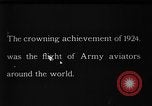
U.S. aviators are welcomed at different places during their journey around the world.
A flight around the world. A globe rotates. U.S. President Calvin Coolidge bids goodbye to army airmen. The President and Major General Mason Patrick and the fliers on a lawn of the White House, Washington DC. The journey starts from Seattle, Washington. Douglas World Cruisers ( DWC ) in flight. The DWCs parked in a bay. A forest in the background. They arrive at Chignik Bay, Alaska. The aircraft in flight. An iceberg. Lieutenant Lowell Smith stands on one of the pontoons and works with propellers on his DWC. The DWCs in flight from America to Asia. The aviators are welcomed by Japanese officials in Yetorufu, Japan. Japanese children playing in a school yard. A child has a Japanese and a U.S. flag, one in each hand. They reach Hong Kong, China. A fleet of native junks to welcome them. In Calcutta, India , a DWC taxis on water. A large number of people gather around a DWC. A crane lifts a DWC out of water. The aviators land in Constantinople. People around the aircraft. They reach Paris, France.. Aerial views of the city. Mrs. Maclaren congratulates the airmen in London, England. The crew of USS Richmond cheers the aviators. The aviators board their aircraft from a small boat. People watch as the aircraft land in Labrador, Canada. The DWCs are anchored in a bay and the aviators are brought to the shore in a boat. Naval officers greet them. The aircraft in flight over the Boston skyline. A motor launch in Boston Harbor. The DWCs land on water. The aviators arrive at the dock in the motor launch and are greeted by officials. They fly over New York. A large crowd greets the aviators at Mitchel Field, Long Island. They arrive at Bolling Field in Washington and are congratulated by President Coolidge and U.S. Secretary of War John Wingate Weeks. The three DWCs are followed by an XNBL-1 Barling bomber in flight in Dayton. Lt. Jack Harding is welcomed home. The world flight ends in Seattle, Washington. Photographers click pictures as a DWC lands. Major Martin greets aviators standing beside a DWC.
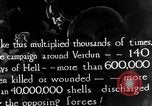
Scenes of battle during World War I. Signing of the Kellogg-Briand Pact in 1928
Opening scene shows a British Siege battery of several 9.2 inch howitzers. View from a protected position, of a huge shell exploding. A formation of French Spad airplanes in flight. A French Renault F-17 light tank traversing rough terrain near a forest. Bombs being dropped by hand from an open cockpit airplane. Three bombs exploding on the ground. German troops running past the camera. Glimpse of others in a trench in the background, who appear to be wearing Pickelhauben. Explosions with dense white smoke. A fallen soldier on a litter, on the ground. Nighttime view of artillery flashes. Troops silhouetted against fires burning in the background as they move at night. Smoke blowing across the scene, as artillery fires. A railroad gun firing. A battery of two French 320 mm railway guns. A shell exploding in a field. French 320mm gun firing. Two French 370mm railway guns. One is firing. A soldier sheltering in a deep shell hole and smoke rising all over No-Man's Land. Wounded soldiers recuperating in a hospital. Patients and medical staff posing for photographs in a ward. Signing of the Kellogg-Briand (Pact of Paris) outlawing war, on Aug. 27, 1928, at the Palais D'Orsay, in Paris, France.
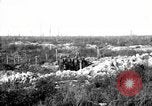
U.S. troops fire a mounted gun from a dugout in France during World War I.
The American Expeditionary Forces ( AEF ) in France during World War I. Troops of the 35th Infantry Division, the 2nd and the 148th Field Artillery Regiments and the 56th Engineers in a forest. They fire a mounted gun from a dugout. A downed aircraft.