


 Francais
 Deutsch
 Italiano

Refine Your Search
Iran 1951 stock footage and images
- Showing 13 to 18 of 1204 results more
 Hide
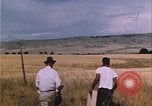
Extreme grasshopper outbreak and emergency control efforts using new insecticides in the United States, 1951
From a Bureau of Entomology and Plant Quarantine (BEPQ) film on grasshopper plagues, made in 1951 in the United States. Men from BEPQ egg survey teams use shovels and wire baskets to dig up and sift through earth, searching for grasshopper eggs. Close up of hands working on the dirt. Grasshopper insect eggs in hand. Narrator notes that the teams have discovered unusually large egg populations. Scene changes to printing of warning papers containing information on a possible grasshopper outbreak. Close up of man from Grasshopper control on the telephone, warning about the possible outbreak. Close up of paper being printed, hands typing at a typewriter, and words on the papers. Maps containing information on the possible grasshopper infestation are created and printed. A team of men pore over maps, planning for the potential outbreak. Truck drives through green field, team of men perform a spot check to determine the status of the outbreak threat, swiping nets back and forth to catch hoppers. An outbreak is confirmed. Scenes of hoppers flying in swarms above farm crop fields. Officials review and plan for the outbreak at a table. A convoy of trucks carrying equipment drives down a roadway. Mixing stations for production of new insecticides are established. A man moves material with a wheel barrow. Belt conveyor moves materials for the fabrication of insecticides. Bran and sawdust loaded into a truck and stockpiled at an emergency station. Surveyor at work collecting grasshoppers. Chartered aircraft are loaded with pesticide and fly over fields, dusting the crop to save the harvest and prevent the spread of grasshoppers. Insect bait is prepared in a mixing machine for less infested areas. Farmers spread bait and insecticides on their crop. Close up of dying grasshopper. Swarms of grasshoppers in the sky, grasshoppers feeding on crops. Mixing and loading of insecticide into planes. Planes fly over crops, dusting them Trucks and vehicles drive across fields spreading bait and insecticide. Dead grasshoppers in piles on the ground. Close up of farmers reviewing and writing on documents. A single hopper slowly moves on the ground, another dying nearby.
Review of the threat of grasshoppers to United States cropland and insecticide control measures, 1951
Close up of grasshopper insect head, from a Bureau of Entomology and Plant Quarantine short film on grasshopper plagues, made in 1951 in the United States. Illustration graphic of the United States shows various crops and areas affected by grasshopper pests, all across the United States. Rolling animation of figures showing economic loss. Grasshoppers feeding on farm crops. Close ups of farmers, some of whom smoke cigarettes. A farmer walks through his field. Close up of farmers inspecting their plants. A farmer spraying crops with insecticide by hand. Various scenes of farmers spraying insecticides from vehicles. Dying, twitching grasshopper, followed by ending scene of the film.

U.S. Marine Corps raise American flag on Mount Suribachi in Iwo Jima during World War II; and original statue unveiling at Quantico in 1951.
A film titled 'Uncommon Valor' about the raising of the U.S. flag by U.S. Marines on Iwo Jima, Japan during World War II. United States naval fleet underway off the coast of Iwo Jima. U.S. Army Air Forces aircraft in flight. U.S. 4th and 5th Division Marines disembark from a ship and get onto landing crafts as they head towards the Iwo Jima shoreline. Marines land ashore and advance inland. They raise the American flag on Mount Suribachi. A newspaper boy sells newspapers on a street in the United States. A picture of the raising of the flag on Mount Suribachi. View of sculptor Felix De Weldon as he carves a sculpture of the flag raising event. Scenes from the unveiling and dedication ceremony of the original limestone statue on November 10, 1951, at the Marine Corps base in Quantico, Virginia, for the 176th anniversary of the founding of the Marine Corps. (The version of the statue seen in this footage had been placed in front of the Navy Department Building at the intersection of Constitution Avenue and 19th Street Northwest, Washington, D.C on 10 November 1945. It features 9 foot figures at 1.5 times life size scale. This sculpture was moved to Quantico Marine Base on 17 November 1947. It had been originally constructed by De Weldon of Indiana limestone, cement, and sand due to a lack of bronze during the war. At the time of its move to Quantico in 1947, the statue had deteriorated due to weather. Also, coats of paint to give the look of bronze had hidden much of the detail and had to be removed. Felix de Weldon supervised the repairs at Quantico before the statue was officially dedicated at the main entrance of Quantico on 10 November 1951, as seen in this ceremony). Officers lined up at the ceremony and many guests in the audience. A parking lot seen in the distance behind the assembled crowd. Cover sheets being removed as the war memorial is unveiled at Quantico.
X-15 on ground. Bell X-1 mach 1, October 14, 1947. The X-1D, nose wheel collapse, July 24, 1951
The high frontier of X-15 in United States. Rocket powered aircraft X-15 is towed and taken out from a hangar. Various symbols on X-15. A sign reads 'North American Aviation Inc'. Models of aircraft from earliest to most recent are shown. B-29 launching Bell X-1 rocket plane on October 14, 1947. View inside cabin of B-29. Airspeed indicator in the X-1 shows Mach 1 plus. View of X-1D rocket plane landing in Mojave desert, July 24, 1951, as nose wheel collapses and the plane sends up plumes of sand as it spins around before coming to rest, facing backwards. Test pilot Jean Ziegler is seen afterwards in the cockpit, breathing a sigh of relief. Jet fighter seen exceeding mach 2 airspeed. Animation of B-52B Stratofortress launching X-15. and its landing on desert.

Scenes from parade celebrating General Douglas MacArthur in 1951 and from his funeral procession in 1964
Opening scene shows ticker tape parade for U.S. Army General Douglas MacArthur underway in New York City on April 20, 1951. General MacArthur waves to parade attendees from back of an open car. Scene shifts to funeral procession for General MacArthur on April 11, 1964, in Norfolk Virginia. Honor guard accompanies his caisson. Mourners including his wife Jean MacArthur and son Arthur MacArthur IV walk in a procession during the funeral ceremony. The casket of General MacArthur covered by a U.S. National Flag.
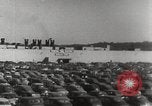
The new (circa 1951) GE jet engine plant at Lockland, Ohio. Engines being assembled. Various aircraft using GE engines
Views of the new (1951) GE jet engine assembly plant at Lockland Ohio. Animated description and U.S. map showing numerous suppliers across the country that contribute parts for the jet engines assembled at the GE Lockland plant.Views inside the plant, with engines being assembled. GE staff members, including chief engineer, Donald F. Warner, are seen in the plant. Various U.S. jet warplanes taking off, including: Hughes XF-91; North American F-86D Sabrejet ; Martin XB-51; North American B-45 Tornado; Boeing B-47 Stratojet bomber; and Convair B-36.