


 Francais
 Deutsch
 Italiano

Refine Your Search
Iran 1951 stock footage and images
- Showing 19 to 24 of 1204 results more
 Hide

The U.S. Navy submarine, Redfin, at the Philadelphia Navy Yard, in May, 1951, being converted into a radar picket boat.
View from above of the U.S. Navy Gato class submarine Redfin, at the Philadelphia Navy Yard, where it is being converted to a radar picket boat. Workers stand above the hull, which has been cut in half. Next, the two halves of the hull are seen being moved apart to facilitate addition of a 34 foot extension in the hull between the control room and the forward batteries. View of derricks and cranes around the Redfin and of Workers standing atop the boat's hull. Camera pans to closeup of one half of the boat as it is being winched away from the other, along a steel rail. View from below the bow. View from floor showing the two halves of the hull separated. Workers sketch diagram in chalk on floor of drydock. Scaffolding shown in place around the opening between the hull halves. Worker cutting steel plate with acetylene torch. A steel plate affixed to the hull, showing the name, USS Redfin (SSR-272) and the schedule for the project. The only item completed is the start date of May 1st. Workers engaged in fabricating the new section of hull.
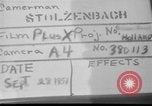
Dutch soldiers practice defending Gilze Rijen Air Base in Holland, during NATO exercise Cirrus, in 1951
Film starts showing Dutch soldiers in a group awaiting signal to begin their exercise. Then the jump up and run to various defensive positions, already prepared with slight berms and camouflage. They take up firing positions in these sites. Most carry rifles similar to Lee-Enfields. But some are equipped with antitank weapons. Closeup of Dutch soldier manning an 84mm antitank weapon. Scene changes to soldiers at camp, where a tent, a shed, and a building surrounded by scaffolding, are seen. Soldiers neat the tent have placed a very long ladder against a tree. Closer views of soldiers in and around the tent. A Dutch officer speaks with a group of Soldiers. Next, a group of soldiers is seen running along a path, where several pup tents have been pitched. The occupants of one tent grab their weapons and join the group that is now assembling in loose formation.
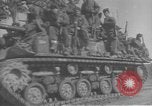
UN Operation Doughnut designed to seize dominating terrain of Sobang Mountains around the Iron Triangle, 1-4 July 1951
U.S. forces on the move to encircle the Iron Triangle, and blast the enemy from the hilltops during the Korean War. The first scene shows a U.S. Sherman tank carrying about 15 American infantrymen who occupy every possible space atop the tank. It is followed by a Patton tank, also covered with American infantry getting a ride. Fuzzy view of a tank in field with traces of snow. U.S. gun crew firing a towed field howitzer. Closeup of American Lieutenant commanding artillery. He is using a field telephone. Another crew firing a mortar. Shells exploding on the hilltops. U.S. soldiers observing with binoculars from a bunker. Numerous explosions of many kinds of ordnance in the hills. Soldier firing a 30-caliber Browning air-cooled machine gun. Another American soldier firing a sub-machine gun. Other infantrymen firing fully automatic rifles. A U.S. Air Force F-51 Mustang fighter plane drops napalm on a target. Another Mustang fighter dives low to fire rockets and strafe an enemy position. Many more views of American artillery, tanks, and machine guns firing at the hills. Infantry move uphill to occupy the hilltops. Two are seen carrying flame throwers. As the infantry enter woods on a hillside, a flamethrower is employed. Troops in a sandbagged position in a town. Sick and wounded Korean civilians lie on litters in a paved area from where they are being placed into trucks.
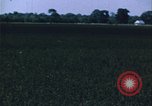
Grasshopper plague devastates the Great Plains of the United States, 1951
Scenes from a U.S. Bureau of Entomology and Plant Quarantine film. View of green plains with grasshoppers flying about. Various shots of dead corn, alfalfa, small grains, and other trees and shrubs, all ravaged by grasshoppers in the Great Plains of the United States. Two men walk along a fence line in the midst of a dust storm. Shot of ruined fence. Illustrated graphic map of the United States outlines regions which were previously affected by grasshopper plagues. Illustration of a grasshopper placed over top of the graphic, entire western United States highlighted. Narrator notes that plagues have caused millions of dollars in agricultural damages. Zooming shot on record book containing figures representing agricultural economic loss for individual states. Scene changes to swarms of grasshoppers crawling and flying in mass, followed by shots of destroyed farm crop land, trees, and eroded river bank.
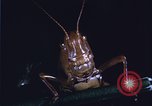
Major crop-damaging grasshopper species and their effects, 1951
From a United States Bureau of Entomology and Plant Quarantine film on grasshopper plagues. Close up of brown grasshopper, mandibles moving. Side view shows developed hind legs, allowing strong leaping abilities. Grasshopper ravaging farm crops and shrubs. Swarm of grasshoppers. Narrator notes that just five species of grasshoppers are responsible for at least ninety percent of all damage done to cultivated crops. Overview and close ups of each of the five species: Migratory grasshopper, Differential grasshopper, Two-striped grasshopper, Red-legged grasshopper, and Clear-winged grasshopper. View of dry, dead crop field. Cattle are herded into a pen, narrator notes that grasshoppers also cause millions of dollars in damages to range and pasture. Graphic map of the United States, Gulf states highlighted. Man speaks about the grasshoppers. Grasshoppers eat farm crops in the fields of the Gulf states. Graphic map of U.S. shows northeast states highlighted. Grasshopper insects eat and destroy crops.
Grasshoppers eating a variety of crops across the United States, 1951
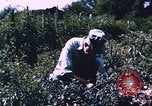
From a U.S. Bureau of Entomology and Plant Quarantine film. Farmer picks crops in a farm field, speaks about grasshopper damages which is expected each year and written off before harvest. Illustrated graphic map of the United States shows crops of different regions and highlights that grasshoppers affect all areas. Close up of grasshoppers feeding on many types of staple crops. Scenes of feeding and destroyed plants. Scenes of grasshoppers eating more unconventional foods such as wood and tree bark, in hot and dry climates. Green and brown grasshopper insects pictured.