


 Francais
 Deutsch
 Italiano
Refine Your Search
Iran 1951 stock footage and images
- Showing 211 to 216 of 1204 results more
more Hide
Hide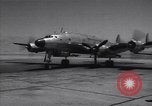
W Averell Harriman, Marie Norton Whitney Harriman, arrive in Tehran
A U.S. Air Force C-121 aircraft taxis after landing in Tehran, Iran. Another plane in the background. United States politician W. Averell Harriman descends stair from aircraft followed by Mrs. Harriman and others. United States Ambassador to Iran Henry Grady greets them. A man welcomes them with flowers. Photographers and crowd gather.
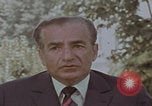
Iranian teacher training, students in class, farmers.
Shah of Iran, speaks about gender equality and education in Iran. Iranian young women attend school and recite in class. A young woman reads aloud from her book. Young women training as teachers walking from school after class. They are wearing traditional Iranian gowns and carrying books. The women board a school bus. Iranian students attend class. An elementary teacher reads to the class. View of a remote desert road in Iran. Water flowing from irrigation system in Iran. View of the countryside as seen from a moving vehicle. Crops growing in farm field. Cotton branches on display. Sunflowers growing in field. Wheat stalks in the wind. Iranian farmers tending wheat and other crops. Farmer tills the land with tractor. Tree lined road.
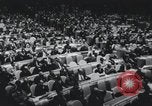
Mao Zedong's stand on war, China's foreign policies and aggression towards neighboring nations.
Propaganda piece about living conditions in the People’s Republic of China under Mao Zedong, with images photographed by Indians visiting the country. Delegates from all over the world at an international conference. Representatives from Iraq, Canada, Romania, Australia, and Pakistan among others. Elderly Chinese communist revolutionaries pose. Mao Zedong's views (according to a narrator) are presented: He believes that war in inevitable between capitalist and socialist nations. View of a rally and military parade in China. Explosions during the Korean War in 1951 with Chinese troops in action. In Tibet, homeless, displaced Tibetan children and families after the Chinese take over in 1959 as part of Communist China expansion. Indian Army soldiers return after China's attack on India during the Sino-Indian War in 1962. View of Soviet Union Premier Nikita Khrushchev. Map of Asia depicts Chinese aggression towards its neighbors. Explosions during the Chinese aggression in Vietnam and Laos. Mao Zedong intent on risking a war with the West.
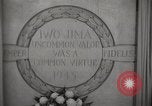
Dedication of Marine Corps War Memorial at Quantico Virginia, and sculptor Felix de Weldon working on sculpture for Arlington location.
The U.S. Marine Corps War Memorial original statue during its unveiling ceremony at the Marine Corps base in Quantico, Virginia on November 10, 1951 (This is after the statue had been moved from its original Constitution Avenue location in Washington DC in 1947, and subsequently renovated under sculptor de Weldon's supervision while it was in Quantico.). A sign on the memorial reads "Uncommon valor was a common virtue, 1945." Next scenes show sculptor Felix de Weldon as he works to build the larger Marine Corps War Memorial in Arlington, Virginia, which was dedicated in November 1954. Felix de Weldon measuring a model of the flag raising on Iwo Jima made by him. de Weldon and others on his team work to carve the large war memorial in plaster before it is cast in bronze. Views of the sculpted faces of the six Marines who raised the flag on Iwo Jima: Faces of John Bradley, Rene Gagnon, Ira Hayes, Franklin Sousley, Harlon Block and Michael Strank. Brief glimpse of the original flag raising scene on Mount Suribachi in February 1945. Next scene, circa 1954 or 1955, shows the completed Marine Corps War Memorial in bronze, in Arlington Virginia, with Washington Monument and Lincoln Memorial landmarks of Washington DC in the background. Close-up views of faces of a young boy, an elderly woman, and a middle aged man who removes his hat. American flag fluttering in the breeze atop the war memorial.

Excerpt from USIA film of orchestra and chorus performing at music festival in Tanglewood, Massachusetts.
Excerpt from United States Information Service film about the music school and festival at the Boston University Tanglewood Institute in Massachusetts. Maestro Serge Koussevitzky conducts the Boston Symphony orchestra and a chorus in an outdoor performance during the summer of 1951. Views of the conductor, orchestra, chorus, and audience including many listening while reclining on the grass on the grounds of the institute.
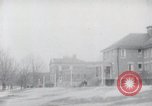
Various activities for assisting mentally disabled children in Mansfield, Connecticut.
Describes the facilities and various activities for assisting the 2000 mentally disabled children and adults at Mansfield State Training School and Hospital. Exterior of a building. Snow covered land. A dining room with rows of tables and chairs. Mentally disabled children in Mansfield State Training School and Hospital clean the dining room as a part of assistance services program. A mentally disabled child and a woman volunteer on a sled slide down the slope. Children enter a school. 'The Longley School, built in 1951, is one where mentally disabled children can participate in many activities such as band, dance and sports as a part of assistance programs. Feet of a dancing girl. A boy in front of a woman on a sled sliding down a snow covered hill, as seen from camera position in front of sled looking at riders on sled. Children play in a park. A boy riding a soap box derby car. Boys playing American football and basketball. A boy crashes in his soap box derby car but gets up and walks away. Mentally disabled children perform a dance routine during a stage program. A man voices his opinion about the need for developing some hobbies in the mentally disabled children helpful for them when they come in contact with the community outside of the program.