


 Francais
 Deutsch
 Italiano
Refine Your Search
John-F.-Kennedy stock footage and images
- Showing 631 to 636 of 3759 results more
more Hide
Hide
Captain Kermit Beahan, bombardier of B-29 that dropped atomic bomb on Nagasaki, interviewed at Tinian, Marianas Islands
Setting: Airbase at North Field, Tinian Island in Marianas Islands. Public Affairs Officer, Major John F. Moynahan (not seen) identifies Captain Kermit K. Beahan, bombardier of the B-29, "The Great Artiste." (Note: Captain Beahan was the regular pilot of the B-29, "The Great Artiste", which was scheduled to carry the bomb. But it needed to be re-instrumented for the mission. So, instead, its crew simply switched airplanes with the crew of the B-29 "BocksCar" which was already properly configured. Thus, "BocksCar" was the airplane from which bombardier Beahan actually dropped the bomb.) When asked about his experience, Captain Beahan recalls being greatly relieved when clouds parted and the target, Nagasaki, could be clearly seen. He felt that dropping the bomb on Nagasaki, was the biggest thrill of his lifetime. (World War II period).
Captain Theodore J Van Kirk, navigator of B-29,'Enola Gay' interviewed at Tinian Island base, Marianas Islands in WW II
Atomic bombing mission in Japan by the United States Army Air Force, during World War II. U.S. military base in North Field, Tinian Island in Mariana Islands, South Pacific. Captain Theodore J. Van Kirk, the navigator of 'Enola Gay' (B-29 which dropped atomic bomb on Hiroshima) is asked about his experience, by Public Affairs Officer, Major John F. Moynahan (seen only from the back at very end of clip). Captain Van Kirk stands in front of Enola Gay and states his belief that the new bomb they carried would be a great help in shortening the war.
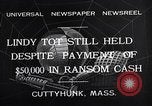
Kidnapped child of aviator Charles Lindbergh missing even after paying ransom of $ 50,000.
Kidnapping of twenty month child of aviator Charles Lindbergh, Cuttyhunk, Massachusetts. Negotiator for Lindberg, Dr. John F. Condon in St. Thomas Cemetery, in the Bronx, New York, with a ransom of $50,000 demanded by kidnapper. Lindberg flies in sky above the area for a clue of his kidnapped child. A kidnapper scales a ladder, tries to reach a baby on first floor but a alarm sounds and he runs back. The mother arrives and picks up her child.

Timeline summary of the events and achievements of President Eisenhower's administration.
"The Eisenhower Story": A pre-election pro-Eisenhower propaganda film designed to highlight Eisenhower's qualifications for reelection as President in the 1956 election. Factory whistle blows and men entering a factory. Car chassis factory assembly line. Locomotive engineer blows train whistle and railroad locomotive with cultivators on a flat bed car. Cultivators harvesting grain. Woman carries groceries from shop to a 1950's sedan car parked on street. View of 1950's automobile highway traffic and aerial view of highways being built under his plans for highway construction and road expansion. View of Eisenhower at swearing in ceremony during his inauguration as President in 1952. In his speech, Eisenhower emphasizes that, "we stand ready to engage with any and all others in joint efforts to remove the causes of mutual fear and distrust among nations..." Newspaper headline 'Korean Truce Signed' at time of armistice during Korean War. American troops disembark ship and greet family. Secretary of State Dulles talking with German chancellor Konrad Adenauer. Secretary John Dulles seen also with British Prime Minister Winston Churchill. Eisenhower and Churchill at Geneva conference, along with Soviet leader Khrushchev and Marshal Nikolai Bulganin. Eisenhower speaks before United Nations about efforts to form an "atom pool." He notes United States "determination to help solve the fearful atomic dilemma...." Newspaper headlines 'Eisenhower Signs Sea Way Bill'. Construction of Saint Lawrence Seaway. 'Budget' and 'tax cuts' news in newspapers, including headline, "White House ends all wage controls...." Farmer plows field with tractor. Construction of new buildings and highway construction through Eisenhower programs. Views of the newly established Department of Health, Education, and Welfare. Workers filing cards in giant room of file drawers and cabinets. Nurse draws vaccine into syringe. Children are vaccinated (likely polio vaccine). President Eisenhower meets leaders from different countries at White House, including England's Queen Mother and King Paul, Queen Frederica of Greece, and Prime Minister St-Laurent of Canada. Eisenhower at press conference discussing disarmament notes importance of the "elimination of opportunity of surprise attack." View of shore towers and listening platforms and missiles rising on platforms to protect America from attacks. First nuclear submarine, the USS Nautilus (SSN-571 ) launched on January 21, 1954 by Mrs. Mamie Eisenhower in Connecticut. Plane taking off from aircraft carrier USS Forrestal (CV-59) while underway at sea. Formation of Northrop F-89 Scorpion aircraft in flight.
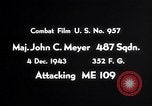
German World War 2 fighter aircraft Messerschmitt Bf-109 exploding after attack by U.S. aircraft
Clip titled 'Major John C. Meyer 487 Sqdn. (Squadron) 352 F.G. (Fighter Group) attacking ME-109 on 4 December 1943'. Gun camera footage of ME-109 seen in flight and later explodes due to attack during World War II in Germany. A parachute descends.
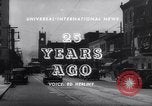
Scenes of evidence against and courtroom trial of Bruno Richard Hauptmann for kidnapping and murder of Lindbergh baby
People gather in front of Bruno Richard Hauptmann's house (1279 East 222nd Street, Bronx, New York) while police dig for evidence near a shed. Marked ransom money found in a can is displayed. Phone number of Dr. Condon, ransom go-between is seen written on a door frame. Sketch of ransom suspect and Hauptmann are compared. Handwriting of the kidnapper compared as a match with Bruno Richard Hauptmann own handwriting. Mrs. Anna Hauptmann seen with her son, in a crib. J. Edgar Hoover, Norman H. Schwarzkopf, and police commissioner John F. O’Ryan at press conference. Document dated September 26, 1934, bearing the names of attorneys Samuel J. Foley and Charles McLaughlin, and detailing charges against Hauptmann is displayed. Scenes of courtroom trial of Hauptmann. Charles Lindbergh leaves the court, enters a waiting car, and departs.
CRITICALPAST.COM: About Us | Contact Us | FAQs - How to Order | License Agreement | My Account | My Lightboxes | Shopping Cart | Advanced Search | Featured Collections | Website Terms & Conditions | Privacy Policy ©2026 CriticalPast LLC.
License Agreement |
Terms & Conditions |
Privacy Policy
©2026 CriticalPast LLC.