


 Francais
 Deutsch
 Italiano
Refine Your Search
John-F.-Kennedy stock footage and images
- Showing 97 to 102 of 3762 results more
more Hide
Hide
President John F. Kennedy address from White House about U.S. action against Cuba and addresses Cuban people also.
President John F. Kennedy addresses people of United States about recent events in Cuba from White House (during Cuban Missile Crisis). President repeats commitment of peace. He warns further action of Cubans towards collection of nuclear weapons. He gives reference of constitution and briefs seven steps he has instructed. First to halt any offensive shipment and cargo carrying weapons to Cuba. He states that they wont stop any essential goods carrier as Soviets did in 1948. He talked to foreign minister of Organization of American States(OAS) and instructed arm forces to stay prepared. Second he warns any launch by USSR to U.S. Then he tells about meeting with organization of Consultation regarding regional security arrangements. He refers about meeting with security council. He discusses Soviet threat to world. President invites Chairman Khrushchev to mediate between Cuba and UN on this matter. He restates no wish to war but difficulty in living in atmosphere of timidness. President Kennedy addresses Cuban people who would be listening this telecast by special radio telecast. He states we respect justice and peace for all. He expresses sorrow for Cuban people. He pronounces Cuban leaders puppets of international conspiracy. He then asks U.S. citizen to be prepared for paying cost of freedom as sacrifice and patience. He states doing nothing to be greatest hazard. He restates U.S. commitment to never choose the way of surrender and work for freedom with peace.
John F Kennedy announces nuclear test ban negotiations with Russia in Washington DC
United States President John F Kennedy speaks on the Cold War nuclear test ban at the American University (4400 Massachusetts Avenue, NW Washington, DC 20016) in Washington DC. Graduates of the American University sit and clap. Professors sit on podium. President announces that the U.S. and Britain will send high level negotiators to Moscow in July for conference on a nuclear test ban. He says that the U.S. will discontinue nuclear tests unless some other country resumes them. “Confident and unafraid, we must labor on, not towards a strategy of annihilation, but towards a strategy of peace. Thanks.” President Kennedy concluded his speech.
President John F. Kennedy's motorcade drives on Vandenberg AFB roads in California.
U.S. Air Force Airman salutes. A group of children wave. Children and adults accompanied by Air Force personnel and Boy Scouts of America line up in large numbers along Vandenberg AFB road in California, United States. Helicopter covering the event can be seen. Crowd along the route waves and cheers as President John F. Kennedy's motor convoy drives by. Air Force personnel salute as President Kennedy passes by in his plexiglass bubble-top covered Lincoln limousine. Shows presidential convoy of cars and buses traveling along Vandenberg Air Force Base roads.
United States President John F Kennedy honors Bob Hope at White House in Washington DC.
A view of the White House in Washington DC. U.S. President John F Kennedy with other members of the Congress. President Kennedy honors Bob Hope for providing entertainment to servicemen. The President makes a speech to thank Bob Hope for his service tours that made servicemen laugh. The President awards the special authorized gold medal to Bob Hope. Bob Hope, also known as ' The Clown Prince' receives the medal and thanks the President and Congress for the honor. He gives his speech and makes the gathering laugh with his jokes.
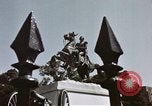
Ivory Coast President Boigny and John F. Kennedy talk about the economic cooperation during a meeting in Washington DC.
Documentary depicts the visit of Ivory Coast President Houphouet Boigny and his wife to the United States. Ground level views of the statue of Andrew Jackson outside the White House. Elevated views of the White House (likely from Washington Monument). Ivory Coast President and John F. Kennedy discuss about the economic cooperation between the two countries specially in agriculture, fisheries and regional development. President Kennedy and Boigny stand together as men take pictures. U.S. President shakes hand with Boigny. U.S. President talks to Boigny. President Biogny leaves in a car.
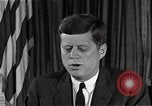
President John F. Kennedy speaks about conducting the nuclear tests for security reason in a speech in Washington D.C.
U.S. President John F. Kennedy speaks on disarmament and testing of nuclear weapons in Washington D.C. A flag of United States on the stage. He speaks that nuclear disarmament will lead to security. He clarifies that U.S. will perform tests on these nuclear weapons not for political or psychological reason but for security reason. He also talks about the negotiation with Soviet Union. “I have no doubt that most of our friends around the world have shared my own hope that we would never find it necessary to test again--and my own belief that, in the long run, the only real security in this age of nuclear peril rests not in armament but in disarmament. But I am equally certain that they would insist on our testing once that is deemed necessary to protect free world security. They know we are not deciding to test for political or psychological reasons--and they also know that we cannot avoid such tests for political or psychological reasons.” President Kennedy said.
CRITICALPAST.COM: About Us | Contact Us | FAQs - How to Order | License Agreement | My Account | My Lightboxes | Shopping Cart | Advanced Search | Featured Collections | Website Terms & Conditions | Privacy Policy ©2026 CriticalPast LLC.
License Agreement |
Terms & Conditions |
Privacy Policy
©2026 CriticalPast LLC.