


 Francais
 Deutsch
 Italiano
Refine Your Search
John-F.-Kennedy stock footage and images
- Showing 2143 to 2148 of 3759 results more
more Hide
Hide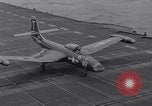
U.S. Navy Training film about recovering aircraft that return to carriers, at sea.
Film illustrating proper technique for recovering jet aircraft as they return to land on U.S. Navy aircraft carrier. A U.S. Navy F2H Banshee airplane lands on carrier flight deck. View of green shirt arresting gear deck crewman greasing an arresting cable to reduce friction for higher speed engagement in jet landings. More views of F2Hs landing. One fails to engage any of seven restraining cables and crashes into the barrier. An F6F airplane engaging cables as it lands on a carrier. View of jet nose passing under top cable of conventional barrier. "Davis"-type barrier used for jet airplanes. View of jet that passed all barriers and crashed into other aircraft. The deck covered in foam from firefighters. View of a Banshee jet crashing, bursting into flames, and falling in pieces off the flight deck. Deck crewmen surround a jet after engaging a Davis barrier. They disengage cables and push the aircraft clear of the deck. Arresting gear deck crewmen seen stowing a damaged Davis barrier. Adapting conventional barriers for use with jets by lowering them. More F2H landings. Landing signal officer with paddles. View from carrier deck of jet on final approach. View from an aircraft on final approach. F2H landing on the USS Coral Sea (CV-43). Taxiing after landing. An F9F that passed the barriers, being stopped and signalled to fold wings. Animated sketches of jet aircraft rocking and tilting. Deck crewmen chocking wheels and latching nosewheels. Firefighters foaming a jet when its engines would not shut down, and fuel continued to flow. View of damaged jet engine turbine wheel. An F6F landing on the carrier. F4U Corsairs, with folded wings, being moved by tug on deck. Views of poisonous lead compound powder on inside of jet engine tailpipe. Maintenance crewmen waxing wings of jet aircraft. Red shirt armament crewmen rearming a jet. Purple shirt aviation fuel crewmen refueling jets, mixing jet engine fuel with oil and spreading wings to refuel tip tanks. Use of a special wing-side ladder to refuel tip tanks on jets where permissable. Diagram of carrier illustraing proper method of spotting jets and conventional aircraft on deck. A Marine F2H being brought up on elevator. Deck crewmen pushing a jet backwards. Summary of jet handling techniques, with brief glimpses of actions being described. Formation of jet planes flying overhead.
U.S. Air Force aircraft take off from the Eniwetok Atoll in Marshall Islands; atomic explosion
B-52, B-47 and B-66 RATO take off from a runway at the Eniwetok Atoll in Marshall Island. Pilot being assisted into an F-84F cockpit and seated in cockpit wearing a helmet. F-84F on ramp with pitot tube in nose section. F-84F taxiing out of parking area while a F-101 taxiing. F-101 takes off on a wet runway. Views of B-52, B-66, B-47, F-84F in flight. Scene of atomic bomb explosion burst over water at Eniwetok Atoll during nuclear testing by the United States. A F-101 in flight. A B-57 flies over on wing at high altitude.
Navy training film about proper handling of jet airplanes on U.S. aircraft carriers
Training film about handling of jet aircraft aboard U.S. aircraft carriers. Introductory scenes show a U.S. Navy F9F-2 jet, of Squadron VF-51, landing on the aircraft carrier, USS Essex (CV-9). Scene shifts to U.S. Marine Corps McDonnell F2H Banshee jets, with tail codes LC, and folded wings, on carrier deck. A flight of four F9F panther jets flies past a carrier. They peel off to land. (They have no tip tanks.) Jet aircraft being moved about on carrier deck. Scene shifts to Vought F4U Corsair aircrafton a carrier. Then a Douglas A-1 Skyraider, tail code M, takes off. Carrier flight deck diagram is shown with typical layouts for positioning jet and conventional aircraft. Jets are then shown being catapulted in pairs. A diagram compares Jet and conventional landing patterns. A skyraider aircraft takes a wave-off without delay. An F9F lands forced to commit earlier than the conventional aircraft. A series of jet landings are shown. An F2H Banshee jet receives a wave-off and must go around. It runs out of fuel and crashes into water, just short of the carrier. Next, helicopter with rescued pilot seen on deck. More views of jets being moved toward elevator on carrier. An F2H coming up on elevator. Blue shirt plane handlers moving, securing, and guiding a taxiing jet. A yellow shirt signalling to catapult a jet. Jets landing closer to one another. Purple shirts refueling a jet on carrier deck.
Demonstrations of Tactical Air Power in air-to-air, air-to-ground, and close support missions
A tactical jet fighter fires a missile at an obsolete jet target aircraft (F-80 or F-84). The missile strikes and the target aircraft bursts into flames and crashes into the ground with huge explosion and fire. An F-100 Supersaber fighter strafes ground targets. An F-105 climbing out. An F-100 dropping napalm, leaving huge explosion of flames. F-105 fires rockets that explode on railroad tank cars. Jet fighter launches missile that strikes and destroys railroad locomotive. F-100s straffing and firing rockets and missiles at various ground targets. F-105 drops cluster of bombs. F-100 and F-105 aircraft engaged in close support maneuvers with U.S. Army artillery and infantry units firing field pieces and machine guns and mortars.
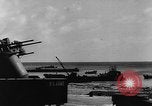
U.S. Navy aircraft making use of new airstrip at Ulithi Atoll, during construction in World War II
A quad 50 (4-50 caliber machine guns) mounted on a U.S. Army vehicle at the shore at Ulithi Atoll, during World War 2. A C-47 (Navy R4D) parked on airstrip with Seabees at work with trucks in background. A PBY Catalina amphibian plane being serviced. An F6F parked on sand in makeshift revetment. Another one coming in for a landing. The landing F6F on ground roll as a steam roller passes in foreground. Navy F6F aircraft arriving, from aircraft carriers, and being parked. Numerous Navy aircraft, including SB2C Helldivers and F6F Hellcats, parked with wings folded on the airstrip, while construction work continues. Men recover items from a crashed F6F, as smoke rises in background. They work to prevent fire around the crashed plane. Hoses are stretched around the plane and one man holds a pressure nozzle.
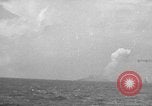
USS Princeton burning and sinking near USS Essex off Luzon at Battle of Leyte Gulf in World War II.
Smoke rises from bombed aircraft carrier USS Princeton (CVL-23) off Luzon in World War 2. Time code 00:29,shows F6F-5 #7 "Paper Doll," of VF-27, (mount of Ensign Bob Burnell who painted most of the famous "cat mouths" on the cowls of VF-27 Hellcats).Pilots walk across flight deck of USS Essex (CV-9). TC:01:04, F6F-5 #47 (VF-15) is seen with Horizontal stripe near rudder tip identifying it as an Air Group 15 aircraft. Further along is F6F-3 #8 (VF-15) Late production -3 with superseded tri-color paint scheme and 7 Japanese victory flag emblems under cockpit. F6F-3 #F-11 (VF-27) Late production -3, "F-11" lettered prefix to aircraft number (unusual on an operational fighter probably indicating a recent replacement). Plane captain is cleaning windshield on the "Minzi III" when Captain David S. McCampbell, the top U.S. Navy ace, approaches and climbs aboard the aircraft. Thirty Japanese flags are painted on the fuselage below the cockpit. McCampbell straps in and starts his engine. He gives a "thumbs up" sign. "Airedales" push empty Hellcat belly tanks across Essex flight deck. A Destroyer fires antiaircraft guns. Japanese aircraft seen in flight over water. Fire from 40 mm guns. (Note: Some planes of Squadron VF-27 on the Princeton, were recovered on the Essex.)
CRITICALPAST.COM: About Us | Contact Us | FAQs - How to Order | License Agreement | My Account | My Lightboxes | Shopping Cart | Advanced Search | Featured Collections | Website Terms & Conditions | Privacy Policy ©2026 CriticalPast LLC.
License Agreement |
Terms & Conditions |
Privacy Policy
©2026 CriticalPast LLC.