


 Francais
 Deutsch
 Italiano

Refine Your Search
John-F.-Kennedy stock footage and images
- Showing 2179 to 2184 of 3762 results more
 Hide
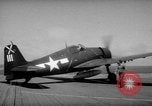
Flight deck operations on the USS Wasp (CV-18) at the end of World War II
Fleet Carrier Air Group 86 (CVG-86) embarked on the USS Wasp (CV-18) at end of World War 2. A pilot of Squadron VF-86, sits in an F6F with engine running, on flight deck of the Wasp. He runs the engine a while, then shuts it down, and climbs down from the aircraft. Another pilot greets him and they both walk across the deck together. An F4U, Corsair (Number 154) of Fighting Bombing Squadron 86 (VBF-86) takes off, followed by another (number 155). Next, a TBM-3E Avenger (number 301) of VT-86, takes off, followed by numbers 303, and 314. An SB2C-4 Helldiver (number 210) is the next to take off. View aft, shows sailors working around an F6F; a tug driving along the flight deck; and a destroyer (looks like Fletcher-class) underway in far background.
The battle of Khe Sanh in the Vietnam War.
Film begins showing two U.S. Air Force McDonald Douglas F4 Phantom jet fighters in flight. Narrator says American intelligence reports on January 29, 1968, of a 4th North Vietnamese Regular Army Division in the Khe Sanh area, bringing total enemy strength to about 40 thousand regular troops. View of photo interpreter rolling large wet film taken by Air Force surveillance aircraft. Map of Hue, area of South Vietnam, showing disposition of American forces in the region. American Marine Colonel David E Lownds, Commander of Khe Sanh garrison, describes North Vietnamese offensives against some American held positions. Views of North Vietnamese attacks being repelled by artillery and air strikes as well as organic infantry weapons like the A1 millimeter mortars, 3.5 rockets, and M79 machine guns. U.S. aircraft drop munitions on enemy positions. Infantry firing guns mounted on vehicles. An F4 Phantom drops napalm that creates a swath of fire. Closeup of North Vietnamese newspaper warns that the Americans face a defeat comparable to that of the French at Dienbienphu. American newspapers express concerns about the fate of the Marine Garrison at Khe Sanh. U.S. Army General William Westmoreland, Commander of U.S. troops in Vietnam, is seen and heard expressing confidence that American forces would win the battle of Khe Sanh. American troops listen as he speaks. Marines in briefings and in combat, including African American Marines. American artillerymen load and fire a 175 mm field gun at Camp Carrol, and a location called the Rock pile with a network of trenches. Inside that base, are seen Ontos M50A1 multi barrel anti-tank tracked vehicles armed with 105 mm recoiless rifles. A marine fires a 4.2 inch mortar, and another fires a recoiless rifle. Marines firing a 155mm howitzer. Scene shifts to deck of an aircraft carrier. View of Navy F4J phantom fighter aircraft being launched from the USS Ticonderoga (CVA 14) (Note: this may be an anachronism. Reportedly, the F4J was not operating from aircraft carriers in the Vietnam until after 1968). F-4 Phantom fighters taking off from an Air Force base. Aerial view of a U.S. Air Force B-52 bomber dropping conventional bombs on North Vietnamese targets. View from the air of bombs exploding on the ground over battlefield terrain. A C-130 transport plane dropping supplies to U.S. marines on the ground. View from below of the parachutes descending with supplies. Closeup of C-130 dropping mail from above. More views of parachute drops from C-130 aircraft to Khe Sanh. C-123 transport landing at a Marine base and a C-130 taking off. Another C-123 landing. Another having load delivered by low level extraction. Marines on the ground at Khe sanh opening packages of supplies and using a tractor to transport large boxes. On February 13, Marines suffered casualties when a platoon was ambushed just outside the base perimeter. View of Marine on a litter. Heavy black smoke rises at the base from shelling by North Vietnamese artillery. A C-123 aircraft takes off with dense black smoke in the background. Another napalm attack by a U.S plane creates a large conflagration. View from above of a B-52 dropping bombs only yards outside the Khe Sanh perimeter. Marines patrolling close in the base. More views of B-52s bombing North Vietnamese targets. View of nighttime bombing operations. A Marine plotting enemy movements on a plexiglass chart. Marines manning machine guns as enemy rockets and mortars continue to pound the garrison. Officers are seen in CINCPAC Command center. Continued U.S. bombardment and air strikes appear to prevent massing of enemy forces for an assault. Marines controlling hills in the area. A UH-1 Iroquois (Huey) helicopter flying low over the base. During a lull in battle Marines fill sand bags, maintain their weapons, play cards, and keep occupies as they sit and wait. Some play basketball with an outdoor improvised backboard and net. Some marines select books from a library. A marine plays a guitar as some others listen. Closeups of Marines in trenches including white and African American Marines. Marines doing their wash and having a meal of C rations. Marines preparing their own combinations of ingredients into meals being cooked over open fires. Views of many marines eating the various mixes of C-rations they called "casseroles." Marines in trucks pursuing retreating elements of North Vietnamese on Highway 9 that had been opened by Marine engineers. U.S. Army First Air Cavalry reinforcements arrive in operation Pegasus. Marine engineers working to restore bridges and roads needing repairs. Soldiers detecting and neutralizing mines. Bell UH-1 helicopters ferry troops. Captured enemy arms and ammunition. Surrendered North Vietnamese soldier prisoners of war marched under guard.
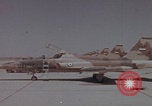
Iranian Air Force jets and pilot training.
Aircraft from the Imperial Iranian Air Force fleet includes United States McDonnell Douglas F-4 Phantom II and Northrop F-5 fighter jets. A row of Northrop F-5 fighter jets at an airfield in Iran. Sign in English and Persian reads “31st T.F. (Tactical Fighter) Squadron”. Imperial Iranian Air Force pilots attend class. A map of the Middle East showing flight paths, radii, flags of the various Air Forces in the region. Flags and roundels of the Soviet Union, Iran, Iraq, Lebanon. A bomb is installed into a jet fighter-bomber. A fuze is fitted into the bomb nose. A man wearing a jacket with an “F-5 Iran” patch. Iranian military pilots run out of a building and board trucks.
U.S. Air Force Military Airlift Operations in 1968 during the Vietnam War, and during 1976 border tensions in Korea
View from a U.S. Marine bunker as enemy shell explodes nearby, during the siege of Khe Sanh in 1968 during the Vietnam War. The United States Marines in the Battle of Khe Sanh firing mortars and a 105mm howitzer from their bunker. Enemy shells exploding on the tarmac, where American Air Force C-130 aircraft are parked. Marines rushing wounded comrades on stretchers, to C-130s for evacuation. Scene shifts to U.S. Marine Corps Lieutenant Colonel James P. Sheehan, standing at Camp Pendleton, California. (He was a company commander in the siege at Khe Sanh.) As he describes the C-130 aircraft support operations, a contingent of marines marches past, behind him. Scene shifts to a civilian narrator standing in the Military Airlift Command (MAC) Headquarters Command Center at Scott Air Force Base, Illinois. Among other things, he describes MAC support to the Tactical Air Command in Korea. Camera focuses on MAC air routes in the vicinity of the Philippines, Japan, and Korea. Next, is seen view of airfield at Mountain Home Air Force Base, Idaho, briefly at sunset, and then at night, as pilots of the 366th Tactical Fighter Wing and their F-111 aircraft prepare to depart for Korea, in response to border tensions, in August, 1976, after North Korean forces killed two American officers ("Korean Axe Murder Incident" and resulting "Operation Paul Bunyan"). Ground crewman directs a taxiing F-111 using lighted wands. The F-111s takes off. One of them is seen landing after the 7 thousand mile flight to Korea, as Major Paul Malandrino,Jr. (unseen) of the 366th Wing, speaks about MAC's airlift support. A C-141 MAC aircraft is seen landing. View of a C-141 with tail doors open and its cargo of military equipment on the ramp behind it. Glimpse of a marine with rifle and earphones, guarding equipment on the airfield ramp. Closeups of F-111 aircraft taking off.

A weapon system developed in Wright Air Development Center (WADC) in Ohio, United States.
The development of weapon system at the Wright Air Development Center of Wright-Patterson Air Force Base. F-86D Sabre aircraft at the base. A pilot in a cockpit. Pilot wears a helmet, flying suit and oxygen mask. Pilot checks control. Various new type parts of the F-86D aircraft are demonstrated like the fuel engine, normal engine, emergency engine etc. Pilot work on controls F-86D taxis and takes off. Radar screen in operation. Radar screens in operation in the background. F-86D in flight. Students receive instructions in a classroom. Students at radarscope. Technicians and workers during a construction of runway. Technicians and Project engineers at work in an office. View of the Joint Project Officers at work. View of Wright Air Development organization and of buildings at Wright Air Development Center (WADC) in Ohio. Entrance of a building at the facility.
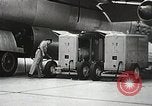
Various activities like Gun fire test, technician works on a fabricated machine at Wright Air Development Center.
Activities at Wright Air Development Center, located at Wright-Patterson Air Force Base in Ohio. Two burners under wing of B-47 Stratojet aircraft. Gun fire test on a container filled with hydraulic fluid. B-47 lands with drag parachute. Technician makes a part for aircraft C-97 Stratofreighter. A stenographer types notes. A woman takes out the printouts. Several view of various office workers. A project engineer works on a machine. A woman takes out the prints of graphs. Librarian checks out book for technician. A woman works on publications. Technicians seated at a desk and look at the project details. Various supplies kept in warehouse. A sign reads 'WADC Supply Shuttle Truck No 6'. A technician works on a fabricated machine. Instrumentation camera in operation. Theodolite camera track B-45 Tornado in flight. Technician checks the propeller. F-86 stationary. Divided frame in five sections shows F-86D Sabre, F-59 buzz camera, Matador missile launching,F-86D, Book entitled 'Nuclear Powered Aircraft' and Bell X-1 in center. Aerial view low-flying over facilites of the WADC in Ohio. A Wright Memorial. A title card reads "For us, This is Not the End."