


 Francais
 Deutsch
 Italiano
Refine Your Search
John-F.-Kennedy stock footage and images
- Showing 2359 to 2364 of 3759 results more
more Hide
Hide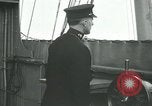
President Woodrow Wilson and other dignitaries aboard USS George Washington bound for Paris Peace Conference
Liner USS George Washington on the Atlantic Ocean after its departure from Hoboken, New Jersey, bound for the Paris Peace Conference after World War 1. One of the ship's officers looks through binoculars. Two ships in the background (one is likely the USS Pennsylvania BB-38 which accompanied the flotilla). President Woodrow Wilson looks through binoculars. Standing behind him is Rear Admiral Cary Grayson, who was also the President's physician, Two women talk to a man on ship. John W Davis looks through binoculars, a woman stands beside him. The woman looks through binoculars. Robert Lansing, U.S. Secretary of State stands on ship wearing a hat and bowtie and looks around. French Ambassador Jean Aderian Antoine Jules Jusserand sits and talks with two women. (World War I; World War 1; WWI; WW1)
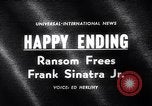
Film covering kidnapping of Frank Sinatra, Jr. in California
Frank Sinatra Junior, the son of singer Frank Sinatra, is kidnapped in California. View of Harrah's casino in Lake Tahoe, Nevada. Sign on casino advertises George Jessel and the Mary Kay Trio, along with the Tommy Dorsey Orchestra, Helen Forrest, Pied Pipers, Sam Donahue, and Chas. Shavers. Frank Sinatra Jr performs at Harrah's casino in Lake Tahoe along with the Tommy Dorsey Orchestra. Room no 417 of the motel in Lake Tahoe from where he was kidnapped. John Foss at the press conference about Sinatra Junior's Kidnapping. Policemen at road lock. Policeman stops a Volkswagen beetle in the snow. Closeup of Frank Sinatra as narrator comments on ransom instructions issued by the kidnappers. Sign identifying Bel Air. People gathered where Frank Sinatra Junior was released a few miles from his home. Closeup of him with mother Nancy Barbato and sister, Nancy. He talks to reporters about his feelings during kidnapping. Reporters ask questions from his mother, who replies and ask them to end their questioning.
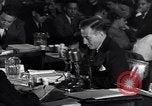
Mr Eric Allen Johnston testifies before the House Committee on Un-American Activities in Washington DC.
The House Committee of Un-American Activities (HUAC or HCUA) an Investigating Committee of the United States House of Representatives, questions Hollywood executives about communist propaganda. Head of Motion Picture Association of America (MPAA) Mr Eric Allen Johnston testifies. He says about John Howard Lawson, that he wouldn't employ him if he was a declared communist. He said he would never support communist related persons or ideas. He says that they are said to be 'war mongers' by Mr McDowels. He said the program should be according to rights of Americans for fair trial. He talks about Howard Rushmore. He condemns parties based on hate and says he will never praise those who work with unconstitutional means. He addresses Mr Richard B Vail and says that American Motion Pictures reach every part of world and it would make bad affect if it would reflect pro communist ideas and would harm world peace.
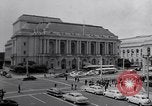
Primer Mr Shigeru Yoshida addresses and signs peace treaty with representatives of other countries in San Francisco, CA
San Francisco Peace Treaty conference with Japan, in San Francisco, California. Beginning shows the War Memorial Opera House and Van Ness Avenue. U.S. President Harry S Truman steps to a podium, at the Opera House, to address delegates at the conference. With him on the stage are Dr. Warren Kelchner, Temporary Chairperson of the Japanese Peace Treaty Conference, Governor Earl Warren of California, and Secretary of State Dean Acheson. Next, Dean Acheson is seen seated at the center of a table with Dr. Kelchner, at his right, as Soviet representative Andrei A. Gromyko steps to the microphone and speaks. (Narrator says he raises complaint about rules of procedure.) Dean Acheson removes his translating headset in frustration. Next, a representative of Poland comes to the microphone, and calls for delays. View of delegates in the audience. New Zealand representative, Sir Carl August Berendsen, takes the stand to renounce delaying tactics. Audience members applaud. Carlos P. Rómulo, of the Philippines, speaks in support of the treaty. John foster Dulles, of the United States, steps to the podium to speak for the treaty. Next, Japanese Premier, Shigeru Yoshida, referring to notes in a roll of paper, endorses the treaty. Audience applauds. Secretary of State Acheson is seen signing the treaty for the United States, followed by representatives of: Australia; Cambodia; Great Britain; Ceylon; France; Indonesia; Philippines; and Pakistan. Next, the Japanese delegation comes forward, and Prime Minster Shingera Yoshida, signs the historic document. Closeups of ordinary Japanese from all walks of life. Japanese people commuting to work.
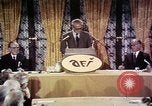
William J Fulbright, Chairman,Foreign Relations Committee, talks about power of Congress in United States.
Debate on the 'Role of Congress in Foreign Policies' between John C Stennis and William J Fulbright in United States organized by the American Enterprise Institute. Senator William James Fulbright, Chairman, Foreign Relations Committee discusses Section- 8, Article-1 about the powers of the Congress. He states the power of Congress regarding war and making rules. He states that since the Kingdom of George III the power remains with the supreme, as stated in article -2 the President has the powers to command all three defensives branches of country. He discusses the role of the President. Fulbright talks about war and treaty power, that the Senate has always supported the Congress, but the Congress has constitutional authority to exercise powers.
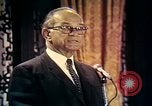
William J Fulbright, Chairman,Foreign Relations Committee, talks about the attitude of Senators in United States.
Debate on the 'Role of Congress in Foreign Policies' between John C Stennis and William J Fulbright in United States organized by American Enterprise Institute. Senator William James Fulbright, Chairman, Foreign Relations Committee discusses about the attitude of Senators to support the Congress. He says that he does not recall any incident when congress has rejected President's decision on any issue. He gives an example of an issue regarding war. He said that it is the responsibility of Congress to present a different view to President and the Senators have a collective wisdom on a particular issue. He states that better relations on non military grounds must be practiced. A comparison with policies and powers of other countries must be done. Fulbright says that no Senator has contested with the President on any issue.
CRITICALPAST.COM: About Us | Contact Us | FAQs - How to Order | License Agreement | My Account | My Lightboxes | Shopping Cart | Advanced Search | Featured Collections | Website Terms & Conditions | Privacy Policy ©2026 CriticalPast LLC.
License Agreement |
Terms & Conditions |
Privacy Policy
©2026 CriticalPast LLC.