


 Francais
 Deutsch
 Italiano
Refine Your Search
John-F.-Kennedy stock footage and images
- Showing 2365 to 2370 of 3759 results more
more Hide
Hide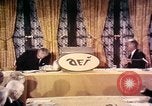
William J Fulbright, Foreign Relations Committee, talks about the issue of resolution passed during WWII in United States.
Debate on the 'Role of Congress in Foreign Policies' between John C Stennis and William J Fulbright in United States organized by American Enterprise Institute. William J Fulbright, Chairman, Foreign Relations Committee talks about the polls. He talks about the role Congress plays in policy making. He discusses the beginning of the war. Fulbright discusses in detail the disagreement among Foreign Relations Committee and the Congress.
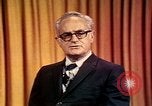
Moderator Peter Lasigor concludes and restates issues raised by Stennis and Fulbright in United States during a debate.
Moderator concludes debate on 'Role of Congress in Foreign Policies' between John C Stennis, Chairman, Armed Service Committee and William J Fulbright Chairman, Foreign Relations Committee in United States organized by American Enterprise Institute. The Moderator Peter Lasigor says that Stennis and Fulbright disagree on the issue of Congress's role in foreign policy. Stennis has said that the Congress has contributed in making 40 mutual treaties and plays a crucial role in making Foreign Policies. Stennis states the resolutions passed on the issues of Cuba, Berlin and others. Lasigor says that both of them agree on the point of reassessment. The points Fulbright raised were about the war making functions and deprivation of senate from the agreement on war issues.
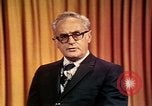
Dr W Kintner with Senator Fulbright during a debate on the 'Role of Congress' in Washington DC.
Question Answer period of the debate on 'Role of Congress in Foreign Policies' among John C Stennis, Chairman, Armed Service Committee and William J Fulbright, Chairman, Foreign Relations Committee in Washington DC, organized by American Enterprise Institute. Moderator of debate Peter Lasigor concludes the Question Answer period. He tells that Dr William Kintner asked Senator Fulbright about the controversy of Gulf of Tonkin Resolution. Senator Fulbright replied that President has the right to act without consultation whenever there is an emergency or threat to the nation's security but the issue about Gulf of Tonkin incident was not an urgent issue. He said that he was only the agent of situation and the decision of war was imposed over them.
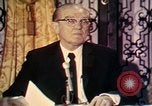
William J Fulbright speaks during the Question Answer period of a debate on the 'Role of Congress' in Washington DC.
Question Answer period during the debate on 'Role of Congress in Foreign Policies' among John C Stennis, Chairman, Armed Service Committee and William J Fulbright Chairman, Foreign Relations Committee in United States organized by American Enterprise Institute. William Fulbright denies blames put on him by Stennis and questions the decisions taken by the President on the issue of Gulf of Tonkin with out his concern. He said that the attack was made without provocation and it is a disgrace to Government. He says that government should give reasons for their act. Fulbright states that necessary action should have been made to prevent war and do the necessary adjustments.
U.S. General Officers discuss a map during planning for Operation Somerset Plain, in South Vietnam.
U.S. General Officers planning for the U.S. Army 101st Air Cavalry Division's Operation Somerset Plain ( A Search and Destroy Mission to prevent North Vietnam Army elements from reentering the A Shau Valley, in Thua Thien Province, South Vietnam). U.S. Officers including Major General Melvin Zais, Brigadier General John, S Lekson, Marine Major General C B Drake discussing a map with Lieutenant Colonel Daniel G. Sharp, Commanding Officer, 2nd Battalion, 502 Infantry Regiment. August,1968. (Vietnam War period).
United States President Woodrow Wilson and party arriving at Boston after returning from the Paris Peace Conference in France.
United States President Woodrow Wilson and the members of the American delegation arriving at Boston in Massachusetts. They are returning from the Paris Peace Conference. An official stepping down the ship with a carton. President Wilson along with Secretary of United States Navy Josephus Daniels, Mrs. Eleanor Roosevelt, Mrs. Edith Wilson and Admiral Cary T. Grayson seen coming out of USS George Washington. The party is headed by Governor of Massachusetts John Calvin Coolidge who had come to welcome the Presidential party. Officers help Mrs. Wilson and others as they come out.
CRITICALPAST.COM: About Us | Contact Us | FAQs - How to Order | License Agreement | My Account | My Lightboxes | Shopping Cart | Advanced Search | Featured Collections | Website Terms & Conditions | Privacy Policy ©2026 CriticalPast LLC.
License Agreement |
Terms & Conditions |
Privacy Policy
©2026 CriticalPast LLC.