


 Francais
 Deutsch
 Italiano
Refine Your Search
John-F.-Kennedy stock footage and images
- Showing 2533 to 2538 of 3759 results more
more Hide
Hide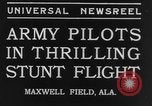
U..S. Army Air Corps flight demonstration team known as "Men on the Flying Trapeze," put on air show at Maxwell field in Alabama, United States
Army pilots in thrilling stunt flight, Maxwell field in Alabama, United States. Four pilots known as "Men on the Flying Trapeze," an Army flight demonstration team, pose in front of a U.S. Army Air Corps P-l2. From the left they are Sgt. William C. McDonald; an unidentified pilot; Captain Claire Chennault and Sgt. John H. Williamson. (Claire Chennault went on to lead the famous "Flying Tigers," The First American Volunteer Group (AVG) of the Chinese Air Force in 1941–1942.) Next, three P-12's are seen taking off together. When airborne, they start an inside loop, then execute other aerobatics in formation Three P-l2's executing a 360 degree roll. Three P-l2's in formation flight.
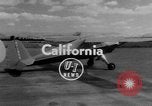
A small home-built bantam biplane makes its first flight in California.
A small biplane parked on the ground in California. John Pontius, the pilot and the manufacturer of the plane pulls the plane. He sits in the cockpit. The plane takes off.
U.S. B-17s of 91st Bomb Group (including the "Memphis Belle") leave Bassingbourn Airfield on bombing mission in World War 2
B-17 bombers of the U.S. 8th Air Force, 91st Bomb Group, take off from their base at RAF Bassingbourn. Views from inside the B-17, "Memphis Belle." The landing gear of the "Memphis Belle" retracting into the wheel well. Views of English countryside, including many RAF airfields. B-17s in close formation. Crew members of the "Memphis Belle" are seen at their duty stations inside the aircraft, including: Captain Robert Morgan,Pilot; Captain Jim Vernis,Co-Pilot; Sergeant Robert Hanson,Radio operator and gunner; Captain Chuck Leighton, Navigator; Sergeant Harold Loch,Flight Engineer and Top Turret Gunner; Sergeant John Quinlan, Tail-Gunner; Sergeant Cecil Scott, ball turret gunner; Captain Vince Evans,Bombardier ; Sergeants Bill Winchell and Tony Nastal, Waist gunners. Pilot , Captain Morgan, alerts crew and dons his oxygen mask as they climb through ten thousand feet. View of coast of England as they leave. Temperatures drop and contrails form as the formation of B-17s climbs to 25 thousand feet.
Soldiers of the 7th Army fight German troops and assist civilians near Strasbourg in France (WW2)
United States 7th Army soldiers fight German troops near Strasbourg, France during World War II. An animated map depicting Nazi Germany and its radius distance to different European cities. Allied troops and tanks move along the countryside in France. Soldiers talk to French civilians. 7th Army troops engage in street fighting in Strasbourg. Tanks on the field. Soldiers fire with their rifles. Buildings and houses sustained damage. 7th Army soldiers use a battering ram to open a door. Newsreel cameraman John Doran records the street fighting. German soldiers surrender to the 7th Army in Strasbourg. Other soldiers on tanks and military vehicles. Wreckage in the area due to the firing and bombarding. A French elderly woman in black meets Allied soldiers. Soldiers help the civilians and take them to safe places. French refugees board a United States Army truck. A United States soldier picks up a pet puppy dog left behind by fleeing Nazi German forces. Medics treat the wounds of a German soldier. Medical troops carry the wounded on stretcher.
Troops of the U.S. 1st, 3rd, 7th and 9th Infantry Divisions assault German Cities in Saar Basin during World War 2.
Troops of the U.S. 1st, 3rd, 7th and 9th Infantry Divisions assault cities in the Saar Basin, including Zweibruecken, Saarbruecken, Remagen, Bad Godesberg, and Bonn, during World War II. They attack the cities with tanks and rocket launchers mounted on top of tanks. U.S. Army soldiers of the 3rd Division enter the ruined city of Zweibrücken. U.S. Army 3rd Division commander Major General John O'Daniel ("Iron Mike") is seen discussing strategy with officers and soldiers. The troops of the 7th Division of the 7th Army moving forward into devastated and bombed Saarbrücken. A group of captured German soldier prisoners of war is shown in Saarbrücken. Wreckage of plaque mounted on Rathaus St. Johann (city hall) in Saarbrücken commemorating the Saar plebiscite and Saar status referendum results of 1935 which was announced by Hitler at the Rathaus St. Johann (Rathauspl. 1, 66111 Saarbrücken, Germany) in 1935. Army vehicles crossing the Rhine on pontoon bridge at Remagen. U.S. Army forces entering Bad Godesberg, where citizens are seen waving white flags of surrender from windows in the town. German civilians in Bad Godesberg read a poster on a building wall giving instructions from the Allied Military Government. German citizens with weapons stand in a line to turn-in the weapons, by order of the Allies. Scenes in Bonn, where the 1st Division of the 1st Army drives to the wreckage of the bridge at Bonn over the Rhine River. Views of the largely destroyed bridge at Bonn. American Army forces guard captured German military prisoners of war in area of Bonn. Views of captured German POW in uniform.
Pork, beef, and sugar crops processed at farms and factories in United States to meet war demand in World War 2
Agricultural progress in the America during World War II, with increased production to meet wartime needs. Pigs, hogs, and piglets on a farm. Trees in the background. Vehicles pass in front of a pork butcher and processing factory. Truck in front says "HH Green" on side. Sign in background of shot says "Morrell" (this is possibly the John Morrell & Co. Packing Plant in Ottumwa Iowa). Butcher workers with cleavers cut and process pork on moving assembly line. Beef cattle graze on a field. Tractor operated on a farm field. View of beef cattle stockyards at butcher and processing factories for meat. Butcher operations for beef cattle seen on moving assembly line. Farmers harvest feed crops for meat production. A feed shed filled to the top. Farmer harvests sugarcane and drives wagon filled with sugarcane, pulled by horses. Farmer on tractor on a sugarcane field. A tall harvesting machine cuts sugarcane in the field at harvest. Farmer on a sugar beet field. A mechanical seed splitting machine is shown. Farmer holding shafts with sugar beet seeds attached. Sorghum plants are shown and described as a new source of sugar. A man feeds harvested sorghum plants into a pressing machine to extract sorghum liquid for sugar.
CRITICALPAST.COM: About Us | Contact Us | FAQs - How to Order | License Agreement | My Account | My Lightboxes | Shopping Cart | Advanced Search | Featured Collections | Website Terms & Conditions | Privacy Policy ©2026 CriticalPast LLC.
License Agreement |
Terms & Conditions |
Privacy Policy
©2026 CriticalPast LLC.