


 Francais
 Deutsch
 Italiano
Refine Your Search
John-F.-Kennedy stock footage and images
- Showing 2545 to 2550 of 3759 results more
more Hide
Hide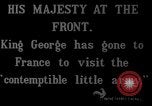
King George V of United Kingdom visits British Expeditionary Force troops at the front in France.
Opening slate refers to King George V visiting the British "contemptible little army," at the front in France. This refers to German Emperor Kaiser Wilhelm, who ostensibly issued an order in August 1914 referring to General French's "contemptible little army." (General French refers to Field Marshal John Denton Pinkstone French, 1st Earl of Ypres, who commanded the British Expeditionary Force following the outbreak of World War 1.) The King with his Aide de Camp, Field Marshal Sir Douglas Haig, and others, steps from an official car. One officer, in an overcoat, walks away, rapidly,heading towards a road where British troops are moving. He is standing there with two officers wearing white arm bands, as King George V and his party reach the spot.Cavalry horses are grazing in a field nearby. British Expeditionary Force (BEF) units are moving along the road. The King greets and shakes hands with an officer standing near the moving troops. The road is crowded with horse-drawn wagons moving war materiel. Infantry are seen in the far background. (World War i; World War 1; WWI; WW1)
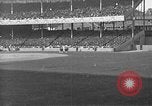
The New York Giants in 1917 baseball World Series games 3 and 4 in New York against the Chicago White Sox.
Baseball 1917 World Series games numbers three and four in New York at Polo Grounds IV stadium in Upper Manhattan, New York City. A large crowd gathers at the stadium to watch the game. New York Mayor John Mitchel arrives along with officers and Mayor Mitchel throws out the first pitch. World Series Baseball game 3 in progress. Giants take the lead at 2 - 0 in the fourth. Robinson scores on Holke's double. Burns singles, sending Holke home. A closeup view of Dave Robertson and Rube Benton in the dugout. The crowd cheers the teams. View also from game 4 where Benny Kauff gets two home runs and Giants win game 4 also. New York crowd, all men, cheering the game 4 win. Mass of spectators exiting the stadium after the game.

U.S. Presidential contender, Republican Wendell Wilkie. Franklin D. Roosevelt, reelected for 3rd term in 1940.
Views of the Republican National Convention in Philadelphia, June, 1940. The hall is filled with delegates holding signs and placards, many for Senator Robert Taft. Several denounce the New Deal. The Republican presidential nominee, Wendell Wilkie, is seen. (The narrator mentions his untimely death in 1944, at age 52.) Scene shifts to cheering crowds in Times Square, New York and to Hyde Park, New York, where the Roosevelt family and associates stand as well-wishers cheer FDR's unprecedented election to a third term as President of the United States. Seen are Colonel House; President Franklin D. Roosevelt; son, John Roosevelt and his wife, Anne Clark Roosevelt; Ethel Du Pont Roosevelt and her husband, Franklin Roosevelt, Jr.; Sara Roosevelt, the President's mother; and his wife, Eleanor Roosevelt.
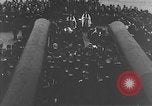
U.S. President Roosevelt and British Prime Minister Winston Churchill attending Sunday church services aboard HMS Prince of Wales
U.S. President Franklin Roosevelt and British Prime Minister Winston Churchill together with British and American delegates to the Atlantic Conference, and crew members of the USS Augusta and HMS Prince of Wales, assemble for Sunday church services aboard the British Battleship, HMS Prince of Wales. The service is conducted by Church of England clergy. U.S. President Roosevelt and British Prime Minister Churchill are seated side by side in the first row. Among those behind them are: Presidential advisors, Harry Hopkins and Averell Harriman; U.S. Vice Admiral Ernest J. King, Commander in Chief of the Atlantic Fleet; U.S. Army Chief of Staff, General George C. Marshall; and British Field Marshal, Sir John Dill. Views of those assembled as seen between gun barrels of HMS Prince of Wales. A British Navy band ensemble provides music for the service.
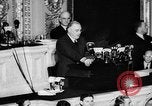
U.S. President Franklin Roosevelt State of the Union address to 77th Congress, known as the "Four Freedoms" speech.
U.S. President Franklin D. Roosevelt addressing the 77th Congress of the United States in the annual State of the Union address. In his "Four Freedoms" speech he speaks of threats to the U.S. and all the American Republics. He calls for support to nations suffering attack from aggressors, He calls for promotion of human rights. After speaking, President Roosevelt turns to greet Congressional leaders, John Nance Garner, his Vice-President (President of the Senate) and Speaker of the House of Representatives, Sam Rayburn. President Roosevelt is assisted as he departs the podium, using a cane. (World War II period).
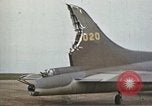
Crew members stand near a wrecked B-17 Flying Fortress in the European Theater .
B-17 Flying Fortress in the European Theater. A B-17 taxis. Damaged wing flap of the B-17. Airmen and crew members stand near the wrecked plane. A man writes information about the wrecked plane. The pilot discusses with the man. The crew of the plane. Damaged wing of a B-17 named 'Little John'. Damaged tail.
CRITICALPAST.COM: About Us | Contact Us | FAQs - How to Order | License Agreement | My Account | My Lightboxes | Shopping Cart | Advanced Search | Featured Collections | Website Terms & Conditions | Privacy Policy ©2026 CriticalPast LLC.
License Agreement |
Terms & Conditions |
Privacy Policy
©2026 CriticalPast LLC.