


 Francais
 Deutsch
 Italiano

Refine Your Search
John-F.-Kennedy stock footage and images
- Showing 331 to 336 of 3762 results more
 Hide
Color Sound
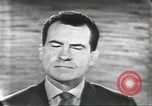
Nixon and Kennedy comment on the Cold War and Communist prestige during a presidential election debate in Washington DC.
The second Kennedy-Nixon Presidential Debate in Washington DC, United States. Edward P. Morgan of ABC News asks Republican candidate U.S. Vice President Richard M. Nixon to comment on whether the United States was doing well in the Cold War. Nixon states that they were not doing as well as they should have in the Cold War because of the presence of the Communists on the international scene. He says that the Communist prestige in the world is lower than the American prestige. He comments on cost cuttings on programs like mutual security and defense by the Democratic Congresses. Democratic candidate Senator John F Kennedy disagrees with Nixon's statement that the Congress has not provided funds for national defense. He also disagrees on the question of U.S. position in the United Nations. He mentions that various reports of Congressional committees indicate that the relative strength of the U.S. compared to that of the Soviet Union and the Chinese Communists together has deteriorated in the past years. Alvin Spivak of United Press International asks Kennedy how the losing prestige can be regained, and programs accomplished without damaging economy. Kennedy talks about the breaking off of the sugar quota with Cuba, passing of an authorization, and the development of the Inter-American Bank. He states that the U.S. has looked at the needs of Latin America. He states that instead of concentrating aid on surplus military equipment in Laos, the aid should have been concentrated in long-term loans. He concludes that Americans should identify themselves not only with the anti-Communist fight but also with the fight against poverty and hunger. Nixon presents his views and states that along with the necessity for economic assistance, the need for technical assistance should also be developed. Americans should not only think in terms of fighting Communism but also in terms of the interests of these countries. He concludes and mentions American ideals of independence, right of freedom and right of progress.
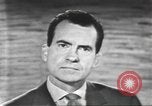
Kennedy and Nixon comment on decisions taken in favor of the U.S. during a presidential election debate in Washington DC.
The second Kennedy-Nixon Presidential Debate in Washington DC, United States. Paul Niven of CBS asks Republican candidate U.S. Vice President Richard M Nixon whether the decisions made so far for the U.S. were right. Nixon says that his decision during the Korean War was right. He disagrees with Kennedy that American prestige is at an all time low. He talks about the average income, daily meal and lifestyle of the Americans. He concludes and states that its his responsibility to correct Kennedy if he misstates. Democratic candidate Senator John F Kennedy disagrees with Nixon and gives the testimony of Senator George Aiken that majority of the Americans did not have income to afford a decent diet. He lays importance on a balanced budget.
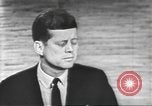
Kennedy and Nixon talk on drawing the defense line in the Far East during a presidential election debate in Washington DC.
The second Kennedy-Nixon Presidential Debate in Washington DC, United States. Edward P. Morgan of ABC asks Democratic candidate Senator John F. Kennedy to comment on whether Quemoy (Kinmen) and Matsu Islands were unwise places to draw U.S. defense line in the Far East. Kennedy states that he believes strongly in the defense of Formosa (Republic of China or Taiwan) and says that the U.S. will defend Quemoy (Kinmen) and Matsu if it is a part of a general attack on Formosa (Taiwan). He says that the U.S. should consult with the Nationalists. He states that the Americans should protect their commitments. Republican candidate U.S. Vice President Richard M Nixon states that he disagrees completely with Senator Kennedy on this point and states the example of the Korean War. Regarding Quemoy (Kinmen) and Matsu he says that these two islands are in the area of freedom and under the control of the Nationalists. He states that the U.S. should not force the Nationalist allies to get off of them and give them to the Communists because the Communists aren't after Quemoy (Kinmen) and Matsu, but after Formosa (Taiwan).
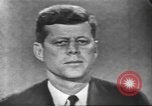
Kennedy and Nixon talk about racial prejudice in the presidential campaign during a presidential election debate in the U.S.
The third Kennedy-Nixon Presidential Debate in the United States. Roscoe Drummond of New York Herald Tribune asks Democratic candidate Senator John F Kennedy to comment on the purpose of the secret domestic militant organization Ku Klux Klan (KKK) in the presidential campaigns. Kennedy answers that the head of the Ku Klux Klan in a statement stated that he would vote for Nixon and not him. Kennedy states that he has never suggested that Nixon has slightest sympathy and involvement with the Ku Klux Klan. Republican candidate U.S. Vice President Richard M Nixon states that it is the Americans who will choose the President. He states that elections are not any test of religion, race but test of a man. He states that Communism is the enemy of all religions and he opposes the Klan organization. He concludes, early in the civil rights movement, that if civilians believe in America they cannot have religious or racial prejudice in the presidential campaign.
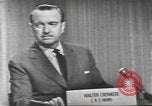
Candidates Nixon and Kennedy debate over prestige of the U.S. overseas prior to the presidential elections in the U.S.
The fourth presidential election debate held between Democratic nominee Senator John F. Kennedy and Republican nominee U.S. Vice President Richard Nixon in New York, United States on 21st October 1960. ABC News correspondent Quincy Howe allows CBS News correspondent Walter Cronkite to ask a question to Vice President Nixon. Mr. Cronkite asks Vice President Nixon if the Eisenhower Administration was suppressing a report by the United States Information Agency that shows a decline in United States prestige overseas as pointed by Senator Kennedy. Vice President Nixon replies and talks about Sputnik space program launched by the Soviet Union (compared to NASA efforts during the Space Race). He further compares the United States and the Soviet Union in terms of education and science. He speaks about UN General Assembly votes called on the Soviet Union to end its Hungarian intervention in 1956 and relates to American prestige. Senator Kennedy says that he did not make most of the statements that Vice President Nixon said he has made and he refers to the first one about Sputnik Program launched by the Soviet Union. Senator Kennedy refers to slums in the United States and talks about support housing legislation which the Eisenhower's Administration has opposed and also speaks about scientists and engineers United States has produced in comparison to the Soviet Union. He further says they were the first in other areas of science but in space, which is the new science, they are not the first
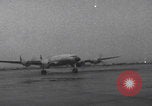
President Kwame Nkrumah of Ghana meets President Kennedy during to the United States
Ghanaian President Kwame Nkrumah arrives at Washington National Airport for an official visit with U.S. President John F. Kennedy. President Kwame Nkrumah climbs down air stair from Military Air Transport Lockheed Constellation as an attendant holds an umbrella behind him. President Kennedy talks with the Ghanaian president at bottom of stairs while Clement Conger (wearing glasses), assistant chief of protocol, stands over his shoulder. At frame left, in dark hat, Chief of Protocol Angier Biddle Duke listens in. Photographers taking pictures of Kennedy and Kwame Nkrumah while the two leaders walk to the hangar of the airport. United States military and government officials meet Presidents Kennedy and Kwame Nkrumah inside hanger.
CRITICALPAST.COM: About Us | Contact Us | FAQs - How to Order | License Agreement | My Account | My Lightboxes | Shopping Cart | Advanced Search | Featured Collections | Website Terms & Conditions | Privacy Policy ©2026 CriticalPast LLC.
License Agreement |
Terms & Conditions |
Privacy Policy
©2026 CriticalPast LLC.