


 Francais
 Deutsch
 Italiano
Refine Your Search
John-F.-Kennedy stock footage and images
- Showing 325 to 330 of 3762 results more
more Hide
HideColor Sound
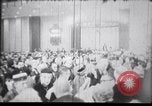
U.S. President Kennedy speaks at Chamber of Commerce Breakfast meeting, in the Texas Hotel, in Fort Worth, Texas
U.S. President John F. Kennedy and Mrs. Kennedy accompanied by Vice President Johnson and Mrs. Johnson, at Chamber of Commerce breakfast meeting in the Texas Hotel, on the morning of the day that the President was assassinated. Those present include Texas Governor Connally, Senator Yarborough, Men take pictures. The officials, Chamber of Commerce members and dignitaries applaud as President Kennedy walks on the stage. The Presidential Seal is displayed on the Podium. First Lady, Jackie Kennedy, is late arriving and applauded when she does. The President and Vice President greet her. Men take pictures. The President speaks to the assembly.
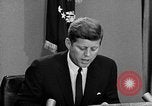
U.S. President Kennedy asks for support of the citizens for ending the discrimination against African Americans, in his speech in the U.S.
U.S. President John F. Kennedy's Civil Rights Address in Washington DC. United States President Kennedy seated at a desk and speaks over a microphone. Following events in Alabama, the President speaks about ending the discrimination of blacks by whites in the United States. He says that it's time for the Congress to act. President Kennedy says that he will ask the Congress of the United States to act, to make a commitment it has not fully made in this century to the proposition that race has no place in American life or law. He talks about the necessary measures that Congress can provide. The President, in his speech, asks the Congress to enact legislation giving all Americans the right to be served the facilities which are open to the public. He talks about his meeting with the business leaders and urges them to take voluntary action to end this discrimination. The President says that he has also asked the Congress to authorize the Federal Government to participate more fully in lawsuits designed to end segregation in public education. He also speaks about giving employment for African American citizens. President Kennedy, in his speech, pays tribute to those citizens of North and South who have been working in their communities to make life better for all. The President asks for support of all the citizens so that the discrimination can be removed and civil rights upheld.
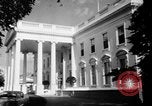
U.S. President Kennedy talks about equal rights for black and white citizens during a speech in Washington DC, United States.
United States President John F. Kennedy's speech regarding racism and racial tensions in Alabama, delivered from Washington DC, the White House. United States President Kennedy seated at a desk and speaks over a microphone. The President speaks about racial discrimination against blacks in the United States. He talks about the University of Alabama not giving admission to two clearly qualified young Alabama residents who happened to have been born African Americans, due to segregation and discrimination practices. View of people crowded outside the University of Alabama (Tuscaloosa, AL 35487, United States). Men take pictures as officials escort entering students Vivian Malone and James Hood into Foster Auditorium of the university. The President says that the nation is founded on the principle that all men are created equal, and that the rights of every man are diminished when the rights of one man are threatened. President Kennedy says that it is right for American consumers of any color to receive equal service in places of public accommodation, to register and to vote in a free election without interference or fear of reprisal. Additional views of Vivian Malone and James Hood walking with crowds and unaccompanied on the University of Alabama campus. A policeman rides a motorcycle on a road at the University. President Kennedy talks about respecting African American citizens and importance of civil rights and equality. The President says that no city or State or legislative body can prudently choose to ignore the rights of any of its citizens. The press record his speech and take pictures.
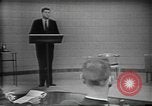
Kennedy talks about federal government assistance for farm surpluses during a presidential election debate in Chicago.
The first Kennedy-Nixon Presidential Debate in Chicago, Illinois. Charles Warren from Mutual News asks Democratic candidate Senator John F Kennedy about the need of assistance by the federal government for farm surpluses. Kennedy answers and states that the federal government supports farmers, as farmers cannot control their market because they lack bargaining power. He states that the overall economy depends on the agricultural economy. He talks about the interdependency of agriculture with other sectors. He further talks about farm policy, support price mechanism and tax load from the Treasury for the farmer. He says the policy for balancing effective supply and demand can only be carried out through governmental action. Republican candidate U.S. Vice President Richard M. Nixon presents his views and states that he disagrees with Kennedy that the farmers need more governmental control. He blames that the farmer is in problem because of the government which asks the farmer to produce surplus to meet emergency. He tells about holding up of farm income by paying the farmer in kind and indemnifying the farmer.
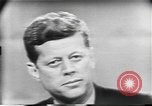
Kennedy states the reasons of failure of passing of Congress bills during a presidential election debate in Chicago, Illinois.
The first Kennedy-Nixon Presidential Debate in Chicago, Illinois. Sander Vanocur from NBC News asks Democratic candidate Senator John F Kennedy about the failure in passing the Congress bills on medical aid to the aged, minimum hourly wage bill and federal aid to education. Kennedy answers and states that his bill to provide a dollar twenty-five cent minimum wage failed because the House of Representatives did not pass it and the House failed by eleven votes. He states the reasons for the the failure of the federal aid to education bill and medical aid to aged bill in the Senate due to lack of votes and U.S. President's Veto power. Republican candidate U.S. Vice President Richard M. Nixon presents his views and disagrees with the statements made by Kennedy regarding action of the House Rules Committee and veto power of the President. He states that the majority of the members of the Congress agreement to the proposals leads to the clearance of a bill. He says that the reason for the failure of these bills was not the President but the people who were against it. He talks about his alternative proposals.
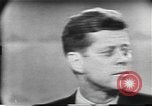
During a presidential election debate in Chicago Kennedy talks about the threats of Communism to the national security.
The first Kennedy-Nixon Presidential Debate in Chicago, Illinois. Charles Warren from Mutual News asks Democratic candidate Senator John F Kennedy about the threats of Communism to the national security of the United States. Kennedy states that matter of Communism should be given great care and attention. He states that the citizens should support the laws passed by the United States and they should sustain the Department of Justice and the Federal Bureau of Investigation (FBI) in its efforts. He further states that the Americans can meet any internal threat but the major threat is external. Republican candidate U.S. Vice President Richard M. Nixon presents his views and states that he agrees with Senator Kennedy's appraisal generally in this respect. He talks about the Cold War. He states that they could also fight Communism at home by moving against those various injustices which exist in their society which the Communists feed upon.
CRITICALPAST.COM: About Us | Contact Us | FAQs - How to Order | License Agreement | My Account | My Lightboxes | Shopping Cart | Advanced Search | Featured Collections | Website Terms & Conditions | Privacy Policy ©2026 CriticalPast LLC.
License Agreement |
Terms & Conditions |
Privacy Policy
©2026 CriticalPast LLC.