


 Francais
 Deutsch
 Italiano
Refine Your Search
John-F.-Kennedy stock footage and images
- Showing 355 to 360 of 3762 results more
more Hide
HideColor Sound
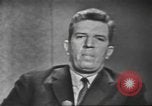
Kennedy and Nixon comment on the Indochina War, Quemoy and Matsu islands, and U-2 flights during their third debate.
Nixon and Kennedy debate questions regarding relations with Communists during the third Kennedy-Nixon Presidential Debate in the United States. Douglass Cater of Reporter magazine asks Republican candidate U.S. Vice President Richard M Nixon to comment whether there was a valid criticism of his statement of foreign policy. Nixon answers and states that the criticism is not valid. Regarding Indochina, he says that the U.S. would not have tolerated Indochina falling under Communist domination. And as a result of that the civil war there ended. He states that he supports the President's position and thinks that the President was correct in ordering the U-2 flights. Referring to Quemoy and Matsu he states that he objects to the constant reference to surrendering these islands. Democratic candidate Senator John F Kennedy disagrees with Nixon's statement on Indochina and states that reason Indochina was preserved was the Geneva Conference. On the question of the U-2 reconnaissance aircraft flights he states that he has never criticized them and never suggested stopping of espionage. On the question of keeping the Communists in doubt about the U.S. defending Quemoy and Matsu he states that the U.S. should meet its commitments to Formosa (Taiwan) and the Pescadores. He concludes by saying that he disagrees with Nixon as Nixon is extending the administration's commitment.
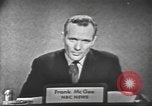
Senator Kennedy and U.S. Vice President Nixon debate on oil depletion allowance during presidential election debate in the U.S.
Presidential election debate held between Democratic nominee Senator John F. Kennedy and Republican nominee U.S. Vice President Richard Nixon in the United States. NBC correspondent Frank McGee asks Senator Kennedy if he considers twenty-seven and a half per cent oil depletion allowance inequitable. Senator Kennedy responds stating that there are many commodities and minerals that have some kind of depletion allowance including oil and no one should get a tax break on the same. He says that if he is elected the president, the whole spectrum of tax will be gone through carefully. ABC correspondent Bill Shadel asks Vice President Richard Nixon to speak on the topic. Vice President Nixon says he favors the present depletion allowance. He further says that if there is no depletion allowance oil exploration will be cut substantially in the United States.
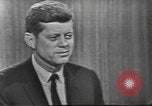
Senator Kennedy gives his closing statement during the fourth presidential election debate held in New York, United States.
The fourth presidential election debate held between Democratic nominee Senator John F. Kennedy and Republican nominee U.S. Vice President Richard Nixon in New York, United States on 21st October 1960. ABC news correspondent Quincy Howe asks Senator Kennedy to give his closing statement. Senator Kennedy says if he loses the election he would continue in the Senate to try and build a stronger country. He says that the year is of importance for the United States. He speaks about the present situation of the U.S. in regard to education, science, and diplomatic relations. He says that the Republican party has stood still really for twenty-five years and opposed all of the programs of President Roosevelt and others. He further says that the U.S. should get a party which believes in going ahead so that the country can reestablish its position in the world with strong defense, economic development, justice for people and should particularly to try to reestablish the atmosphere which existed in Latin America at the time of Franklin Roosevelt.
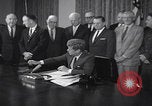
President Kennedy signs the Uniformed Services Pay Raise Bill in Washington DC
United States President John F. Kennedy signs the Uniformed Services Pay Raise Bill (sometimes called the Military Pay Bill) in the Cabinet Room of the White House, Washington, D.C. The Joint Chiefs of Staff, Congressional Members, and other military and government officials witness President Kennedy as he signs the Military Pay Bill. President Kennedy turns to the officials after signing the bill.
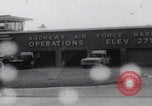
President Kennedy disembarks from a helicopter and boards Air Force One aircraft
A guard outside Andrews Air Force Base near Morningside, Maryland. The seal of the President of the United States. Honor guard marches on the airfield. Civilian crowd stands behind fence waiting for United States President John F. Kennedy. Men disembark from a United States Marine Corps (USMC) helicopter. President Kennedy arrives on a United States Army helicopter. President Kennedy disembarks from the helicopter, walking toward Air Force One (VC-137C SAM 26000). The president is accompanied by assistants, and an unidentified woman as he boards Air Force One. Another man carrying a suitcase follows them. The air stair is pushed back. Air Force One aircraft taxiing and taking off from Andrews Air Force Base.
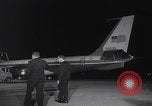
President Kennedy’s hearse leaves Andrews Air Force Base; President Johnson and wife stand at microphones
An air stair moves toward Air Force One aircraft (VC-137C SAM 26000) at Andrews Air Force Base near Morningside, Maryland. The casket bearing the body of President John F. Kennedy is taken out of Air Force One. President Kennedy’s casket is loaded into the hearse. The hearse is followed by a group of staff cars. President Lyndon B. Johnson and First Lady Lady Bird Johnson stand at microphones to make comments to the press following the assassination of President Kennedy in Texas.
CRITICALPAST.COM: About Us | Contact Us | FAQs - How to Order | License Agreement | My Account | My Lightboxes | Shopping Cart | Advanced Search | Featured Collections | Website Terms & Conditions | Privacy Policy ©2026 CriticalPast LLC.
License Agreement |
Terms & Conditions |
Privacy Policy
©2026 CriticalPast LLC.