


 Francais
 Deutsch
 Italiano
Refine Your Search
John-F.-Kennedy stock footage and images
- Showing 349 to 354 of 3762 results more
more Hide
HideColor Sound
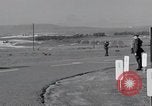
President Kennedy and official party watch Atlas 134D Launch,US
President John F Kennedy arrives in his bubble limousine. President Kennedy, Secretary of Defense Robert McNamara, Lt. Gen. Howell M. Estes, Maj. Gen. Joseph J. Preston, Brig. Gen. Seth McKee, and Dr. Harold Brown at Minuteman silo. President Kennedy and official party watch Atlas 134D launch at Minuteman silo.23 March 1962.
President Kennedy inspects Ballistic Missile Early Warning System in the United States
President John F. Kennedy inspects Ballistic Missile Early Warning System. President Kennedy looks at model Pioneer with paddlewheels, Mark lV and Mark V head cones. President looks at RVX-II head cone and Moon Base display. President Kennedy leaves in his bubble Limousine passing. President's motor caravan passes past flight line display of missiles.
Kennedy and Johnson speak about peaceful aims of the United States in 1963 during the Cold War.
"To keep the peace" about need for peace, during Cold War. Expansive farm field of wheat waving in breeze under a sunny to partly cloudy sky in the United States. Wide shot of ocean waters and sun breaking through low clouds near dawn or dusk. President John F Kennedy delivering a speech on peace and nuclear testing, on July 2, 1963, in Naples Italy at NATO headquarters. Kennedy says, "The purpose of our military strength is peace. The purpose of our partnership is peace. So our negotiations for an end to nuclear tests and our opposition to nuclear dispersal are fully consistent with our attention to defense--these are all complementary parts of a single strategy for peace." Shortly after President Kennedy's death, President Lyndon B Johnson addresses a joint session of Congress on November 27, 1963. Shows segment of speech where President Johnson says, "We have proved that we are a good and reliable friend to those who seek peace and freedom. We have shown that we can also be a formidable foe to those who reject the path of peace and those who seek to impose upon us or our allies the yoke of tyranny."
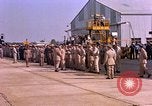
U.S. President Kennedy and party visit space rocket hangar bay with Dr. Wernher Von Braun in Huntsville, Alabama.
President of the United States John F Kennedy's tour to Redstone arsenal in Huntsville, Alabama. Soldiers of Allied nations holding flags of their countries. An aircraft taxis. Honor guard stand at attention. U.S. Army band plays. President Kennedy and party including Vice President of the United States Lyndon B. Johnson and U.S. Secretary of Army Cyrus Roberts Vance arrive in staff car. The party being taken on tour to hangar by astronautics engineer Dr. Wernher Von Braun. The hangar houses the Saturn rocket which Kennedy and the tour group examines. The party talks in the rocket hangar.
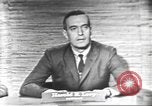
Kennedy and Nixon present their views about tax increments during a presidential election debate in Washington DC.
The second Kennedy-Nixon Presidential Debate in Washington DC, United States. Harold R. Levy of Newsday asks Democratic candidate Senator John F Kennedy about his recommendations to increase tax. Kennedy answers and states that in the present scenario tax increase is not desirable. He says that if it would be essential to U.S. security he would suggest a tax increase. He talks about his programs for economic growth, care for the aged, development of natural resources which would build the strength of the United States. He states that Americans can mobilize their economy and resources. Republican candidate U.S. Vice President Richard M Nixon comments on the increasing expenditures for defense, mutual security, economic and technical assistance. He says that he thinks it may be necessary to increase taxes to maintain a sound economy. He concludes and states that no president can add billions of dollars to his nations expenditures and not pay for it, after all the payment is made by peoples money.
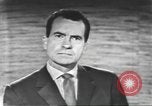
During a presidential election debate in Washington DC, Kennedy and Nixon give their views on the importance of party labels.
The second Kennedy-Nixon Presidential Debate in Washington DC, United States. Harold R Levy of Newsday asks Republican candidate U.S. Vice President Richard M Nixon to comment on the importance of party labels. Nixon answers and talks about Democratic and Republican Presidents. He says that the party label is not important, it is the belief and the leadership qualities of the presidential candidate that are important. He states that it is the people who determine and elect their presidents. He disagrees with Kennedy's statement that his party has not proposed programs. He mentions the programs proposed by his party in fields like education, housing and defense that would lead to the overall development of the nation. Democratic candidate Senator John F Kennedy presents his views and states that party labels are important as they tell about the programs and the candidate. He says that the Democratic party has stood for progress, people's welfare, strong foreign policy and national defense. He compares the approaches used by Democratic presidents with those used by the Republican presidents. He concludes that in the past years the Republicans have opposed housing, care for old age, federal aid to education and minimum wage. Moderator Frank McGee thanks the candidates and mentions future program details.
CRITICALPAST.COM: About Us | Contact Us | FAQs - How to Order | License Agreement | My Account | My Lightboxes | Shopping Cart | Advanced Search | Featured Collections | Website Terms & Conditions | Privacy Policy ©2026 CriticalPast LLC.
License Agreement |
Terms & Conditions |
Privacy Policy
©2026 CriticalPast LLC.