


 Francais
 Deutsch
 Italiano
Refine Your Search
Kaiserslautern Germany 1962 stock footage and images
- Showing 139 to 144 of 6816 results more
more Hide
Hide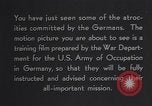
Training film for U.S. troops with the Army of occupation in Germany after world War II
Opens with bell tolling Victory against Germany in World War II. Next, a slate reads: "Victory Leads to Peace," and a farmer is seen with cattle pulling a plow. But narrator says "the problem now is future peace," and a map of Germany is shown overlaid with "Your Job in Germany." A cartoon of a soldier is superimposed on the map, along with one of a World War 1 American soldier and a figure of possible future soldier with similar mission. Camera focuses on parts of German aircraft in a jumbled heap. Closeups of weary defeated German soldiers at end ot World War II. Glimpse of Adolf Hitler speaking and haranguing an audience from a podium in an animated and forceful way. Swastika flags displayed from houses in a quaint German town. Joseph Goebbels, Nazi Reich Minister of Propaganda, at a microphone. Glimpse of a German concentration camp. But as they appear, each of the Nazi elements promptly disappears, showing the scenes without such Nazi symbols and persons. Skeleton remains of bombed buildings. Flower displays. Bucolic German rural countryside and quaint old villages in peaceful settings. Camera focuses on a book titled "German History." Chapter I, titled "Blood and Iron," shows Image of Otto von Bismarck. German troops march in a parade. Narrator states that "under Bismarck, the German empire was built." (He formed the German Empire in 1871, unifying Germany with himself as Imperial Chancellor, while retaining control of Prussia at the same time.) The film shows mounted German lancers as it alludes to Bismarck's campaigns against Denmark in 1867; Austria in 1866; and France, in 1870. Germany's leaders celebrating its status, in 1871, as the mightiest power in Europe. Troops marching and girls dancing nearby. Farmers plowing field with a horse and cow. Classic peaceful rural alpine scenes with local people in agricultural pursuits. A group of local German musicians playing folk music as village people dance outdoors. Back to the book, Kaiser Wilhelm II is shown on Chapter 2, entitled: "Deutschland über Alles." Gathering of German soldiers in Pickelhaube (spiked helmets). A German Big Bertha howitzer firing. German troops marching against Serbia; Russia; and France (with view of war damaged French cathedral). German invasion of Belgium in 1940 (with view of clock tower resting in rubble). German troops seen in Italy, walking past battle-damaged buildings. German Zeppelin dropping bombs on British targets and view of bombed out London neighborhood. Next scene shows a capsized ship with survivors running across its hull. Film slate labels the scene as United States, as if it is a U.S. ship attacked by Germany. (Actually, it is the Austro-Hungarian Battleship, SMS Szent Istvan, torpedoed, by Italian torpedo boats, during World War I.) Next, American soldiers in trench are seen going "over the top" and into "no man's land" on the western front of World War 1. Glimpse through a window of Kaiser Wilhelm II, after defeat of Germany, in 1918. View of Germans in a Beer Garden. Picturesque view of German town. A German orchestra performing. American soldiers marching out of Germany, with flags waving. Back to the history book,as chapter III is revealed, entitled "Today Germany, tomorrow, the world," and featuring Adolf Hitler. German troops invading Austria (where a civilian lies dead on the ground). German troops entering Czechoslovakia (where local people in tears render the Nazi salute). They march into Poland (where a girl weeps over someone, not seen, on the ground). They march into France (where a wounded, bandaged child cries in a bed). Next, is a scene from England, where a British child victim of bombing lies dead in the remains of a shelter. German troops invading Norway, Holland, Denmark, Belgium, Luxembourg and Russia (where a woman tries to rouse a dead woman). They invade Yugoslavia (where women sit near coffins of children) and Greece (where a woman rescues a naked child). A U.S. merchant ship explodes after being torpedoed by a German submarine (unseen). Scenes of destruction with people plucking dead victims from rubble of buildings. American troops invading Normandy, France on D-day, June 6, 1944. Several American soldiers fall to German gunfire on the beach. Wounded American soldiers being transported in jeeps on the battlefield and being placed on landing craft for evacuation. Americans walking past huge piles of destroyed aircraft parts. A landing craft filled with wounded American soldiers. American wounded and dead on a battlefield. Sailors abandoning a burning American ship by jumping into the sea. A sailor picked up in a life boat. A wounded American soldier being dragged from the beachhead at Normandy. Various wounds being treated by U.S. Medical Corps personnel. More scenes of American wounded being moved on stretchers. Scene shifts abruptly to German people folk dancing. Film concludes with question marks about the future.
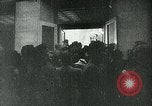
People gather at an opera house in Germany; various performing arts in Nazi Germany; Winterhilfswerk fund drive
People gather at an opera house in Germany. Dancers perform a high kick routine in the hall. People watch the show and applaud. Some are Nazi German soldiers in uniform. View of an acrobatic show with a floor show followed by a trapeze act entertaining an audience in Germany. Men play in an orchestra in a symphony hall or opera house. Conductor leads orchestra. View of various instrument sections up close, including trumpets. View from behind violin players as they read music and play. Woman model on a stage comes forward and stoops with a tin can to accept contributions in the annual Winterhilfswerk des Deutschen Volkes drive, for relief for needy people in Germany during the winter. Street scenes of youth carrying tins and accepting coin and money contributions from German citizens for the Winterhilfswerk fund drive. A small child adds a coin to the tin. A Nazi officer adds a coin. A group of men crowd around to put coins in the tin. People watch them. Brief montage scene of German armament in World War 2, including artillery being raised to fire, close-up view of tank tread as tank advances, German Navy ships underway in the ocean, low-flying German aircraft flying overhead in the sky including a Junkers Ju 52 tri-motor aircraft.
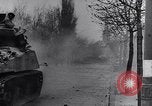
End of World War 2 in Germany, the Four-power occupation of Germany after World War II, and the Berlin Airlift
Allied tank and tank destroyer firing and Allied infantry in Germany during World War 2. British, American, and Soviet troops escorting German Prisoners of war at the end of the War. Animated map shows line where U.S. and Russian troops met.and zones of occupation in Germany and Berlin. It depicts routs of access into the Soviet zone of Berlin View from a vehicle driving through utterly destroyed part of Germany in 1945 with rubble and ruin of many buildings seen. German citizens cooking on outdoor fire in a city street, and trying to clear some debris of destroyed buildings by hand and using buckets in a "bucket brigade." Bus service being restored and German citizens boarding. Vehicle traffic moving with a German police officer directing. Doctors perform physical examination of a German boy as a group of German boys wait in queue for examination. Soviet Leader, Joseph Stalin, with U.S. President, Harry Truman, British Prime Minister, Winston Churchill, at the Potsdam Conference. Children receiving soup at a school in Berlin. Animated map shows routes through the Soviet occupation zone, used by Western Allies, to supply essential food and supplies through the Soviet zone of occupation to sustain West Berlin residents. It then depicts Soviet action blockading the road and rail routes to isolate West Berlin. Views of empty roads, rails, and canals. A DC-3 (US Air Force C-47) transport aircraft taking off. Men loading supplies on aircraft for delivery to West Berlin. A C-54 transport airplane taking off. A British Short S.25 Sunderland flying boat carrying cargo in the Berlin Airlift. Troops carrying supplies for airlift. A British Avro York transport aircraft taking off. A warehouse filled with barrels for Berlin. View from overflying airplane. Trucks resuming travel to Berlin after the Soviets finally lift the 9-month blockade. Normal supplies of food seen again, in West Berlin shops. Vehicle stopped at a checkpoint. Sign warning that: "You are leaving the American Sector." and similar ones at the French and British sector borders. Old road sign pointing to Potsdam, beside another sign warning of entering the Russian zone. Traffic moving between East and West Berlin.
German children seated in side U.S. aircraft and fly to West Germany for summer vacation during Operation Kinderlift, Germany.
U.S. Air Force aircraft fly some Berlin children to West Germany for summer vacation during Operation Kinderlift in Germany. German children with their parents at an airport. A young German child with a tag around his neck. An officer holds a German boy and he cries. A young German boy stands by. A woman holding her son. The U.S. officer along with the German children board a U.S. aircraft. The parents of the German children wave as their children depart for vacation holidays in West Germany during the Cold War. The aircraft taxis and takes off. The children seated inside the aircraft. Two boys play chess. A boy eats banana. Another looks through binoculars.

Guidelines to the United States occupation soldiers in Germany after the end of World War II.
This film contains numerous views of citizens in postwar Germany interposed with flashbacks of Nazi activities seen in Germany during the war. At start, film shows drawing of U.S. soldier superimposed on map of Germany. Armed U.S. troops, early in the occupation of Germany, proceed with caution along an alleyway, when an explosion occurs in a nearby building. German citizens going about their daily affairs in a village. Many patronize an outdoor market. Flashback to Germany during World War 2, with view from a high overlooking building, of troops marching along a street below. Closeup of German SS Guards marching in abbreviated goose step along a street. Glimpse of civilians in German city. German storm troopers marching at the Nazi Rally grounds in Nuremberg. More views of citizens on the streets of a city in postwar Germany. Glimpse of several German Nazi officials meeting together. A group of German civilian men relaxing in a courtyard. A town decorated with Nazi flags and banners. Views of ordinary Germans: a doctor, a technician, a clock maker, a postman, a farmer, a woman housekeeper, women toy makers, barbers, cooks, and dockworkers, all at work during the Nazi wartime era. A gathering of Hitler Youth at a rally. Closeups of young boys playing band instruments, then, marching through a gateway labeled: "Nordmarch Lager 1935," and parading through the streets of a town. A different group, dressed in black uniforms, and carrying backpacks, as they march in a town. Members of the Reich Labor Service marching with shovels on streets and during a rally at the Nazi grounds in Nuremberg. Several cartoon drawings accompany messages for U.S. troops on postwar occupation duty in Germany. They remind the soldiers that they are standing guard, but they must obey local laws, respect local customs and respect property rights. Also that they are not to ridicule or argue with local people. They are cautioned not to make friends with German citizens, but to be cautious and suspicious. Views of German people socializing, and gathering at outdoor markets. Views of German men, women and children in various activities, in their homes and outside. Narrator tells U.S. soldiers not to fraternize with the German people.
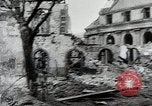
End of World War 2 in Germany, with Allied forces advancing in Germany; destruction of German areas and German forces surrender
American Troops occupying Germany in 1945, near the end of World War II in Europe. Ruins of German cities. White flags displayed from windows. German civilians distraught over destruction of their homes and towns. Towns ablaze in the night with ambulances passing through. Scenes of utter destruction in Basel, and Wurtzburg. Destruction of Essen, Germany, including the Krupp munitions works. German ME-109 plane by the roadside.A truck passes by. Abandoned Marder II Panzerjaeger in the woods. Bombed columns of German soldiers, with equipment and dead German soldiers along roadways. Massive groups of German soldiers surrendering under guard of Allied forces.