


 Francais
 Deutsch
 Italiano
Refine Your Search
Kaiserslautern Germany 1962 stock footage and images
- Showing 3607 to 3612 of 6816 results more
more Hide
Hide
British prosecutor Shawcross presents crimes by Nazi leaders during Nuremberg Trials; scenes from Molotov-Ribbentrop Pact signing
Trial of Nazi leaders for war crimes in Nuremberg, Germany soon after the end of World War 2. British Chief Prosecutor Hartly W Shawcross presents count no 2, crimes against peace involving wars of aggression in violation of international treaties and agreements. A document reveals Adolf Hitler's plans to occupy Poland. Footage showing Soviet Leader Joseph Stalin and Germany's Joachim Von Ribbentrop as they sign non-aggression pact between Russia and Germany on August 23, 1939 (also called the Molotov-Ribbentrop Pact). Germany prepares to occupy Poland as Pope Pius XII and President Franklin D Roosevelt appeal for peace just before start of World War II.
Russian chief Prosecutor, Roman A Redenko charges Nazi leaders with commitment of war crimes during the Nuremberg Trials.
Nuremberg Trials in Germany. Russian Chief Prosecutor Roman A Redenko presents count 3 and 4 charging Nazi leaders with commitment of war crimes in Germany and in other countries occupied by Germany. Prisoners of war searched for weapons, starved, made to march and abused by Nazis. A General and Kenaris testify before the tribunal in Nuremberg, Germany
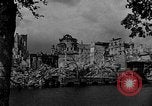
People in the U.S. listen as President Truman speaks during the United States flag raising ceremony in Berlin at end of World War 2
Filmed shortly before the Potsdam Conference in Berlin, Germany. A view of the devastated city of Berlin shortly after the end of World War 2 in Europe. Aerial views of bomb damaged Berlin and point of view shots from a moving car passing destruction, rubble, and skeletons of buildings from bomb damage. U.S. President Harry Truman surveying the damage from an open car, and view of his car approaching the Brandenburg Gate and driving on the Unter den Linden. Three flag towers each decorated at the base with an image of Truman, Stalin, and Churchill. U.S. President Harry S. Truman is riding through Berlin with General Secretary of the Communist Party of the Soviet Union Joseph Stalin and Soviet Foreign Minister Vyacheslav Mikhailovich Molotov. Flashback shows German Fuhrer Adolf Hitler parading in Berlin. People crowd on either side of a street to cheer. Close up back and side profile view of Hitler as he stands in a moving car waving to the crowd. Hitler speaking at a Nazi Rally, forcefully and animated, about Germany wiping out inferior races, and decrying America's society of mixed people, saying that it has a ridiculous notion of equality and freedom that cannot stand up against Germany. The German people in the hall applaud. Truman speaks into a microphone in Germany after the war. U.S. delegates stand in the background. A radio tower. A U.S. military serviceman operating controls for the radio broadcast. People in the U.S. listen to President Truman speaking from a Berlin Radio Station. A hand on a typewriter. People of the United States in groups listening to radio: Men gathered at a city store listening to the radio speech; a woman typist listening to the radio beside her typewriter; men in a rural general store gathered around a radio near a wood stove; farmers listening to a radio; office workers gathered around a radio; a family in a living room listens to the radio; group of U.S. Army soldiers gathered to listen to the radio . Truman speaking on the grounds of the United States Group Control Council Headquarters in Berlin. He is in a courtyard that had been the home of the German Air Defense for Berlin. An honor guard from Company 'E' of the 41st Infantry is present, along with Secretary Stimpson, Assistant Secretary McCloy, and Generals Eisenhower, Patton, Clay, and Bradley. Soldiers stand in formation in the background. He speaks about peace in the world during the ceremony raising the United States flag over the U.S. controlled area of Berlin. His words included the statement, "Let's not forget that we are fighting for peace and for the welfare of mankind. We're not fighting for conquest."
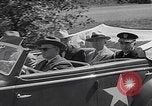
President Harry S. Truman and officials inspect damage in Berlin before the Potsdam Conference (WW2)
United States President Harry S. Truman visits Berlin for the Potsdam Conference at the end of World War 2 in Europe. President Truman, Admiral William D. Leahy, Secretary of State James F. Byrnes, sit in open car to view Berlin in ruins. Berlin buildings and façade are destroyed from heavy bombing. Ruins of the Reich Chancellery (Wilhelmstraße 77 10117 Berlin Germany) is seen. President Truman’s car passes by the Berlin Victory Column or Siegessäule (Großer Stern, 10557 Berlin, Germany). Closer view of the Berlin Victory Column, featuring the Victoria statue on top. Large portraits of President Truman, Russian Premier Joseph Stalin and Prime Minister Winston Churchill on a Russian reviewing stand on Berlin’s Unter den Linden Avenue. President Truman’s convoy approaches the Brandenburg Gate (Brandenburger Tor Pariser Platz, 10117 Berlin, Germany), damaged by heavy bombing. Cars driving on the Unter den Linden Avenue. The Berliner Schloss (Schloßpl. 1, 10178 Berlin, Germany) with significant damage. The Secret Service stand on running boards of President Truman's car. President Truman greets a man from his car. President Truman, Admiral Leahy and Secretary of State Byrnes talking. A huge pile of rubble stands in front of a damaged building. Crowds of men and soldiers surround President Truman and his car. Soldiers with cameras take photographs. Secret Service men running alongside President Truman’s car. President Truman’s car passes by a Nazi-style building, driving into the Autobahn. A Military Police vehicle, which acts as guard, follows behind President Truman's car heading to Potsdam.
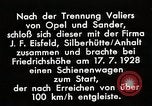
Eisfeld-Valier rocket propulsion system tests using simple chassis with steel wheels running on narrow gauge railroad.
July 17, 1928, Friedrichshohe, Harz, Sachsen-Anhalt, Germany. Trial run of an Eisfeld-Valier propulsion system on a simple rail car (chassis mounted on steel wheels) running on the Harz Narrow Gauge Railway ,in central Germany. A man fits rocket boosters in the chassis. A flag marks the start point. The car leaves the start point and attains speed of over 100 Km per hour. Spectators stand near the track. July 25, 1928. Another trial run of the rocket-propelled rail car. Men near Eisfeld-Valier-Rak-1propelled rail car on tracks. Men fit rocket boosters in the car. The boosters are ignited. The car attains a speed of 180 Km per hour. July 26, 1928. Official speed run of the Eisfeld-Valier-Rak 1rail car at Stiege, Germany. On this third run, the car reached 180 km / hr but continues its strong acceleration, causing it to derail and fly off the track at a speed estimated to be 300 Km per hour.
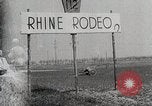
U.S. troops put on a rodeo that entertains themselves and local German citizenry during World War II
American troops take time out during advance into Germany during World War 2. Sign erected by American soldiers, in a field in Germany, reads: "Rhine Rodeo." What appears to be a sign for highway "112" is behind and an artillery piece sits in field in background. Two U.S. soldiers in top hats laugh as they watch others, who appear to be experienced cowboys, take turns in bronco busting and other rodeo events. Local German civilians and youth watch events from the side of the field. U.S. troops seen moving on further into Germany.
CRITICALPAST.COM: About Us | Contact Us | FAQs - How to Order | License Agreement | My Account | My Lightboxes | Shopping Cart | Advanced Search | Featured Collections | Website Terms & Conditions | Privacy Policy ©2026 CriticalPast LLC.
License Agreement |
Terms & Conditions |
Privacy Policy
©2026 CriticalPast LLC.