


 Francais
 Deutsch
 Italiano
Refine Your Search
Kaiserslautern Germany 1962 stock footage and images
- Showing 3613 to 3618 of 6816 results more
more Hide
Hide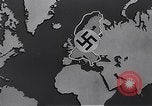
German and Japanese positions destroyed by bombing from Allied bombers, during World War II.
Allied air war over Germany and Japan in World War II. A map showing the Germany occupied areas in Europe and Japan occupied region in South Asia. Aerial views of Allied bomber aircraft flying over the city of Berlin, Germany. The target, Messerschmitt AG, a German aircraft manufacturer company, is bombed by the bombers. Bombs strike the target and huge explosion destroys the factory. Allied bombers drop bombs over targets in Tokyo, Japan. Bombs hit the ground and explosion smoke can be seen from the plane during saturation bombing of Tokyo, Japan.

Analysis of the German labor force from 1939 to 1943 (WW2)
Analysis of the Germany's labor force, military strength and effects of World War II on manpower. German soldiers march. Men work in factory on equipment and machinery. Women work in factory. A cemetery of World War 1 soldiers in Germany. Narrator explains how loss of man power from world War 1 deaths, and subsequent lower birth rate leads to war production worker needs being filled by many young German women and even German boys and girls working in industrial factories also. Wounded German soldiers being treated in field during World War 2. A map points Germany, Sudetenland and Austria. Graphs examine labor force by sex, age and military replacement availability; compare the labor force according to sex from 1939-1943; detail the increase of work force through the women part time workers and the veterans. Women weld equipment in a factory. Men do mining work. Narrator speaks of foreign workers (such as from Poland, Netherlands, Czechoslovakia, Yugoslavia), and how some now serve "under economic pressure and compulsion" (as forced labor or slave labor). Views of forced labor crews working digging earthworks. Laborers also work on building or repairing railroad stations and track work. Lines of prisoners of war, also used for labor, walk under German guard as lines of German uniformed troops walk in the opposite direction. Graphs compare the labor force in agriculture, industry, trade services, transport and government.
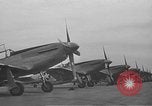
P-51 Mustangs and B-17 Flying Fortress planes attack German aircraft plants during World War II.
U.S. Army Air Force bombers attack Germany during World War II. View of U.S. P-51 Mustang aircraft in flight line at U.S. Air Base in England, United Kingdom. Aerial views of a formation of B-17 Flying Fortress planes and P-51 aircraft in flight over Germany. Bombs fall on German aircraft plants. Ruins of German aircraft plants after facing the bombings. Scene changes to show German war production workers building new Focke-Wulf aircraft (e.g., Fw 190) at production factory in Germany.
German surrender scenes and views from wrecked German cities at end of World War 2
Documentary titled 'Deutschland Erwache' recounts Germany's wartime experiences. Explosion seen as the Nazi Swastika emblem is blown up on top of the Zeppelintribüne (at Zeppelinfeld) at the Nazi party rally grounds in Nuremberg in 1945 by the U.S. Army. Following explosion, the pieces from the destroyed emblem fall from the sky. Montage shows: German Prisoners Of War (POWs) marching; Ratification of the German surrender documents (from surrender two days earlier at Reims) held at Soviet headquarters in Karlshorst, Berlin, Germany on May 9, 1945. German officers present include Colonel-General Hans-Jürgen Stumpff from the Luftwaffe, Field Marshal Wilhelm Keitel as Chief of Staff of OKW, and Admiral Hans-Georg von Friedeburg as Commander-in-Chief of the Kriegsmarine. They are seen entering room and signing documents. View of Keitel signing the surrender document. Soviet Russian General looking at surrender documents. General Eisenhower, General Montgomery and others shown in brief glimpses. Stalin, Roosevelt and Churchill at Yalta. Aerial views of heavily bomb-damaged cities in Germany, including wrecked German cities of Cologne, Nuremberg, Hamburg, and Berlin. View of Brandenburg gate in background and rubble of bombing in foreground as two people carry a stretcher down the street. A wrecked street sign for the Unter Den Linden lies on the ground partially covered in mud. Ground level views of smoking ruined buildings in Berlin and a few German citizens walking on the streets following Battle of Berlin. Views of dead German soldiers on a battlefield. German soldiers helping to carry and tend to wounded and bandaged German soldiers. Large group of German citizens gathered in a public square.
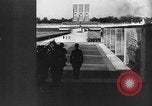
Nazi Party ceremonial grandeur is contrasted to the horrors perpetrated under the 3rd Reich
6th Nazi Party Congress at Nuremberg, in 1934, featuring a "Totenehrung" ceremony, honouring dead. Nazi SA ( Sturmabteilung) and SS (Schutzstaffel) troops in precise formations fill the Zeppelin Field Luitpold Arena, leaving only a wide pathway to the Ehrenhalle war memorial. View from behind honor guard standing at the Ahrenhalle, as Adolf Hitler, flanked by SS leader, Heinrich Himmler (in Black) and Viktor Lutze, head of the Sturmabteilung (SA), approach. Three huge banners with swastikas are seen in the far background. Scene shifts to 1945. American troops are now assembled at the main grandstand (Ehrentribüne) of Zeppelin Field. The American flag covers the wreathed swastika sculpture at the top of the Grandstand. View of German soldiers, who have been mustered out, mingling with civilians in a town. Some speak with an American soldier, who is part of the U.S. occupying force. Scene shifts to the Yalta conference in February, 1945. Winston Churchill, Franklin D. Roosevelt, and Joseph Stalin are seen seated while their most senior military staff members stand in the background. Allied leaders sit around a large conference table. U.S. Secretary of State James F. Byrnes, sits near Prime Minister Winston Churchill. Scene shifts back to Nazi era. Joseph Goebbels, Reichminister of Propaganda is speaking and haranguing a crowd. In contrast, German soldiers are seen conversing with occupying American soldiers. This is contrasted with more scenes of Nazi leaders giving impassioned speeches to a hall filled with Nazi faithful. German soldiers, prisoners of war are seen directed by U.S. military police, behind a barbed wire enclosure. Large numbers of German prisoners of war in an open holding area. Closeups of some. Bucolic scenes of farmers working in fields and herds of sheep and cattle. Hitler speaking in a forceful, animated way and haranguing an audience of rapt listeners. German civilians standing quietly in a group. (Narrator refers them being the people of Beethoven, Goethe, and Martin Luther, as statues of those iconic Germans are shown.) In dramatic contrast, numerous dead bodies of victims are being shown to German citizens by American troops, at Nordhausen, Buchenwald, and Bergen-Belsen concentration camps. This is contrasted against views of German people folk dancing in traditional costumes, German contributions to science (view of Albert Einstein speaking) and industry (view of professional glass blowers at work). Glaring contrast shows German civilians moving the body of a concentration camp victim; several civilians being shot dead by a firing squad (unseen); Rudolf Himmler; and an image Germany being destroyed, as result of the Nazis. American soldiers are loosely assembled in an open field. by the Elbe River at Torgau, Germany on 26 April 1945. American and Russian officers greet each other at the site, where their armies have met in World War 2. American and Russian soldiers mingle and greet one another. Views of Allied forces entering Germany. Another scene of victims' bodies stacked at a concentration camp. French soldiers examine stake where prisoners were tied and executed in the Gestapo headquarters on Paris France. Other views of the Gestapo prison, where victims were buried. Examples of torture devices used to coerce information from prisoners. More views of stacked bodies of victims. Germans carrying bodies from a concentration camp. General Dwight Eisenhower and General George Patton visiting the Ohrdruf Concentration Camp. Burned remains of victims. Closeup of General Patton. German officials and citizens confronting horror as they are compelled to walk through the camp. A huge wagon loaded with bodies of the dead. German women appalled and repelled by the sights. Countless numbers of dead victims covering a large courtyard. German citizens compelled to carry body of a victim from the yard. Others carrying bodies of victims. Large numbers of German citizens, seemingly shamed and remorseful at the revelations. A group of German men carrying shovels and others carrying crosses to commence burying the victims appropriately. Men carrying victims bodies in open wooden caskets along a road lined with spectators. Coffins of victims laid out in a cemetery. (Narrator alludes to them never forgetting.) German men gently place covered coffins in a long mass grave.
Victims of the holocaust being liberated and receiving medical aid at Nazi German concentration camps
Evidence of holocaust atrocities in Germany near end of World War 2 in Europe. German civilians in Gardelegen Germany carrying crosses for 1,100 fresh graves for victims of the holocaust at Gardelegen. The German citizens walking on the streets carrying the crosses. Buildings in view. Scenes from various liberated concentration camps in Germany. A crowd around a liberated concentration camp building. The Allied army soldiers enter a gate of a camp. Soldiers enter through gates of several different camps with sign "Arbeit Macht Frei" on Dachau Concentration Camp gate. Scenes of happy liberated inmates at various camps. Two men walk in front of a crowd entering a liberated camp. Liberated concentration camp inmates in striped prison uniforms smile and some wave. Some of them appear to be very young men or older boys. Men cheering. U.S. Army soldier leans head out of watch tower and looks down on concentration camp field and barracks. Freed inmates around and on top of a concentration camp barracks building. Allied soldiers escort horse drawn wagon with potatoes in it through camp as inmates scramble to gather food. Starved man on a street scraping spilled food of some kind from the ground and eating it. Soldiers bring out body of liberated prisoners from barracks and dungeons. A soldier carries an injured person in a stretcher. Men carry emaciated and injured victims into a vehicle. A victim man lying on the ground. Physicians provide medical aid to victims of Auschwitz Concentration Camp. Doctors examine a man, a woman, and several starving child victims.