


 Francais
 Deutsch
 Italiano
Refine Your Search
Kiribati Gilbert Islands 1943 stock footage and images
- Showing 2197 to 2202 of 6726 results more
more Hide
Hide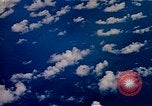
Operations Crossroads atomic test "BAKER" in Marshall Islands
Nuclear weapons test "BAKER" in Bikini Lagoon, on July 25, 1946. Ships anchored in the lagoon are seen from aircraft flying above. The nuclear device with yield of 23 thousand tons of TNT equivalent, is detonated from 90 feet below sea level. The screen goes white from the light of the resulting fireball. As that light dissipates, a huge wall of water is seen rising rapidly to create a mountainous ball of water, from which a mushroom cloud starts billowing upwards. A huge column of water is seen falling out of the mass, as the mushroom cloud continues to rise and spread.
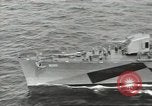
USS Braine transfers men to the USS New Mexico, during the Mariana Islands campaign in World War II
The destroyer USS Braine, DD-630, transfers wounded men, via Stokes stretcher, to the battleship USS New Mexico, BB-40, for medical treatment, during the Marianas campaign of World War 2. (The USS Braine had earlier been hit by a Japanese six-inch shore battery off the shores of Tinian, causing minor damage.)
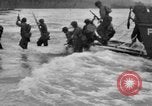
U.S. troops unload from the LVT,head for beach to advance and men play a crap game in Palau island.
The amphibious landing of U.S. troops in Palau during World War II. The American aircraft in flight overhead. A Landing Vehicle Tracked (LVT) coming on to the beach. Three LVTs heading for the beach. Part of the task force. The armored LVT passes on the reef. Two armored LVTs on the beach. Troops unloading from the LVT and running up through the surf. The troops advancing on to the beach. The LVT high on the beach. A dead man floating in the water. A dog tag around the man's neck. Men play a crap game using a helmet. The dice and money in the helmet.
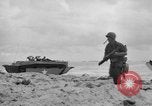
U.S. troops advance on the beach with a flame thrower and bazooka in Palau island.
The amphibious landing of U.S. troops in Palau during World War II. The beachhead area as two Landing Vehicles Tracked (LVT) pull up and troops disembark. The troops advancing on the beach and the ships in the far background. A man with a flame thrower squatting behind a tree. A man squat in the bushes. The beach as the troops advance. A man falls down on his stomach and mans a bazooka.
U.S. troops unloading from the LVTs and LCT on the beach as it loads Sherman tanks in Palau island.
The amphibious landing of U.S. troops in Palau during World War II. Four Landing Vehicles Tracked (LVT) heading for the beach. The troops unloading from the LVTs. A wrecked aircraft in the water. The troops unloading from the LVT. The wreckage of the aircraft. A man digging a foxhole. A man getting his knee bandaged. A man jumping over the side of an LCM (Landing Craft Mechanized) into the surf. Men unloading into the surf from an LCVP (Landing Craft, Vehicle, Personnel). A man carrying a stretcher on his shoulder. Two Sherman tanks with snorkels on the beachhead and an LCT (Landing Craft Tank) in the background. Sign: 'Tokyo Bound' on the side of the tank. Snorkel on the port of the tank. LCT 1292 on the beach as it loads Sherman tanks. The tanks load onto LCT on the ramps. Two tanks in the LCT. A soldier wearing foul weather gear and life jacket talks over the radio.
USNS Rose Knot functioning as a telemetry station for the Mercury-Atlas 6 network off the coast of the Canary Islands in Africa
View of the antennas of USNS Rose Knot (T-AGM-14), operating as USAFS Rose Knot E-45-1850, a missile range instrumentation ship assigned in the Atlantic Ocean off the coast of Africa, to function as Station 3 telemetry station for the Mercury-Atlas 6 network. View of bow of the USAFS Rose Knot E-45-1850 sailing in the Atlantic Ocean, communicating with American astronaut John Glenn on Friendship 7 and monitor its journey. Inside the engine room, a senior sailor operates the ships telegraph engine and speed control back and forth. A sailor seen at helm on the ship’s wheel. The older sailor speaks through an intercom with an Eastern European accent. Telemetry communicators aboard USAFS Rose Knot goes down a spiral stair and submits a paper to a colleague in the control room. The telemetry specialist, wearing headphones, reads the paper given to him by his colleague earlier.
CRITICALPAST.COM: About Us | Contact Us | FAQs - How to Order | License Agreement | My Account | My Lightboxes | Shopping Cart | Advanced Search | Featured Collections | Website Terms & Conditions | Privacy Policy ©2026 CriticalPast LLC.
License Agreement |
Terms & Conditions |
Privacy Policy
©2026 CriticalPast LLC.