


 Francais
 Deutsch
 Italiano
Refine Your Search
Kiribati Gilbert Islands 1943 stock footage and images
- Showing 2365 to 2370 of 6726 results more
more Hide
Hide
Wounded U.S. soldiers being treated during Pacific campaign of World War II, Pacific Ocean Theater.
U.S. soldiers land on an enemy island and being wounded in action during a Pacific campaign of World War II. U.S. troops care for wounded soldiers being hit during initial enemy attacks. Another wounded soldier being carried on a stretcher inland. Wounded soldier being placed on a jeep. Shell blasts on the island. Jeep pulls away. U.S. tanks advance on island. Wounded soldiers of U.S. army being brought at a field hospital. First aid and plasma being given to wounded soldier by medics. Leg of a wounded soldier affected by gangrene being treated. Wounded soldiers being loaded into ambulances and evacuated. Enemy shells fire on island as smoke rises from explosions.
A Japanese film describes her Empire ambitions in the early 1930s
Film opens with animated map showing Japan and its nearby Asian mainland neighbors. Arrows from Japan point to areas and islands that Japan considers part of the Japanese empire. In addition to Pacific islands, they include Asian mainland places, Manchuria, and the Sakhalin Islands. The map shows the Northern limit of Japan's territorial reach with a line drawn on the map at about 47 degrees North latitude. The map shows the reach of Japan's empire extending South to include all of Manchuria and in the Pacific to encompass all the scattered islands in the Pacific accessible to Japan. The map begins drawing a circular boundary to the East encompassing all these areas of the Japanese Empire. Film shifts to Japanese navy warships patrolling the Eastern Pacific boundaries of the Empire, and bi-wing aircraft flying in formation overhead. Rising sun symbol seen on underwings of biplanes. Admiral Tōgō Heihachirō who was later Commander-in-Chief of the Combined Japanese Fleet during the Russo-Japanese War is seen seen as a young Admiral in 1895. Next, he is seen in 1934 at the age of 86, coming out of a barn and walking toward the camera. He is bent over and walks slowly, dressed in woolens and wearing thick eye glasses. (He died on May 30, 1934.)
Landscapes, volcanoes and waterfalls in Hawaii, United States.
A film about places of interest in Hawaii, United States. A lush green mountain overlooking a sea. A waterfall in a forest. Passenger aircraft landing at airport on Hawaii Island (the Big Island) and it taxis after landing. Orchids bloom on the island. A puff of smoke rises from a volcano. A boat underway at sea. A man surfing. People playing tennis. People play golf at a golf course. A woman relaxes and sun bathes. A man in 1970s fashions walking. Various flowers including orchids. A child swims in a pool. People seated, standing, and waling on a beach. A woman seated near a beach cove with her feet in the water. A paraglider in flight over water. Traditional Hawaiian boats in a cove. A Woman walking among flowers and plants, and view of a waterfall. Cattle at Parker Ranch. A couple on a vacation and walking on grounds of their hotel. View of hotel pool. Couple on the island attend a luau and wear flower leis around their necks. Smoke rises from a volcano crater. Women perform Hula dance as men and women look on and enjoy a dinner at an outdoor table. A painting of a sunset.
A 20mm gun crew on forecastle of LCI underway in the Pacific Ocean during World War II.
A Landing Craft Infantry underway in the Pacific Ocean during World War II. View of a island. A man sucks lemon. A Landing Craft Infantry (LCI) passes. A man handles lines on a LCI deck. Men stand on forecastle of a LCI staring at the island. Men work on the LCI. A LCI underway. A United States Navy OS2U Kingfisher aircraft fly overhead. Island in the background. 20mm gun crew on forecastle of LCI fire on the island.
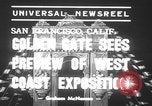
The Tower of Sun,Court of Flowers and fountains in San Francisco Bay, California during Golden Gate International Exposition
Golden Gate International Exposition on Treasure Island in San Francisco Bay, California. The Tower of Sun in the Treasure Island. A fountain in the foreground. Fountains in the treasure island. People walk along a water pool. The Court of Flowers. Entrance to the treasure island. The tower of sun at night.
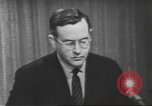
Vice President Nixon and Senator Kennedy debate over Quemoy and Matsu issue prior to presidential elections in the U.S.
The fourth presidential election debate held between Democratic nominee Senator John F. Kennedy and Republican nominee U.S. Vice President Richard Nixon in New York, United States on 21st October 1960. ABC News correspondent Quincy Howe speaks during the debate and allows NBC correspondent John Chancellor to pose a question to Richard Nixon a . Correspondent Chancellor asks a question about Quemoy and Matsu issue. Vice President Nixon points out inconsistency of Senator Kennedy. He further explains it by saying that Senator Kennedy signed a resolution in 1955 which gave the president the power to use United States forces to defend Formosa (Taiwan) and offshore islands. But he also voted for an amendment which was lost, an amendment which would have drawn a line and left out those islands. Vice President Nixon supports President Eisenhower's position. Correspondent Howe asks Senator Kennedy to comment on the topic. He speaks about President Eisenhower sending a mission to persuade Chiang Kai-shek in the spring of 1955 to withdraw from Quemoy and Matsu because they were exposed. The President was unsuccessful. He refers to the fact that in 1958, as a member of the Senate Foreign Relations Committee, he was very familiar with the position that the United States took in negotiating with Communist China (PRC) on these two islands. He further that the U.S. was unable to persuade China's Chiang Kai-Shek to withdraw and thus it was decided by the U.S. to defend the islands.
CRITICALPAST.COM: About Us | Contact Us | FAQs - How to Order | License Agreement | My Account | My Lightboxes | Shopping Cart | Advanced Search | Featured Collections | Website Terms & Conditions | Privacy Policy ©2026 CriticalPast LLC.
License Agreement |
Terms & Conditions |
Privacy Policy
©2026 CriticalPast LLC.