


 Francais
 Deutsch
 Italiano

Refine Your Search
Kiribati Gilbert Islands 1943 stock footage and images
- Showing 265 to 270 of 6739 results more
 Hide
Color Sound
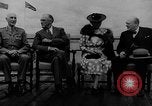
President Franklin D Roosevelt, Miss Churchill and Prime Minister Winston Churchill in Quebec.
Scenes at the Quebec Conference in 1943. President Franklin D Roosevelt, Mrs Churchill, British Prime Minister Winston Churchill seated. Allied military generals stand behind the leaders, and Prime Minister Mackenzie King is seated also. Chateau Frontenac in background. President Roosevelt and General Omar N Bradley watch plane land on water. Boat brings party from plane. Anthony Eden and President Franklin Roosevelt shaking hands and talking. (World War II period).
Winston Churchill waves his hat as his car passes by the crowd in Quebec, Canada.
Prime Minister of UK, Winston Churchill in Quebec, Canada for Quebec Conference of 1943. Sign reads: 'Stand By On The Air.' Winston Churchill and Canadian Prime Minister Mackenzie King in an open top car (a Canadian McLaughlin-Buick convertible, specifically a Buick Series 90 Limited Convertible Phaeton). Churchill in white coat, waves his hat as the car passes by the crowd assembled.
British Prime Minister Winston Churchill in many meetings before and after America's entry into World War II
Opening slate reads: "Quebec Conference August 1943." The English battleship, Prince of Wales, is seen in fog off the Coast of Newfoundland, in August 1941. View of sailor on fore-deck of the British ship. View inside engine room of the ship where sailor manipulates her power. Closeup of engine crankshaft stopping as she drops anchor in Placentia Bay. View of Prime Minister Winston Churchill, greeting U.S. President Franklin D. Roosevelt aboard the Prince of Wales. He proffers a letter to the President, from the King of England. View of Roosevelt and Churchill seated on deck with their respective military leaders standing behind them. Admiral Ernest King, U.S. Chief of Naval Operations converses with U.S. Army Chief of Staff, George Marshall, as they stand behind Churchill and Roosevelt. Wider camera view shows the larger military entourage accompanying the Prime Minister and the President. Glimpse of prisoners and enslaved workers taken by Nazi Germans in Europe. Glimpse of bombs falling from an airplane. Classic film views of the Japanese attack on Pearl Harbor in December 7, 1941. Bombs exploding along "Battleship Row." Heavy smoke rising from the bombed ships. The USS Arizona tilted heavily and burning. Camera pans along the path of destruction, as the voice of President Roosevelt is heard in the background, asking the Congress to declare that the Japanese attack created a state of War between the United States and the Japanese Empire. View of President Roosevelt speaking to the U.S. Congress. Seated behind him are Vice-President Henry Wallace and Speaker of the House, Sam Rayburn. Glimpse of Congress members applauding. Change of scene shows President Roosevelt and Winston Churchill meeting in Washington, DC, in December of 1941, during World War 2. Views of war preparations in the United States, including the building of new war production plants and facilities. A large steel ingot being forged into an artillery gun barrel. Machinist at work turning a gun barrel on a lathe in a munitions factory. Views of manufacturing plants in operation and steel being made. A railroad train carrying new Army trucks. Another meeting of Churchill and Roosevelt in Washington, D.C. June, 1942. Standing behind them is President Roosevelt's special assistant, Harry Hopkins, a British naval officer, and an American navy Captain. American soldiers boarding a troop ship, and closeups of them as they enter the ship, looking out of portholes, and waving from the ship's deck. Glimpse of Washington Monument and its image in the reflecting pool in Washington DC. Closeup of a book entitled, "Time Table for Invasion." General George Marshall with several of his generals doing preliminary planning. Series of scenes involving senior military officers engaged in war planning. A convoy of warships is seen at sea during the Operation Torch Allied invasion of French North Africa during 8–16 November, 1942. Views of Allied Navy ship guns firing. Allied troops riding in landing craft, and advancing from beached craft on shore of Algiers. Aerial view of a flight of Douglas Dauntless bombers in formation. "Bombs away" view from Allied airplane dropping bombs. Allied troops firing camouflaged antiaircraft guns from sandy positions near shore. Enemy shells or bombs exploding nearby. Two U.S. Army soldiers holding a document in French entitled, "Message from the President of the United States.
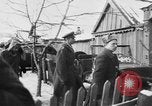
German 6th Army surrenders to Soviet forces at battle of Stalingrad in World War II
German Field Marshal Friedrich Paulus, enters a wooden building near Stalingrad where he surrenders the German 6th Army. He, and Arthur Schmidt, General-lieutenant, Chief of the 6th Army Staff; take seats,surrounded by Soviet Army officers. Scene shifts to the twenty two Divisions (300 thousand men) of the 6th Army trudging through the snow as they surrender. Most of them are seen in open fields near Stalingrad, Russia. Closeups of some make their way along a street in the city. Many wear makeshift shoes and other contrived clothing. They are clearly suffering from their lack of any cold weather equipment. Aerial view of a long line of surrendering German soldiers making their way on snow-covered street in Leningrad. Closeups of some of the German soldiers. One soldier walking slowly, alone, across a stretch of snow. He wears woven homemade coverings over his feet.He heads, alone, toward an open stretch of barren snowy land. Camera focuses on ice strewn Volga River. A dead German soldier lies on its bank. View of Russian countryside, the following Spring. An animated map depicts the extent of the Soviet advance in the previous winter with the occupation of 185 thousand square miles of territory (more than previously occupied by the German forces). Film shows weapons captured during the 6th Army surrender, including German aircraft, tanks, heavy artillery guns, light machine guns, rifles, artillery shells and small arms ammunition. Glimpse of dead German soldiers in the snow. Aerial view of rail cars containing captured German military supplies. Lines of surrendering German soldiers making their way in the snow. Numerous dead German soldiers in body bags, in the snow. Animated film reviews the German operation Barbarossa and subsequent events in the German invasion of Soviet Russian in 1941, 1942, and 1943. Glimpses of Russian troops dressed in white and British troops advancing. Film concludes with artistic representation of United Nations flags and troops marching to victory.

Meeting of British 8th Army and U.S. 5th Army near Agropoli in Italy, and U.S. troops entering Albanella Italy in World War II
First Meeting between British 8th Army and the American 5th Army, 35 miles south of Salerno, on a high mountain road near Agropoli, during World War 2. PR officer from the London Irish Army and War Correspondents meet the U.S. Army's 3rd platoon, 36th Division Recon Cavalry troops. The U.S. Army soldiers wait in jeeps at a bend in the road. When the British group arrives they stop and talk together. Then views of a company of the 504 Abn Infantry on the Via Roma entering Albanella Italy. A half-track personnel carrier is seen followed by several M10 Tank destroyers. from Company C of the 601st Tank Destroyer Battalion, driving through town on September 14th, 1943. Views of M4 Sherman tanks on the roads of Albanella. (Note: The location where Infantry and tank views was taken has been identified as the intersection of Via Piazzie Chiesa and Via Roma at coordinates: 40 degrees 28' 41.29"N/15 degrees 06' 52.24"E.)
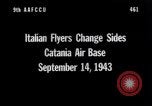
Kingdom of Italy aircraft and crews surrender to Americans at Catania Air Base in Sicily, Italy, during World War II.
Italian aircraft and crews surrender to Americans at Catania Air Base, in Sicily, during World War 2, under terms of the Armistice of Cassibile , signed on September 3, 1943 and publicly announced on September 8th by U.S. General Dwight D. Eisenhower, on Radio Algiers. Under its terms, the Kingdom of Italy ceased hostilities against the Allies and Kingdom forces were to surrender to the Allies. An Italian SIAI-Marchetti SM79 ("Sparviero") Torpedo-Bomber is seen in flight over water, as viewed from another airplane. It carries the number 1NS-20. View of Catania Air Base, with U.S. B-25 Mitchel bomber, of the 340th Bombardment Group, landing, in background. The Italian SM79 is seen taxiing to the ramp, after landing at the Base. A Italian crew man opens the door and an officer exits using the aircraft ladder. He is followed by Giulio Cesare Graziani, torpedo bomber ace and winner of the Italian Gold Medal of Military Valor. (He is framed at 1:12.) Another officer also exits and the three shake hands with U.S. 9th Army Air Force officers on the ground. Commander of the 340th Bomb Group Lt Col Adolph "Tik" Tokaz appears in frame 1:05. The Italian officers present some documents and discuss them with the U.S. officers. The officers from both countries gather around the Italian seal, of the kingdom of Italy, on the tail of the plane and discuss it. The officers turn to watch another Italian SM79 land, taxi in, and park. Italian fliers exit this airplane and walk across the ramp to join the others, with whom they exchange salutes, and shake hands.
CRITICALPAST.COM: About Us | Contact Us | FAQs - How to Order | License Agreement | My Account | My Lightboxes | Shopping Cart | Advanced Search | Featured Collections | Website Terms & Conditions | Privacy Policy ©2026 CriticalPast LLC.
License Agreement |
Terms & Conditions |
Privacy Policy
©2026 CriticalPast LLC.