


 Francais
 Deutsch
 Italiano
Refine Your Search
Kiska Aleutian Islands Alaska 1944 stock footage and images
- Showing 739 to 744 of 9821 results more
more Hide
Hide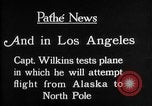
Crew men work on a parked aircraft, and the aircraft in flight in Los Angeles.
Testing of aircraft at airfield in Los Angeles. Crew men work on an aircraft parked on an airfield. Captain Wilkins stand near the aircraft before his flight from Alaska to North Pole. The aircraft in flight over the city.
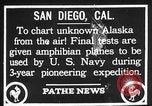
Pilots load tri-lens aerial camera aboard aircraft and Lieutenant Wyatt discusses problems with pilots in San Diego,California.
First test flight of the amphibian aircraft to be used by United States Navy out of San Diego, California, to document unchartered territory in Alaska. An aircraft taxis and takes off from the airfield. Mountains in the background. The aircraft in flight over sea. Ships docked at sea in the background. The wheels of the aircraft fold and the aircraft taxis at sea. Pilots load tri-lens aerial camera aboard an aircraft. Lieutenant B H Wyatt, Commander of the expedition, discusses problems with pilots. The Commander points at a map. Tents in the background.
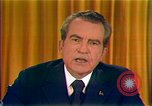
U.S. President Nixon speaks urging action from the Congress to fight inflation in the United States.
Speech by U.S. President Richard Nixon from the Oval Office of the White House in Washington DC, United States about inflation in the country. President Nixon speaks about battle against inflation. He states that the Congress can only hold down cost of living by holding down cost of the government. He says he would continue to veto spending bills which the country cannot afford. President Nixon urges the Congress to reduce tariffs and increase the supply of scarce goods. The President says the Congress should give him authority to move ahead with the Alaska Pipeline for oil to meet the shortage of oil and gas during energy crisis. He urges high production for farm industries. President Nixon speaks about peace in Vietnam and that all American prisoners have returned back. He talks about his summit meeting with General Secretary of the Communist Party of the Soviet Union Leonid Brezhnev which would take place a week later in Washington. President Nixon talks about achieving full prosperity without war and inflation. (Vietnam War period).
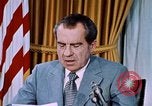
President Richard Nixon gives an energy crisis statement from the Oval Office of the White House in Washington DC.
U.S. President Richard Nixon addresses the nation from the Oval Office of the White House in Washington DC, United States. President Nixon says that lack of energy supplies would bring temporary shortages in fuel supplies and some increase in fuel prices. He says that if energy resources were properly developed they could fulfill American energy requirements for centuries. He says that his administration was going to end quantitative controls on oil imports and establish a national energy office in the United States. He talks about increasing the ability of the United States to prevent oil spills. The President proposes that the Congress should remove government regulations which discouraged the growth of domestic natural gas industry. Secondly, the Congress should help to establish research and ground work for developing new forms of energy for a long range future (alternate sources of energy). Thirdly, the Congress should permit the licensing of new deep water ports to open the way for long delayed Alaska oil pipeline.
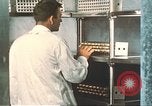
Research animals herded in research building at the Plum Island Animal Disease Center in Long Island, New York.
A film based on the Plum Island Animal Disease Center in Long Island, New York which is dedicated to study of foreign animal diseases. A technician works with bacteriological incubators to grow tissue cultures. Technicians inoculate a culture with foot and mouth disease virus of animal. The technicians carry out this procedure in a safety hood. Cattle are used as research animals and are held in quarantine for two weeks. Animals enter a research building after the quarantine period is over. The animals are herded through different doors in the building. A man dumps food for the animals in a chute. The cattle feed is processed in a hammer mill. Air passes through filters. Glass block openings in the research building. A guard patrols the area in a radio equipped vehicle. A fisherman's boat goes away from Plum Island coast. Two wire fences to isolate the area. A technician handles supplies.
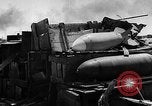
Principal factors and benefits of plan of execution of Flintlock Operations on Kwajalein Atoll in the Marshall Islands.
A training film on operations of U.S. forces on Kwajalein Atoll in the Marshall Islands during World War II. Wrecked guns and shells on the island. Burlesque and Camouflage Islands shown on a map. There are two principal factors of the plan of execution of Carillon Island. The seizure of weakly defended islands and the use of three islands for emplacement of artillery to support principal landings. This is depicted with the help of animation. Heavy gun fire and aerial bombardment on all the principle islands. Coordination between land, naval and aerial forces helped in the accomplishment of objectives. A map of Carillon Atoll. A map of the Marshall Islands. Major benefits of Flintlock Operations and how it was effective in achieving victory are explained.
CRITICALPAST.COM: About Us | Contact Us | FAQs - How to Order | License Agreement | My Account | My Lightboxes | Shopping Cart | Advanced Search | Featured Collections | Website Terms & Conditions | Privacy Policy ©2026 CriticalPast LLC.
License Agreement |
Terms & Conditions |
Privacy Policy
©2026 CriticalPast LLC.