


 Francais
 Deutsch
 Italiano
Refine Your Search
Kiska Aleutian Islands Alaska 1944 stock footage and images
- Showing 745 to 750 of 9821 results more
more Hide
Hide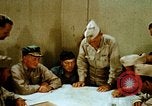
U.S. Navy fighter and bomber aircraft from USS Yorktown strafe Japanese bases and positions on the Truk Islands.
USS Yorktown CV-10 in the Pacific Theater during World War 2. U.S. Naval officers and sailors discuss over a map on a table. Animated map depicts Japanese fleet positions on the Truk Atoll of Islands. USS Yorktown Navy flier squadron and squadrons from other carriers take off for combat over the Truk Islands. Sailors talk over the radio aboard USS Yorktown. A map shows the heavily fortified islands surrounded by air strips, and naval anchorages among the islands. Crewmen aboard Yorktown prepare the planes for take off. Machine gun fire from the planes over the Truk Islands. They dive bomb the island. The aircraft are hit and descend to the ground. A plane drops into the ocean. U.S. airplanes bomb Japanese planes on fighter strips, bomb bases and sea plane ranches. Smoke due to heavy bombardment. Planes dive and drop bombs. Fire due to bombing of a fast fleet tanker hiding in a sheltered cove. U.S. bombers and fighter planes strafe other fleet auxiliaries including rice boats, transports and ammunition ships. They are set on fire with 50 caliber incendiaries and armor piercing plugs. The ships on fire sink into the ocean.
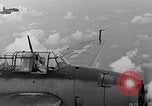
TBF and F4F aircraft, from USS Marcus Island, in practice maneuvers while en route to Peleliu, Palau Islands in World War II
Navy Task Force engaged in practice maneuvers while headed for Peleliu, Palau Islands in World War 2. Closeups of Grumman TBF Avenger aircraft, with canopies open, flying in formation,as viewed from one of the aircraft in the formation. Several of the TBFs skim the water surface in simulated torpedo runs. Two Grumman F4F Wildcat aircraft in flight. A flight of three F4Fs. Close view of TBFs on downwind leg in landing pattern,abeam the Escort Carrier USS Marcus Island (CVE-77), with landing gear down and tail hooks extended.

Technicians carry out tests on foot and mouth disease virus at the Plum Island Animal Disease Center in Long Island, New York.
A film based on the Plum Island Animal Disease Center in Long Island, New York which is dedicated to study of foreign animal diseases. Animated map of the United States of America depicts the New England region of the U.S. affected with foot and mouth disease of animals during year 1870 and Mexico and Canada affected by epizootics in 1946 and 1952 respectively. A technician stores animal foot and mouth disease virus in a laboratory freezer.
A scientist examines the internal organs of a dead animal at the Plum Island Animal Disease Center in Long Island, New York.
A film based on the Plum Island Animal Disease Center in Long Island, New York which is dedicated to study of foreign animal diseases. Incoming supplies and equipment needed to carry out research are admitted through autoclaves to achieve sterilization. Technicians at different machines handle glassware and other equipment to be used for the research. Scientists expose research animals to foot and mouth disease virus in an isolated room. The virus is injected below the tongue of the animals. A man takes out the internal organs of a humanely destroyed cattle. The scientist lays down his knives and wears rubber gloves. He examines the internal organs of the cattle during the post-mortem. The animal carcass is placed into an incinerator. A technician wearing red clothing operates the incinerator. The carcass burns in the incinerator.

Japanese delegates reach Ie Shima, Ryukyu Islands and then advance towards Manila, Philippine Islands in the South East Asia.
Japanese surrender in Southeast Asia during World War II. Airplanes in formation flight. Two Japanese Mitsubishi G4M-1 'Betty' twin-engine bombers painted white with green crosses on their wings, fuselage and tail land at Ie Shima Ryukyu Islands near Okinawa carrying Japanese delegates. The planes land at Nichols Field at 1813 hours. The planes are dubbed 'Bataan number 1' and 'Bataan number 2.' Lt. Gen. Torasirou Kawabe, the vice chief of the Japanese Army's General Staff and his surrender party disembark from the airplanes. Members of the surrender party include Rear Admiral Ichiro Yokoyama Representative, Imperial Japanese Navy Staff., Colonel Yashima Terai General Staff, Colonel Orato Yamoto General Staff, Mr. Morio Yakawa Secretary, Japanese foreign office. Kawabe leads the surrender party. Army C-54 transport airplanes parked. Japanese surrender delegates board the airplanes which take off for Manila, Philippines. United States Army General Douglas MacArthur speaks to his troops from a balcony at the war damaged Manila City Hall (Padre Burgos Ave, Ermita, Manila, 1000 Metro Manila) on 20 August 1945. He notes that he is hopeful that they will all be able to return home soon.
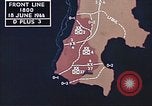
Naval battle, and U.S. 2nd and 4th Marine Divisions advance on enemy positions on Saipan and Tinian in the Mariana Islands.
U.S. forces battle against the Japanese on Saipan, Mariana Islands during World War II. Animated map shows United States forces landing on Saipan. The map displays the position of a Japanese fleet and U.S. Task Force 58. View of Japanese ships being bombed and attacked by aircraft from U.S. Navy 5th fleet ships. A damaged U.S. fighter aircraft lands on an aircraft carrer ship deck at dusk with only its right landing wheel functional. It grinds to a halt without proper landing gear. Dramatic night views of battle as Japanese aircraft attack U.S. Navy warships. Sky filled with barrage of anti aircraft fire. Two Japanese aircraft are hit and are seen in flames as they crash in the sea. U.S. Marine 2nd and 4th division along with U.S. Army 27th Infantry Divisions advance on the island. Marines load and fire guns at the enemy on Saipan island. Firing on Tinian Island also begins. Transports of northern task force arrive for resupply. Animated map shows the territory acquired by U.S. forces.
CRITICALPAST.COM: About Us | Contact Us | FAQs - How to Order | License Agreement | My Account | My Lightboxes | Shopping Cart | Advanced Search | Featured Collections | Website Terms & Conditions | Privacy Policy ©2026 CriticalPast LLC.
License Agreement |
Terms & Conditions |
Privacy Policy
©2026 CriticalPast LLC.